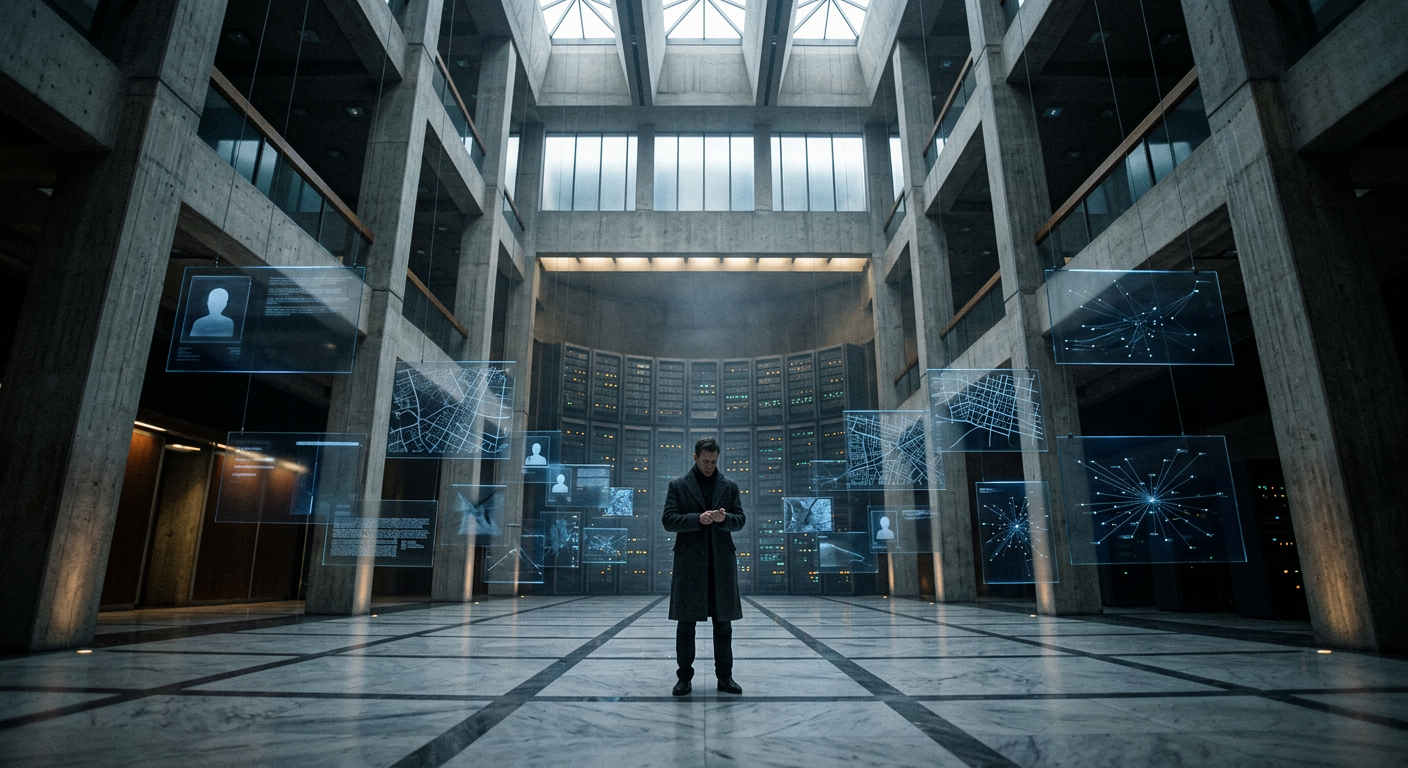
There is a good chance that on any given day in a U.S. city, a camera has scanned your vehicle’s license plate, cross-referenced it against a database, and logged your location — automatically, in real time, without a warrant. If you were in a high-crime area, an algorithm may have flagged your presence. If your face appeared on a camera in the right (or wrong) place, facial recognition software may have run a match against a law enforcement database.
None of this required a judge’s approval. Most of it happened without you knowing.
This is not a hypothetical future. It is the current state of American policing — and it is expanding fast.
The Infrastructure That Watches Everything
Three companies dominate the AI surveillance stack that cities are now deploying.
Flock Safety
Flock Safety makes automated license plate readers — small, solar-powered cameras that can be mounted anywhere and scan every passing vehicle. As of 2025, Flock operated in over 5,000 communities across 49 states, performing more than 20 billion vehicle scans per month in the United States.
Twenty billion. Every month.
Each scan captures the vehicle’s license plate, make, model, color, and any visible markings. The data is stored in a centralized cloud database. Law enforcement can query it instantly: “Show me every instance this plate appeared in the last 30 days.” Or: “Show me every dark-colored truck that passed through this intersection on Tuesday.”
In May 2025, 404 Media reported that Flock was developing a new product called Nova — described internally as a “public safety data platform” — that would supplement license plate data with information from data breaches, public records, and commercially available data. In other words: enriching surveillance camera data with the kind of personal information data brokers sell. The same data broker loophole that lets the government buy your location without a warrant would feed directly into Flock’s product.
Axon Enterprise
Axon started as the company that made Tasers. Today it is a surveillance ecosystem.
Axon’s product suite includes body-worn cameras deployed by hundreds of law enforcement agencies, cloud storage for footage (Axon Evidence), AI-powered transcription and report writing, and real-time situational awareness platforms. The Axon network creates a continuous video record of police interactions — and increasingly, of the spaces police patrol.
The company’s AI layer analyzes footage, flags anomalies, and integrates with facial recognition systems. Axon has its own AI ethics commitments and a Privacy Advisory Council — but it also sells to agencies that have demonstrated willingness to push legal boundaries, and its data sits in a cloud environment accessible to federal authorities on appropriate legal process.
Motorola Solutions
Motorola Solutions sells CommandCentral Aware — a situational awareness platform that ingests real-time data from CAD (computer-aided dispatch) systems, GPS tracking, video feeds, sensors, and records management into a unified operational picture.
CommandCentral’s analytics features include crime hotspot mapping, pattern recognition, and resource forecasting — the core elements of predictive policing. The system identifies areas where crime is likely to occur based on historical patterns and deploys resources preemptively.
Predictive policing has a documented bias problem. A 2018 study found commercial facial recognition systems had error rates of 0.8% for light-skinned men but 34.7% for darker-skinned women — a 40-fold disparity. A 2019 NIST study found African American and Asian faces were 10 to 100 times more likely to be misidentified than white male faces. When those systems are used to make policing decisions, errors mean innocent people get stopped, searched, or arrested. The errors are not randomly distributed.
What Real-Time Crime Centers Do
Individual products become a surveillance dragnet when combined in Real-Time Crime Centers (RTCCs) — centralized facilities where analysts monitor live feeds from multiple camera networks, run queries across databases, and push information to officers in the field.
The Brennan Center for Justice documented this infrastructure in a 2026 report: RTCCs aggregate data from license plate readers, surveillance cameras, ShotSpotter gunshot detection systems, social media monitoring tools, and facial recognition into a single operational dashboard. Analysts can track individuals across camera feeds in real time, identify vehicles of interest, and coordinate officer responses — all without ever obtaining a search warrant, because each individual data source sits in a gray zone where courts have not yet clearly required one.
The ACLU of Massachusetts put it plainly in a recent report: AI-powered surveillance is “turning the United States into a digital police state.” The infrastructure is not hypothetical. The cities deploying it are not doing so secretly. What’s missing is the legal framework to govern it.
The Legal Gap
Fourth Amendment jurisprudence has struggled to keep pace with surveillance technology.
The core doctrine comes from United States v. Jones (2012) and Carpenter v. United States (2018). In Carpenter, the Supreme Court held that the government needs a warrant to obtain historical cell-site location data from a carrier — recognizing that prolonged tracking of someone’s movements is a Fourth Amendment search.
But Carpenter was about carrier records, not about public cameras. Courts have generally applied the third-party doctrine — information you expose to others (including cameras in public spaces) carries reduced privacy expectations. Under this reasoning, your license plate in public is fair game. Your face in a public square is fair game. The aggregate picture those observations paint of your life, your movements, and your associations may not be — but courts haven’t consistently said so yet.
The result: surveillance companies and law enforcement operate in a legal space where the technology has dramatically outrun the case law. The cameras are legal. The databases are legal. The queries are legal. The AI analysis connecting them may not survive future scrutiny — but it’s operating right now.
What Regulators and Legislators Are Doing
The legislative response has been fragmentary but real.
Facial recognition bans: At least a dozen U.S. cities have banned or significantly restricted government use of facial recognition, including San Francisco, Boston, and Portland. Several states are considering statewide restrictions.
Predictive policing oversight: Illinois, Colorado, and California have passed laws requiring impact assessments and public disclosure for algorithmic decision-making in government contexts. Several cities have disbanded or restricted predictive policing programs after civil rights challenges.
The biometric angle: Illinois’s Biometric Information Privacy Act (BIPA) — still the strongest biometric privacy law in the country — has generated hundreds of lawsuits against companies collecting biometric data without consent. For a full breakdown of how biometric surveillance laws vary by state, see biometric.myprivacy.blog.
Congress: Federal bills targeting facial recognition in law enforcement — including the Facial Recognition and Biometric Technology Moratorium Act — have been introduced but not passed. The surveillance industry has spent millions lobbying against federal restrictions.
The Data Broker Connection
One underappreciated dimension of AI-powered policing is how much it relies on commercially purchased data — not just cameras and sensors.
Law enforcement agencies routinely purchase data from brokers: location data, social media activity, financial transactions, device identifiers. This is legal under current law precisely because the Fourth Amendment applies to government collection, not commercial collection. When the government buys data instead of seizing it, courts have generally held no warrant is required.
Flock Safety’s Nova product is the logical endpoint of this dynamic: a surveillance platform that combines real-time camera data with commercially acquired personal data, all processed through AI to identify, track, and flag individuals. The government data broker loophole provides the legal cover. The AI provides the scale.
For context on how much government appetite for commercial surveillance data has grown: government requests for social media data surged 770% in recent years. That appetite is now being extended to the surveillance camera and data broker markets.
What to Watch
The AI surveillance infrastructure is being built faster than the legal framework governing it. A few pressure points:
Fourth Amendment litigation: The ACLU and EFF are actively litigating cases challenging various forms of automated surveillance. Expect Carpenter-style expansions as more cases reach appellate courts.
FISA and the data broker loophole: The Section 702 reauthorization debate in Congress is partly about whether to require warrants for data broker purchases. That fight is directly connected to whether AI surveillance systems can continue operating at scale.
State legislative action: Washington state lawmakers advanced six AI and privacy bills out of committee in early 2026, including measures targeting high-risk AI systems and surveillance-based price discrimination. State action is moving faster than federal.
Municipal procurement: Every contract a city signs with Axon, Flock Safety, or Motorola is a local decision. Residents and city councils have real power to demand transparency, limit use cases, and require independent audits.
The cameras are already up. The question is whether the law will catch up before the infrastructure becomes too entrenched to challenge.
For state-by-state coverage of biometric surveillance laws — including facial recognition restrictions, BIPA-style consent requirements, and enforcement actions — visit biometric.myprivacy.blog.