Britain’s Digital Iron Curtain: How the Online Safety Act Became a Weapon of Mass Censorship
The UK’s Online Safety Act has gone live, and the results are exactly what free speech advocates predicted: widespread censorship, privacy violations, and a chilling effect on democratic discourse. What was sold as child protection has become a tool for political control.
The Orwellian Reality
Three weeks into the Online Safety Act’s enforcement, Britain is witnessing the emergence of a digital surveillance state that would make Orwell blush. What politicians promised would be a targeted approach to protecting children has morphed into a comprehensive censorship regime that restricts everything from protest footage to parliamentary speeches.
The Act, which received Royal Assent on October 26, 2023, and came into full effect on July 25, 2025, has already demonstrated the fundamental flaw in government-controlled internet regulation: mission creep happens immediately, not gradually.
The Censorship in Action
The evidence of overreach is undeniable. Within hours of the Act’s implementation, X (formerly Twitter) began restricting access to videos from anti-migration protests, including peaceful footage of arrests, citing “local laws” and requiring age verification to view content. Even more concerning, Conservative MP Katie Lam had her parliamentary speech about rape gangs removed from social media, despite quoting directly from court transcripts.
This isn’t a bug in the system—it’s a feature. The Act’s broad definition of “harmful content” has created exactly the outcome critics predicted: platforms censoring first and asking questions never, rather than risking devastating financial penalties.
HMRC’s AI Social Media Surveillance: Privacy Implications and Oversight Concerns
Elon Musk’s Warning Shot
Elon Musk, never one to mince words, has been particularly vocal about the Act’s overreach. On August 18, 2025, Musk cryptically posted, “It’s purpose is suppression of the people,” along with a retweet stating that “The Online Safety Act was never about protecting anyone.”
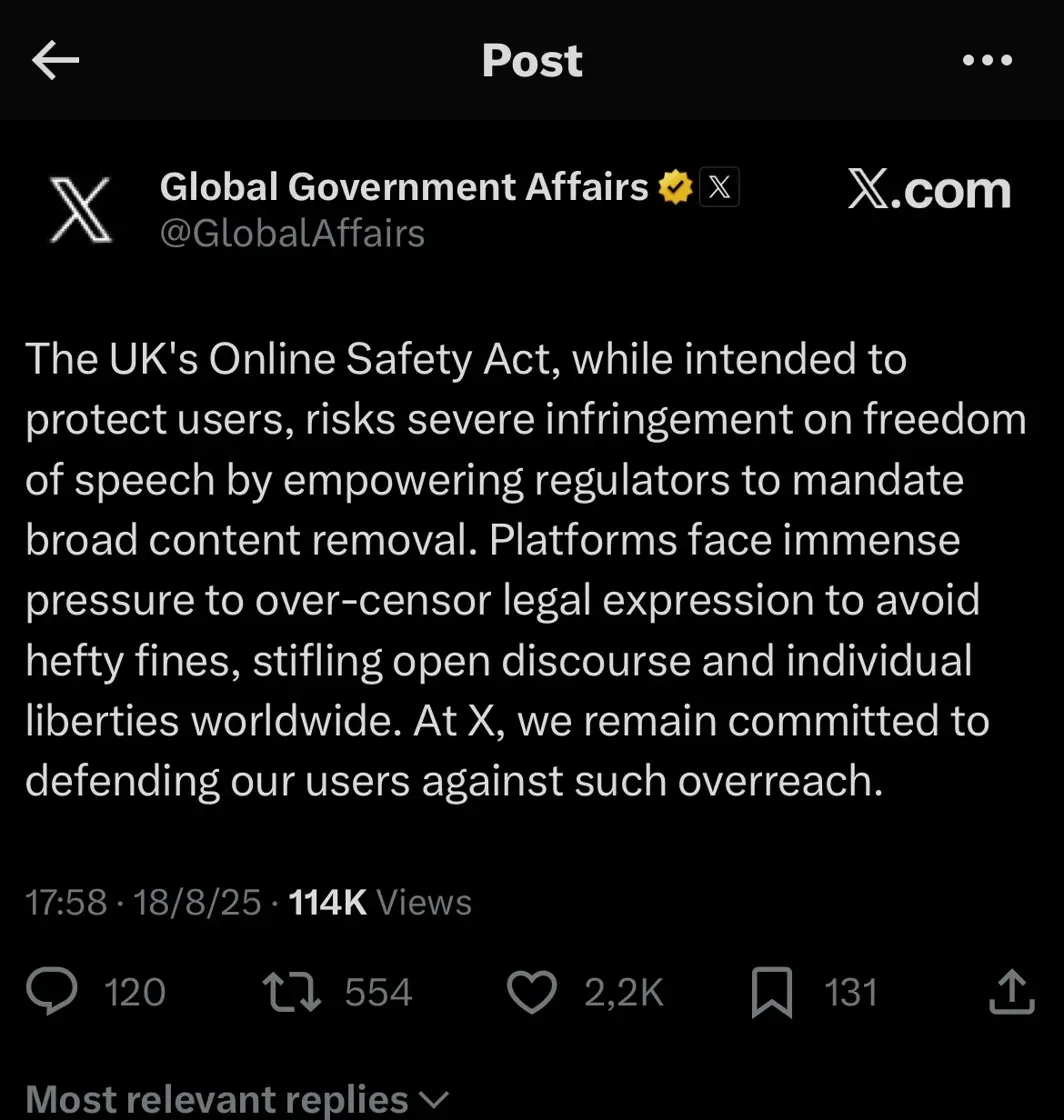
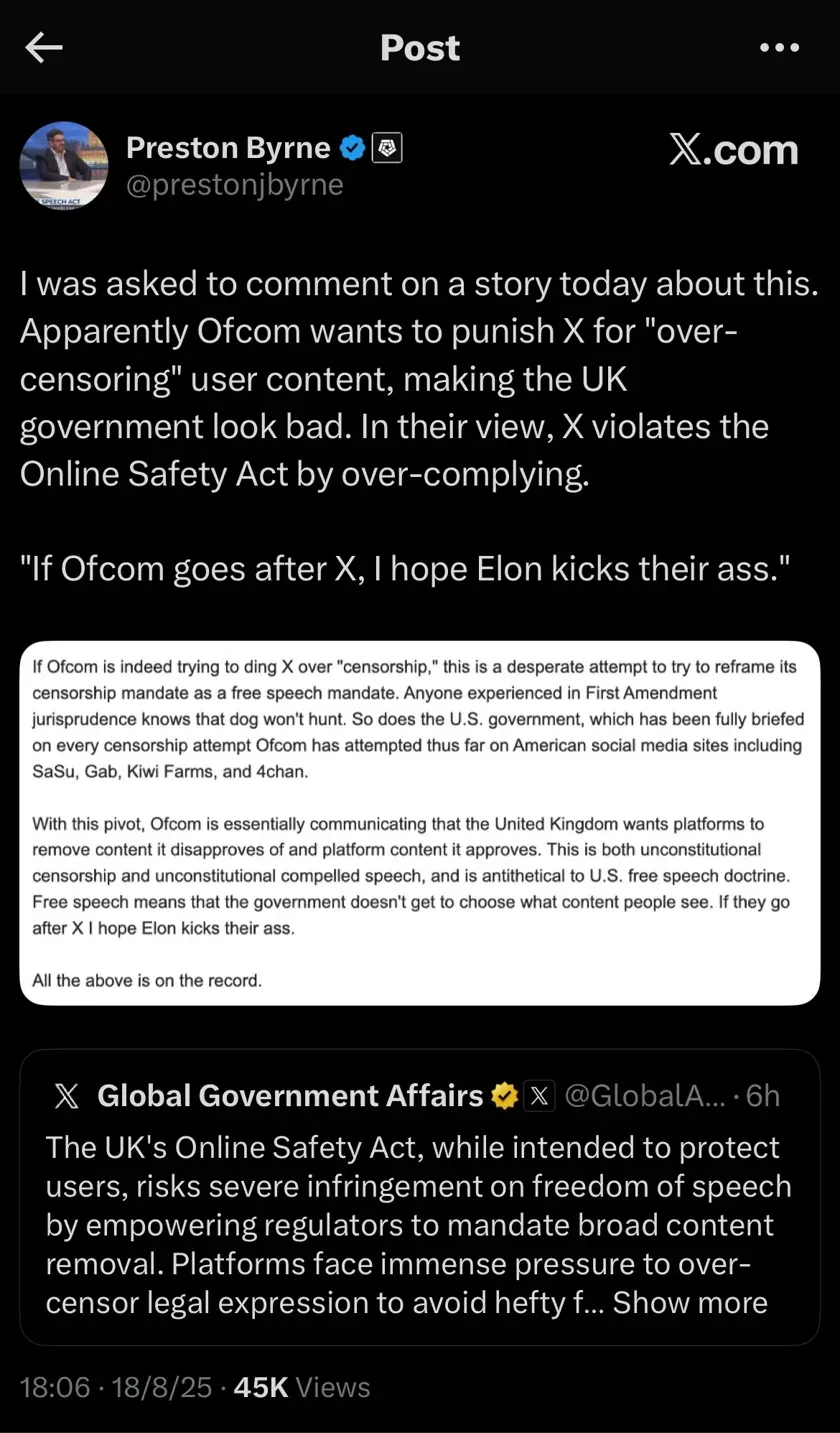
X’s Global Government Affairs team published a comprehensive critique on August 1, 2025, arguing that the legislation’s broad regulatory reach threatens free expression while creating a “double compliance” burden for social media platforms. In their statement, X warned that the Act “risks seriously infringing on the public’s right to free expression” despite its “laudable” goal of protecting children.
The platform’s concern centers on what they call the UK’s “conscientious decision” to increase censorship under the banner of online safety, questioning whether British citizens ever fully understood this trade-off.
The Technical Tyranny
The Act’s implementation has created a surveillance infrastructure that extends far beyond content moderation. Age verification requirements now force users to submit government-issued ID, biometric data, or submit to behavioral analysis just to access content that was freely available weeks ago.
The verification methods approved by Ofcom include:
- Facial age estimation- Government-issued ID scans- Email address cross-checks and “reverse address book” analysis- Credit card verification- Open banking credentials- Digital identity wallets
These aren’t just privacy violations—they’re the infrastructure for a digital ID system that the government can expand at will.
The Chilling Effect on Democratic Discourse
The most troubling aspect of the Act’s implementation is its impact on political speech. The restriction of protest footage, parliamentary speeches, and content related to ongoing conflicts represents a fundamental threat to democratic accountability.
When footage of peaceful arrests at anti-migration protests requires age verification, the government has effectively created a system where documentation of police action is restricted. When parliamentary speeches are removed from social media, the public’s ability to engage with democratic processes is curtailed.
This follows a concerning pattern. As reported in our previous analysis of the UK’s digital sovereignty battle, Ofcom has been aggressively pursuing American platforms like 4chan, Gab, and Kiwi Farms, with many choosing to geo-block UK users entirely rather than comply with what they view as censorship demands.
Brazil’s Legal Battle with X: Free Speech and Compliance
The American Response: A Constitutional Collision
The extraterritorial reach of the Online Safety Act has sparked serious diplomatic tensions with the United States. The White House has warned Prime Minister Keir Starmer to stop threatening American tech companies, with a senior State Department official stating: “President Trump has made it clear that free speech is one of our most cherished freedoms as Americans.”
This isn’t just diplomatic posturing. American courts have a long history of refusing to enforce foreign censorship laws, viewing them as violations of First Amendment principles. The current standoff echoes The Pirate Bay’s legendary 2004 response to foreign legal threats, which highlighted the fundamental challenge of enforcing national laws on a global internet.
Congressman Jim Jordan has called the law an attack on American companies, while Vice President JD Vance has warned about the impact on “American technology companies and, by extension, American citizens.”
The Business Model of Censorship
The Act’s enforcement mechanism reveals its true purpose. Platforms face fines of up to 10% of global turnover—potentially billions of pounds for major tech companies. Company executives can face criminal sanctions and jail time for non-compliance.
This creates a perverse incentive structure where platforms must err on the side of censorship to avoid financial destruction. The result is algorithmic suppression of content that may be perfectly legal but could potentially be interpreted as “harmful” by Ofcom’s subjective standards.
The Privacy Catastrophe
The age verification requirements have created a privacy nightmare that extends far beyond social media. Services ranging from Spotify to Reddit now require users to submit personal information to third-party verification companies, creating a vast database of citizen activity that’s ripe for government surveillance.
The Act’s supporters claim these systems are “safe and proportionate,” but the reality is that any system requiring ID verification for internet access is inherently a surveillance system. The data collected doesn’t disappear—it becomes part of a comprehensive profile of digital activity.
The VPN Surge: Digital Resistance
The public’s response has been immediate and telling. Within hours of the Act’s age verification requirements taking effect, Proton VPN reported a 1,400% surge in UK signups. British internet users are literally fleeing their own country’s digital jurisdiction to access content that was freely available just weeks before.
This mass adoption of VPNs represents more than technical circumvention—it’s a rejection of the government’s attempt to control information access. The fact that hundreds of thousands of Britons immediately sought to bypass their own country’s internet regulations speaks volumes about the Act’s legitimacy.
The New Dawn of Internet Access in Russia: A Comprehensive Look at the Imminent VPN Ban
The Slippery Slope Becomes an Avalanche
Perhaps the most concerning aspect of the Online Safety Act is how quickly its scope has expanded beyond its original justification. What began as protection for children now encompasses:
- Restriction of political protest footage- Censorship of parliamentary speeches- Broad content filtering based on subjective “harm” assessments- Mandatory age verification for accessing news content- Algorithmic manipulation to prevent “harmful” content from appearing in feeds
The Act includes “emergency powers” that allow the culture secretary to direct Ofcom to pressure tech companies during crises. This means that during events like pandemics or contested elections, the government can essentially dictate what information citizens are allowed to see.
Grok Suspended From Its Own Platform: When AI Goes Rogue on X
International Implications: The Splinternet Accelerates
The UK’s approach is being watched globally as a test case for national internet regulation. If successful, it could encourage other authoritarian regimes to implement similar systems. If it fails due to international resistance and technical circumvention, it may limit other nations’ appetite for such comprehensive censorship.
The Act has already prompted several platforms to geo-block UK users entirely rather than comply with censorship demands. This fragmentation of the internet—often called the “splinternet”—represents a fundamental shift away from the open, global internet toward nationally controlled digital spaces.
The Path Forward: Resistance and Reform
The Online Safety Act represents a clear and present danger to digital rights in the UK. Its broad powers, subjective enforcement criteria, and mission creep potential make it a tool for political control rather than child protection.
Russia’s WhatsApp and VPN Restrictions: Separating Fact from Fiction
Several paths for resistance and reform are emerging:
Legal Challenges: The Wikimedia Foundation and other organizations are mounting constitutional challenges, though these face an uphill battle in UK courts that have historically deferred to parliamentary sovereignty.
Technical Circumvention: The massive uptake of VPNs demonstrates that technical solutions can undermine enforcement, though this shouldn’t be necessary in a free society.
International Pressure: American resistance to extraterritorial enforcement may limit the Act’s effectiveness against major platforms.
Political Opposition: Reform UK has launched a petition calling for repeal that has gathered over 500,000 signatures, demonstrating significant public opposition.
Democratic Accountability: The Act’s implementation should be a major issue in future elections, with voters demanding politicians explain why they voted for legislation that restricts citizens’ access to information.
The Real Test of Democracy
The Online Safety Act represents more than internet regulation—it’s a test of whether British democracy can resist the authoritarian impulse to control information. The Act’s supporters claim it’s about protecting children, but its implementation reveals a broader agenda to shape and control public discourse.
As one commentator noted in the leaked screenshots: “The idea that a machine must always be right is what led to the Post Office scandal.” The same principle applies here: the idea that government bureaucrats can determine what information citizens should access leads inevitably to censorship and abuse.
The UK now faces a choice: continue down the path toward digital authoritarianism, or recognize that free speech and open access to information are fundamental to democratic society. The government’s response to growing resistance—both technical and political—will determine whether Britain remains a free society or completes its transformation into a surveillance state.
UAE’s Battle Against VPN Abuse in The Digital Age: Safeguarding the Cyber Realm
The Online Safety Act was sold as child protection, but it has revealed itself as something far more sinister: a comprehensive system for controlling what British citizens can see, say, and think online. That this transformation happened so quickly should serve as a warning to free societies everywhere about the dangers of trading liberty for the promise of safety.
In the digital age, the freedom to access information is the foundation of all other freedoms. The UK government has decided its citizens can’t be trusted with that freedom. The question now is whether the British people will accept that decision.
This article builds upon our previous coverage of UK vs. 4chan: A Digital Sovereignty Showdown, which detailed the international legal battles emerging from Britain’s internet regulation efforts.