For two and a half centuries, American policing followed a particular logic. Cops developed a suspect. They built probable cause around that suspect. They asked a judge for permission to search a specific person, a specific house, a specific phone. The Fourth Amendment was written specifically to prevent the alternative — the British “general warrants” and “writs of assistance” that let officers of the Crown rummage through anyone’s papers in search of something incriminating.
The geofence warrant inverts all of that.
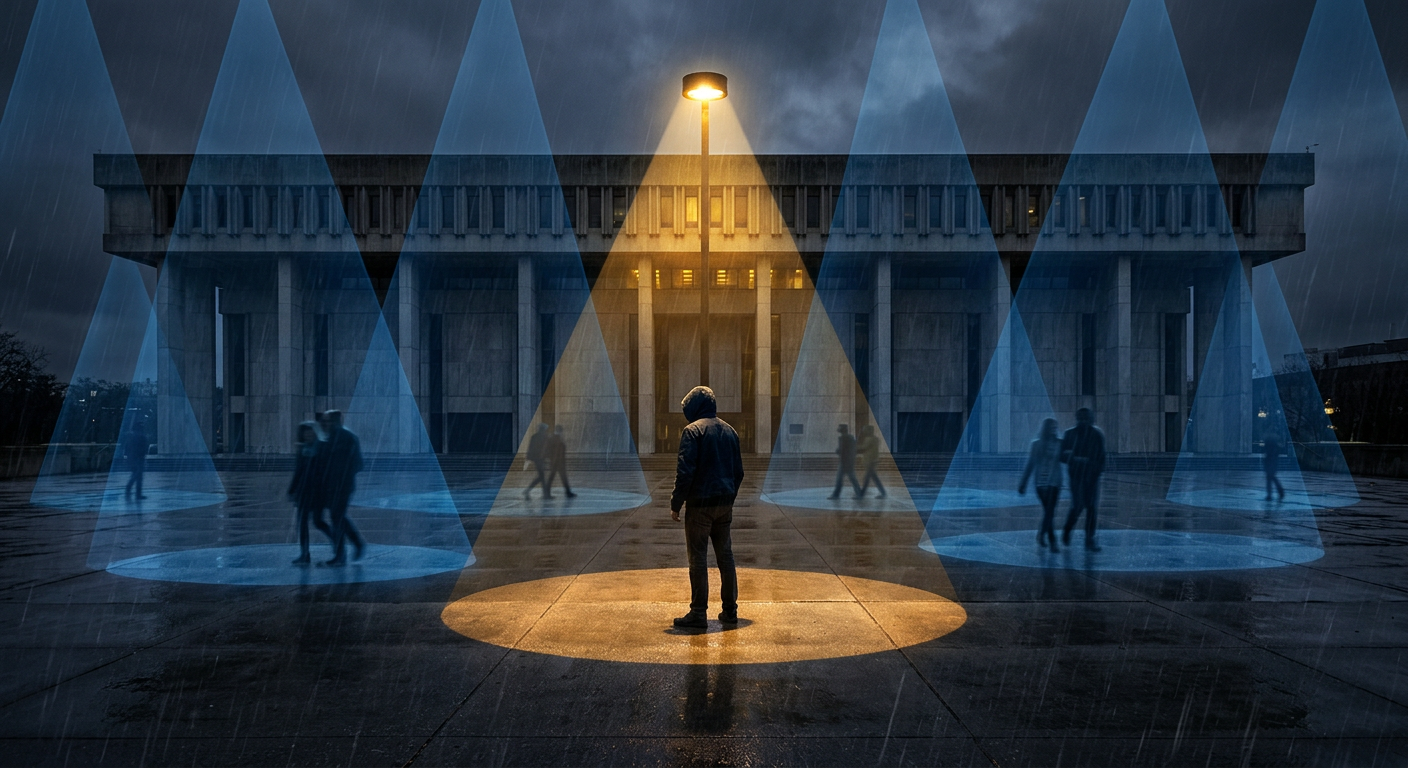
A geofence warrant doesn’t start with a suspect. It starts with a time and a place. Police draw a digital boundary on a map — sometimes 17.5 acres, sometimes 160 miles wide — and demand that a technology company hand over data on every device that pinged inside that perimeter during a chosen window of time. The data shows up anonymized at first. Then officers narrow it down. Then they unmask the people who look interesting.
It is, in plain terms, the digital reincarnation of the general warrant. And on April 27, 2026, the Supreme Court heard oral arguments to decide whether it survives the Fourth Amendment.
The case is Chatrie v. United States. It is the first major Fourth Amendment case the Court has taken up since Carpenter v. United States in 2018. The ruling, expected by summer 2026, will set the rules for digital dragnets for at least a generation.
The Case That Got Us Here
In 2019, an armed robber walked into the Call Federal Credit Union in Midlothian, Virginia. He brandished a gun, forced everyone to the ground, and escaped with $195,000. Surveillance footage showed he had a cell phone with him. Police had no traditional leads.
So they tried something newer. They got a magistrate to sign a geofence warrant directing Google to search every Location History record for any device that had been within roughly 150 meters of the credit union during a one-hour window around the robbery. Google’s process — which has since been described as a “three-step” approach — works like this:
Step one: Google identifies all anonymized devices within the geofence at the chosen time. In this case, that initial pull included an unspecified number of people. (Across thousands of geofence warrants nationwide, “small geographic areas covering short periods of time can include hundreds of thousands of people,” Google has noted in court filings.)
Step two: Police ask for expanded location data on a subset of those phones — covering periods of time outside the original geofence, sometimes 30 minutes before and after the robbery. This is the part that quietly turns the dragnet from local to mobile-tracking, because it can pull in people’s movements through their homes, hotels, churches, doctors’ offices, and political rallies.
Step three: Police ask Google to unmask the subscriber information — names, account details — for the handful of phones that look most relevant.
In Chatrie’s case, Google initially identified 19 accounts. Officers narrowed down to nine. Then to three. One belonged to Okello Chatrie. He was eventually charged, pleaded guilty to armed robbery and brandishing a firearm, and received a sentence of nearly 12 years. But he reserved the right to appeal the geofence warrant itself.
The legal saga has been chaotic. The district court found the warrant “plainly” violated the Fourth Amendment but admitted the evidence anyway under the “good-faith exception.” The Fourth Circuit panel originally ruled 2-1 that no Fourth Amendment search had occurred at all. The full Fourth Circuit, sitting en banc, deadlocked 7-7 on whether a search occurred — but 14 of 15 judges still voted to uphold the conviction on good-faith grounds. The Fifth Circuit, in a different case, ruled in 2024 that geofence warrants are inherently overbroad and unconstitutional. That circuit split is what brought Chatrie to the Supreme Court when certiorari was granted on January 16, 2026.
What Each Side Is Arguing
The arguments split along familiar Fourth Amendment fault lines, but the digital context makes the stakes far higher than any wiretap or thermal-imaging case the Court has previously decided.
The government’s position — defended by U.S. Solicitor General D. John Sauer and supported by 32 state attorneys general — leans heavily on the “third-party doctrine.” That’s the rule, articulated in Smith v. Maryland (1979) and United States v. Miller (1976), that you have no reasonable expectation of privacy in information you’ve voluntarily handed over to a third party. Bank records, dialed phone numbers — these are “business records” the government can obtain without a warrant.
The government’s framing for Chatrie: Okello Chatrie opted in to Google’s Location History feature. That’s an affirmative act. Most users haven’t opted in (the government estimates roughly one in three Google users had Location History enabled). When Chatrie did, he voluntarily turned over his location data to Google. Therefore, Google’s later disclosure to law enforcement triggered no Fourth Amendment search at all.
Or, as Chief Justice John Roberts put it during oral arguments: “The only reason the government has access to this information is you decided to make it public. If you don’t want them to peer into your window, you can close your window, or the shades.”
Chatrie’s position — argued by Adam Unikowsky and supported by amicus briefs from the EFF, the Brennan Center, the Center for Democracy & Technology, EPIC, the Surveillance Technology Oversight Project, X Corp., Google itself (on the underlying privacy question, though not the warrant’s specific validity), and a long list of Fourth Amendment scholars — leans on Carpenter v. United States (2018).
In Carpenter, the Court ruled 5-4 that police needed a warrant to obtain seven days of historical cell-site location information about a specific suspect. Chief Justice Roberts wrote the majority opinion, joined by the Court’s then-four liberal justices. Roberts wrote that location data “provides an intimate window into a person’s life, revealing not only his particular movements, but through them his familial, political, professional, religious, and sexual associations.”
Unikowsky’s argument: if seven days of location data on one person triggers Fourth Amendment protection, then a warrant authorizing Google to search every user’s account to find anyone within a geographic perimeter is exponentially more invasive — and qualifies as a “general warrant,” precisely the kind of search the Founders specifically wrote the Fourth Amendment to forbid.
“The technology may be novel, but the constitutional problem it presents is not,” Unikowsky told the Court. “The Fourth Amendment was born of the Founders’ revulsion for general warrants and writs of assistance — instruments that allowed the government to search first and develop suspicions later.”
The Justices’ Concerns Are the Right Ones
The justices’ questions during oral argument suggested they understand the broader stakes — even if they’re divided on what to do about them.
Chief Justice Roberts, who in 2018 sided with the Carpenter majority, asked the central question: “What’s to prevent the government from using this to find out the identities of everybody at a particular church, a particular political organization?”
That isn’t theoretical. Geofence warrants have already been used to identify supporters of President Donald Trump who entered the Capitol on January 6, 2021. Privacy advocates and members of Congress have raised similar concerns about the warrants being deployed against abortion-clinic visitors in states with new abortion bans, against participants in protests, and against attendees at religious services in surveilled communities.
The Brennan Center’s amicus brief warned the Court that approving these warrants “would enable a new class of ‘reverse search’ warrants that would chill First Amendment rights to speech and association,” noting that the same logic could be extended to “dragnet searches for everyone who ran a web search using certain terms, watched a specific video, or issued a prompt to an AI chatbot.”
That last clause is the one that should keep CISOs and privacy professionals awake at night. The constitutional principle the Court adopts in Chatrie will apply by analogy to:
- Reverse keyword searches — police asking Google for the identities of every user who searched for “how to dispose of a body” or “abortion clinic in [city]” or the name of a victim
- Reverse video-watch warrants — demands for the IP addresses of everyone who viewed a particular YouTube or TikTok video
- AI chatbot prompt logs — demands for the identities of users who issued specific prompts to ChatGPT, Claude, Gemini, or any other commercial AI service
- App-level location queries — demands aimed at any app or service that collects location data, not just Google
If the Supreme Court signs off on the principle that “you opted in, so you have no expectation of privacy,” that principle is perfectly portable to every other consumer technology that requires an opt-in.
The Third-Party Doctrine Is Already Cracking
Here’s the deeper jurisprudential drama in Chatrie. The third-party doctrine — the bedrock the government’s argument rests on — is a 1970s-era rule articulated when the typical “third party” was a bank holding your check register or a phone company logging which numbers you dialed. The mid-twentieth-century cases that built the doctrine were, as one amicus brief in Chatrie points out, “secret agent” cases — situations where someone you confided in was actually a government informant.
That world is not this world.
Today, “voluntary disclosure to a third party” describes essentially every act of digital living. You disclose your location to Google, Apple, your cell carrier, your weather app, your map app, your fitness tracker, your rideshare app, your doorbell camera, and your car’s manufacturer, all simultaneously, all the time, all without any meaningful choice if you want a functional smartphone.
In Carpenter, the Court took the first significant bite out of the third-party doctrine, ruling that the doctrine doesn’t extend to long-term cell-site location records. That ruling was the first signal that the Court understood the doctrine couldn’t survive a literal application in the digital age — and that some categories of “third-party data” deserve constitutional protection regardless of whether technically a third party holds them.
The X Corp. amicus brief in Chatrie (yes, Elon Musk’s company filed an amicus) goes further, arguing that contracts between users and platforms shouldn’t be read to “extinguish” Fourth Amendment property rights — and explicitly calling for the Court to “reconsider” Smith and Miller. That’s a remarkable position because it represents a major tech company arguing that its own users should have more constitutional protection from the government, not less.
What the Court Is Likely to Do
Most close observers of the oral argument expect a narrow ruling rather than a sweeping one. Stanford law professor Orin Kerr — one of the country’s leading Fourth Amendment scholars, who filed an amicus brief on the government’s side — predicted that the Court will likely rule that geofence warrants can be drafted lawfully but must be “limited in time and space.”
Other observers note that the conservative-liberal alliances on Fourth Amendment cases are unpredictable. The Carpenter majority that ruled for privacy in 2018 included Chief Justice Roberts joined by Ginsburg, Breyer, Sotomayor, and Kagan. Three of those justices have since been replaced by Kavanaugh, Barrett, and Jackson. Justices Thomas, Alito, and Gorsuch dissented in Carpenter, though Gorsuch’s dissent argued for more constitutional protection through a property-rights theory rather than less.
Several scenarios are plausible:
-
The narrow ruling. The Court holds that a geofence warrant is a search requiring a warrant, but that the warrant in Chatrie was constitutionally adequate — and lays out limits on time, geographic scope, and the three-step expansion process going forward. This is what Kerr predicts.
-
The “good faith” punt. The Court avoids the constitutional question entirely, ruling that even if the warrant was problematic, the officers acted in good faith and the evidence is admissible. This is what the en banc Fourth Circuit did. Justice Kavanaugh raised this possibility during oral argument.
-
The privacy victory. The Court rules that geofence warrants as currently structured violate the Fourth Amendment — that they are general warrants, full stop. This would align with the Fifth Circuit’s 2024 ruling and would substantially restrict (though probably not eliminate) the practice.
-
The third-party doctrine victory. The Court adopts the government’s position broadly, ruling that opt-in location services convey no expectation of privacy. This would be the broadest possible ruling for the government and would have downstream consequences for nearly every reverse-search context imaginable.
Google itself has already partially mooted the practical impact of the case. In 2023, the company changed its Location History architecture to store data on individual devices rather than on Google’s servers — meaning Google says it can no longer respond to most geofence warrants based on Location History. But other apps, services, and advertising networks still hold location data centrally, and the constitutional principle the Court announces in Chatrie will govern all of them.
What This Means For You Right Now
Whether the Supreme Court rules narrowly or broadly, the existence of geofence warrants — and the broader category of “reverse search” warrants that may follow — should change how privacy-conscious people think about their digital footprint. A few practical considerations:
Audit your Location History settings. On Android, check Google’s “Location History” and “Web & App Activity” settings. On iOS, check Apple’s “Significant Locations” and individual app location permissions. Default settings tend to favor data collection. Default settings can be changed.
Use airplane mode or leave the phone behind for sensitive activities. This sounds extreme, but the only foolproof way to not generate location data is to not have a connected device with you. Activists, journalists protecting sources, lawyers meeting with clients, and people accessing sensitive medical care should all consider this seriously.
Remember that “anonymized” data isn’t anonymous. The pattern of where you go is itself a fingerprint. Even if Google or your carrier pulls your name off the record, your home address, workplace address, and routine destinations identify you uniquely in any reasonably-sized dataset.
Push for state-level legislation. Several states have passed or proposed laws requiring stricter standards for geofence warrants (and reverse keyword warrants) at the state level — including New York, California, and Illinois. State law can provide protection above and beyond the constitutional floor the Supreme Court sets.
Pay attention to what app permissions you grant. “Always” location access is rarely necessary. “While using the app” is usually fine. “Never” works for most apps you’d be surprised. Each grant of “always” location access expands the set of records that could potentially be subpoenaed.
For organizations: Build geofence-warrant response into your incident response and legal-hold playbooks now, not later. Companies are increasingly receiving these warrants, and the response procedures, customer-notification obligations, and legal-challenge options vary substantially by state.
The Real Issue Is Bigger Than One Bank Robber
Daniel I. Levy, Head of Technology Legal at his organization, summed up the underlying tension well in a recent LinkedIn post on the case. The technology, he wrote, exists in a space where “people certainly do click ‘allow’ on apps and services to share and agree to the real-time sharing of their location data, but most assume the tradeoff is convenience or advertising” — not the construction of a continuously-updated law-enforcement database.
That’s the heart of it. The choice architecture of consumer technology — click “I agree,” tap “allow” — was never designed as a meaningful waiver of constitutional rights. People consent to share their location with Google so they can use Google Maps. They do not, in any meaningful sense, consent to share their location with the FBI, the DEA, ICE, or local police. The legal fiction that “voluntary disclosure to a third party” extinguishes Fourth Amendment protection is increasingly indefensible in a world where every major aspect of modern life requires that disclosure.
What Chatrie will decide — narrowly, broadly, or somewhere in the middle — is whether the Constitution catches up with the technology, or whether the technology has effectively rewritten the Constitution by accident.
The Court will rule by summer 2026. Whatever it decides, the deeper fight is just beginning. As Monique Ferraro, a cyber/privacy/AI governance attorney, observed in response to the Supreme Court news: this is “piling on the trash heap of our eroded civil rights, but on the plus side, maybe Carpenter will be expanded.”
That’s the most optimistic read available right now. The pessimistic read is that the third-party doctrine survives intact, and that every reverse search the government can imagine becomes constitutionally permissible because, after all, you clicked “I agree.”
Defend Your Location Privacy Today
The geofence-warrant question is one symptom of a much broader privacy collapse. Practical resources for taking control of your location and behavioral data:
- Mobile privacy guides and assessments — Step-by-step controls for iOS, Android, and major data-collecting apps: MyPrivacy.blog
- Surveillance and law-enforcement compliance frameworks — How privacy laws and warrant standards work across jurisdictions: ComplianceHub.wiki
- Recent breach and surveillance incident reporting — Track corporate and government data exposure events: Breached.company
For organizations and CISOs receiving geofence warrants, reverse keyword warrants, or similar bulk-data demands, CISO Marketplace provides incident response, legal-hold consulting, and privacy program assessments tailored to high-volume law enforcement data requests.
Sources: Oral arguments in Chatrie v. United States, April 27, 2026; reporting from CNN, NBC News, The Washington Times, ABC News, The Hill, Stateline / The Lens, and CyberScoop; Congressional Research Service Sidebar on geofence warrants; amicus briefs from EPIC, the Brennan Center for Justice, the Center for Democracy & Technology, the Electronic Frontier Foundation, and X Corp. Daniel I. Levy commentary referenced from public LinkedIn post; Monique Ferraro commentary referenced from public LinkedIn comment.