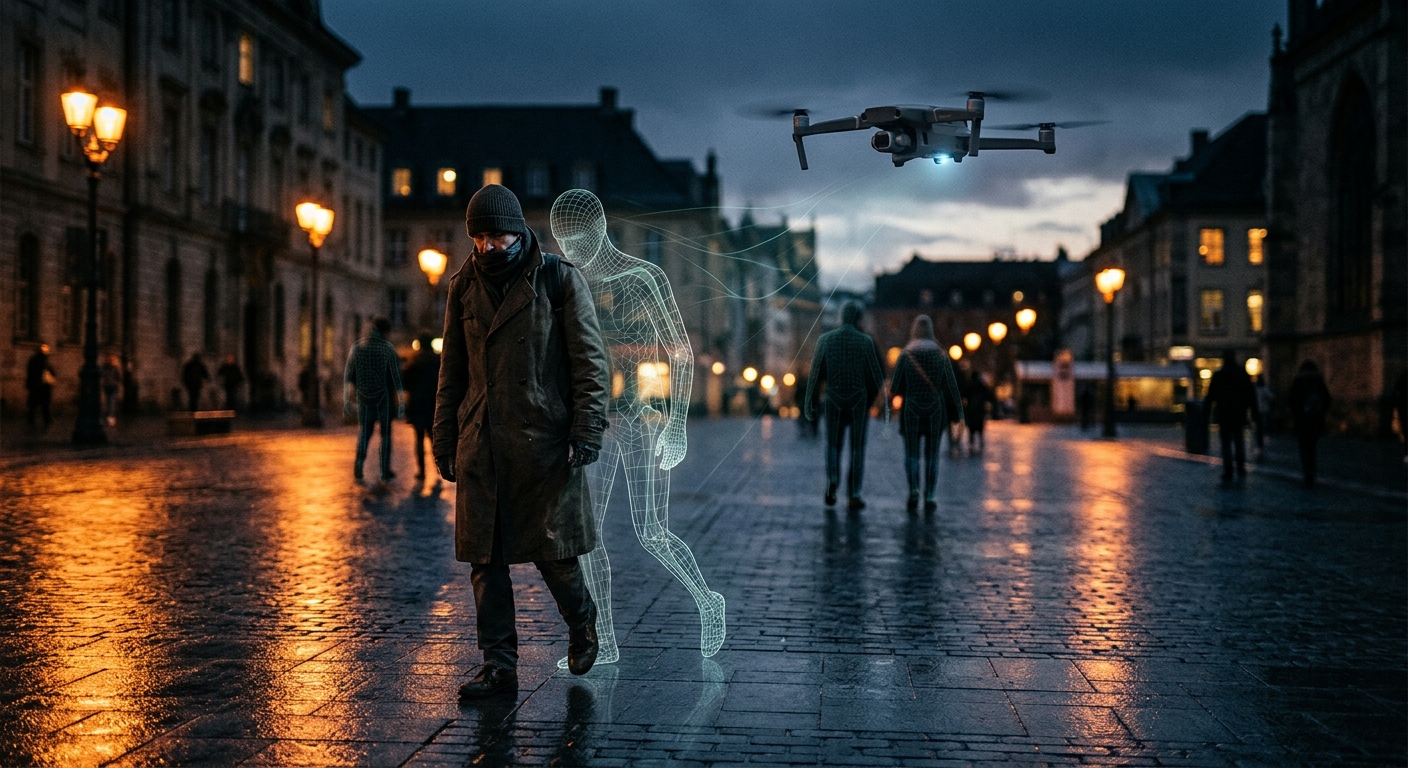
Privacy law, in most jurisdictions, has absorbed the concept of facial recognition as a meaningful category. Statutes in Illinois, Texas, and several other US states regulate it. The EU’s AI Act treats real-time remote biometric identification — including facial recognition — as a high-risk practice requiring strict conditions. Municipal bans on police use of facial recognition have passed in more than a dozen US cities. The legal and advocacy community has spent a decade learning to argue about faces.
A surveillance system called FarSight renders much of that framework insufficient.
FarSight, described in research published in May 2026 and building on work originally posted to arXiv as paper 2306.17206, is a drone-based biometric identification system that does not rely primarily on facial recognition. Instead, it fuses three distinct biometric modalities: facial recognition for cases where the face is visible and legible, gait analysis that characterises individual walking patterns, and 3D body-shape modelling that extracts identity-linked features from body geometry independent of clothing and pose.
The system is specifically designed to operate in conditions where facial recognition fails — at long distances, from aerial angles where faces are not clearly visible, or when subjects are wearing masks or hats. When the face is unavailable or unreliable, FarSight falls back to gait and body shape. All three signals are combined in a multimodal fusion architecture that outperforms any single modality in both identification and verification accuracy.
Why Gait and Body Shape Change the Equation
Facial recognition has a natural counter-surveillance response: cover your face. Masks, hats, hoods, and face coverings all reduce the accuracy of facial recognition systems operating at distance. This is why facial recognition bans generate meaningful protection — if the technology cannot read your face, you can defeat it with a scarf.
Gait recognition has no equivalent counter-measure that is practical for daily use. Your walking pattern is a biometric that reflects your skeletal structure, muscle development, and neurological motion patterns. It is remarkably consistent across contexts and conditions. You walk the same way whether you know you are being filmed or not. Wearing a disguise does not change it. Walking purposefully does not change it — trained analysis can distinguish deliberate gait alteration from natural variation.
Body shape is similar in character. The 3D modelling component of FarSight extracts features described in the research as “naked 3D body shape” — geometrical features reflecting body structure rather than clothing or posture, isolated from other variables using machine learning and neural implicit functions. This is not a measurement of how you dress. It is a measurement of your physical geometry, which does not change with a change of clothes.
The combination of all three modalities tested on IARPA’s BRIAR benchmark — a dataset commissioned by the US Intelligence Advanced Research Projects Activity containing more than 350,000 images and 1,300 hours of video from 1,055 subjects — and showed meaningful improvements over single-modality systems in both controlled and uncontrolled conditions.
The Regulatory Gap
The researchers explicitly list the intended applications for FarSight: law enforcement, border security, forensic analysis, and surveillance operations. These are the same application categories that facial recognition has been deployed in, and for which facial recognition restrictions have been developed.
Existing restrictions do not reach gait and body-shape recognition. Illinois BIPA covers “biometric identifier” and “biometric information” with definitions focused on retina or iris scans, fingerprints, voiceprints, hand geometry, and facial geometry. Gait is not listed. The EU AI Act’s definition of remote biometric identification addresses systems that operate by identifying individuals “without their active involvement” — which gait recognition satisfies — but in practice regulatory guidance and implementation focus has centred on facial systems.
The researchers note directly that “legal and policy frameworks focused primarily on facial recognition do not clearly address gait recognition, body-shape analytics, or multimodal biometric fusion.” The regulatory gap is not a matter of interpretation; it is acknowledged in the academic literature describing the technology.
This creates a predictable trajectory: regulators and legislators negotiate restrictions on facial recognition while researchers develop systems that route around the restriction entirely. By the time policy catches up to multimodal fusion, deployments at borders, in public transport networks, and in urban surveillance infrastructure may already be operational.
What Persistent Remote Identification Actually Means
The deeper concern the researchers flag — carefully, in academic language — is persistence. Current surveillance requires decisions: point the facial recognition camera at this crowd, not that one; run this checkpoint, not that street. Resources constrain coverage.
A drone-mounted multimodal biometric system that can identify individuals from aerial altitude, in crowds, through common counter-surveillance measures, and across the full range of body orientations raises the coverage ceiling substantially. Persistent aerial surveillance of a city, a protest, a border crossing, or a transit hub using a system that identifies everyone moving through it is no longer a distant theoretical concern. It is a system with a name, a test dataset from a US intelligence agency, and documented accuracy improvements over prior approaches.
The researchers are transparent about their goals — they list law enforcement and border security as primary use cases. That transparency is useful precisely because it removes ambiguity about intended deployment. The question that follows is not “what will this be used for” but “under what legal authority, with what oversight, with what limits on retention and use of the biometric records collected.”
Those questions have no good answers yet. Most jurisdictions have not yet finished drafting answers to the simpler version of those questions about facial recognition. FarSight suggests the underlying problem has already outpaced the solutions being developed for it.
FarSight research was reported in Biometric Update (May 19, 2026). The underlying paper is available on arXiv as 2306.17206. IARPA’s BRIAR dataset is a US government-funded benchmark for long-range biometric identification.