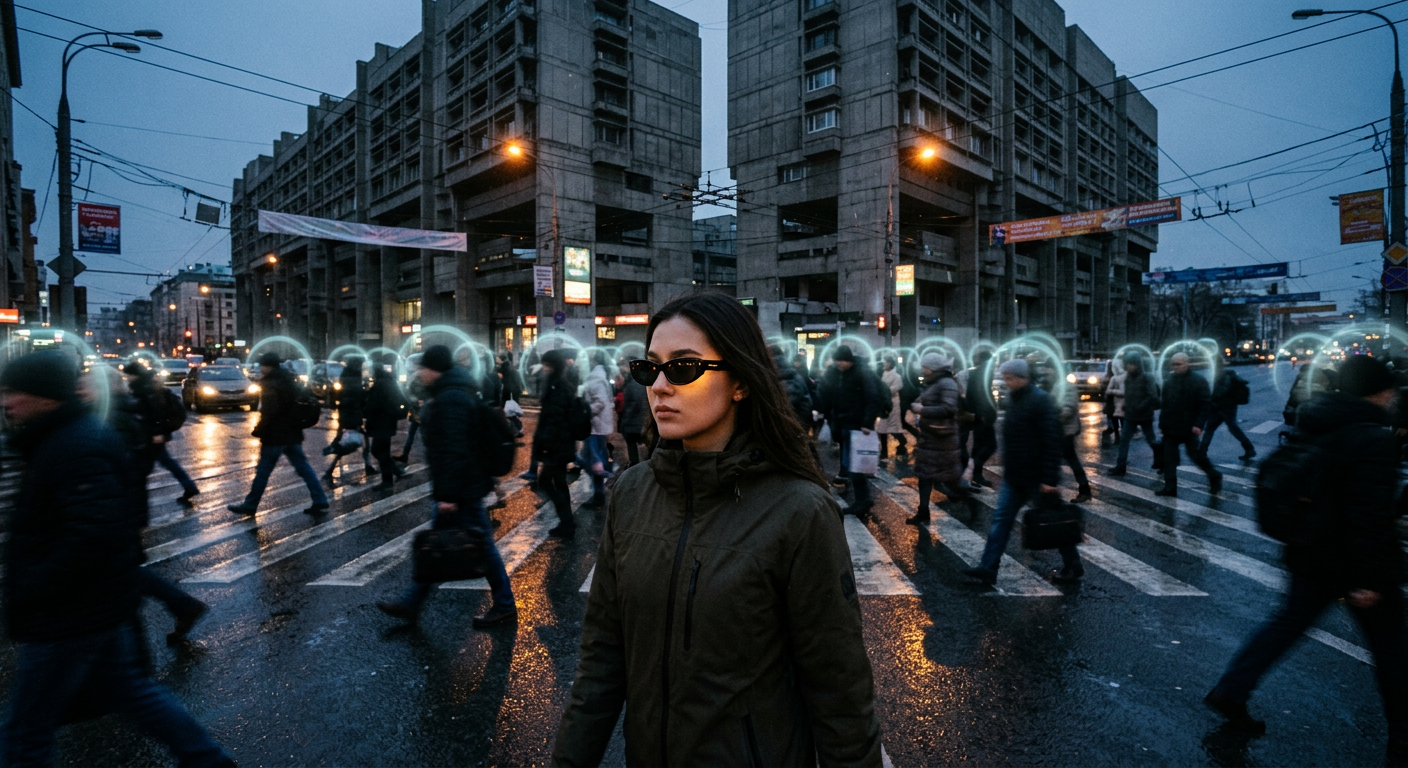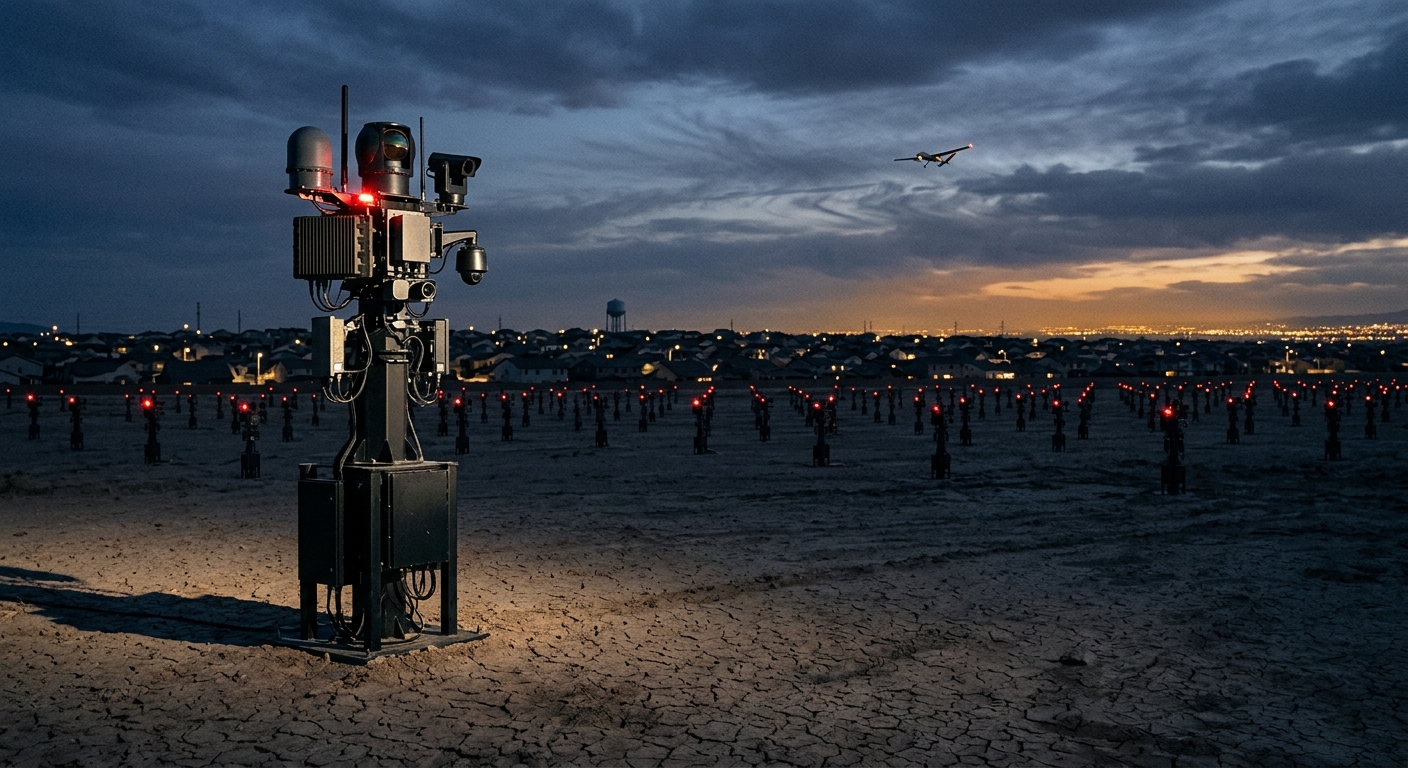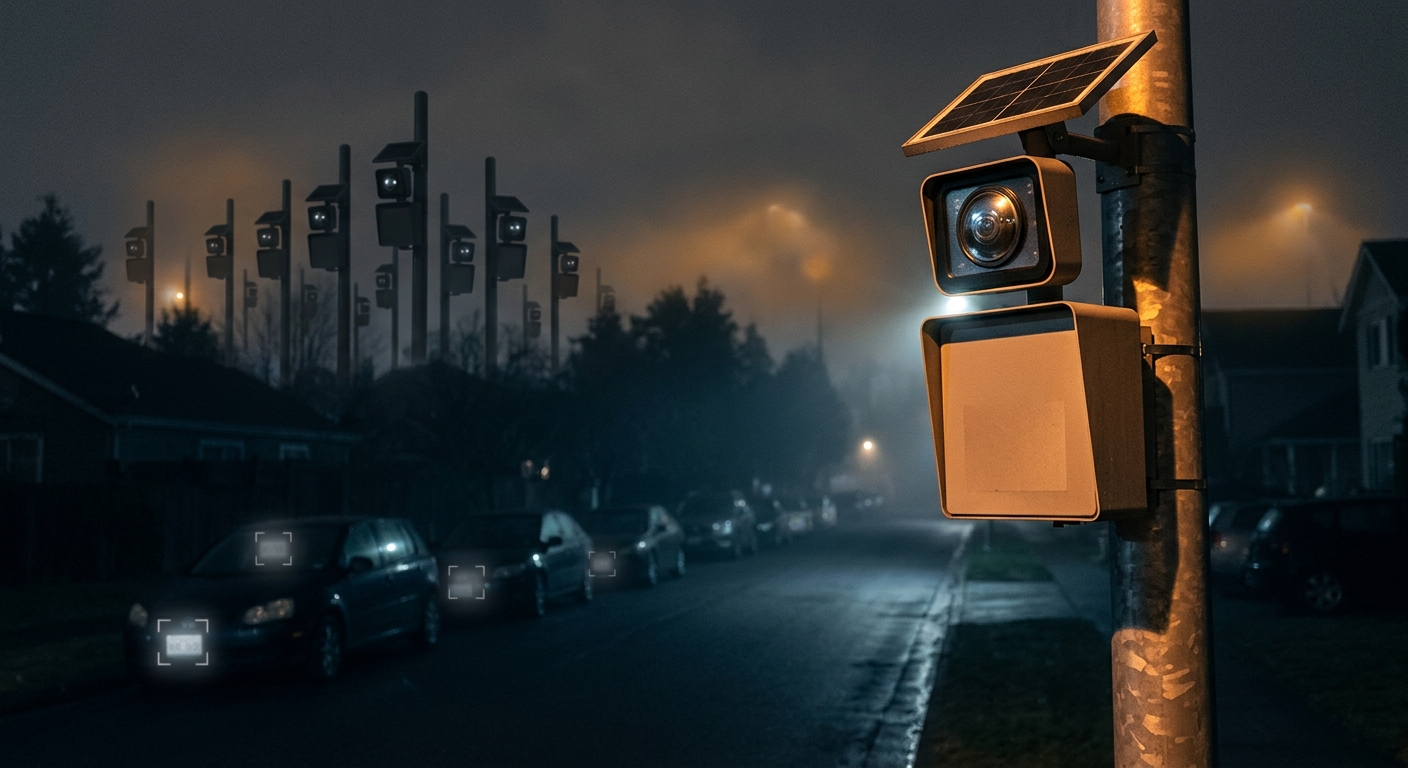
There is a good chance a camera photographed your car today. Not a red-light camera, not a toll gantry — a small, solar-powered box on a pole at the edge of your neighborhood, reading your license plate, noting the time, logging the location, and filing all of it into a database that thousands of agencies can search. The company that makes most of those boxes is called Flock Safety, and in 2026 its network crossed 100,000 cameras across the United States.
That milestone arrived at the exact moment the backlash did. This is the year cities started ripping the cameras down.
The scale of the thing
Flock is not a niche vendor. By mid-2026 the company reported more than 12,000 customers — over 5,000 law enforcement agencies, roughly 1,000 businesses, and a long tail of homeowners’ associations — and a valuation of $7.5 billion after a $275 million funding round. The independent, crowdsourced mapping project DeFlock has plotted more than 99,000 of these readers on a public map, a number that only ever goes up.
Each camera does more than read a plate. Flock’s “Vehicle Fingerprint” system uses onboard AI to catalog make, model, body style, color, bumper stickers, roof racks — even dents and scratches — so a vehicle can be located even when the plate isn’t visible or isn’t known. Point enough of these at enough intersections and you no longer have a set of cameras. You have a time machine for cars: type in a plate and retrace weeks of someone’s movements.
The Electronic Frontier Foundation put a number on the reach. Reviewing a dataset of roughly 12 million searches run by more than 3,900 agencies, EFF found that a single query from one Texas sheriff’s office fanned out across 6,809 separate networks and 83,345 cameras — “across nearly the entire nation.” A local officer runs a local search, and the search quietly becomes national.
The 1.6 million searches
The abstract danger became a lawsuit in San Francisco Superior Court. On February 26, 2026, the firms Gibbs Mura and Milberg PLLC filed a class action — amended on April 3 — alleging that out-of-state and federal agencies searched San Francisco’s Flock database more than 1.6 million times in a roughly seven-month window. Los Altos’s cameras, the complaint says, were queried by out-of-state agencies more than a million times on their own.
The legal problem is specific. California’s ALPR Privacy Act (Civil Code § 1798.90.55(b), enacted as SB 34 in 2015) prohibits sharing license-plate data with out-of-state and federal agencies, and the state’s SB 54 sanctuary law reinforces the wall. The complaint names federal agencies including ICE and CBP among those that reached in. Under California law, plaintiffs can pursue at least $2,500 per violation against both the cities and Flock — and when you multiply that floor by 1.6 million queries, the exposure runs into the billions.
Flock has pushed back on the framing, arguing that federal agencies did not “directly” access San Francisco’s system. But “directly” is doing a lot of work in that sentence, because the more damning disclosures came from the police themselves.
The audit that found 299 doors left open
On June 18, 2026, the San Francisco Police Department disclosed the results of a compliance audit: 299 improper searches of the city’s camera network over roughly a year. The queries weren’t run by SFPD. They were run by analysts at a regional intelligence-sharing body — the Northern California Regional Intelligence Center (NCRIC) had granted access to another network’s watch center, which ran searches during overnight hours without SFPD’s knowledge. Some of the analysts, the reporting noted, “were unaware of California law.” The chief cut off the access on discovery.
Two hundred ninety-nine is a small fraction of total queries — about 0.005%. That is exactly the point. This is not a story about a rogue operator hammering the system. It’s a story about how many quiet, plausible, well-intentioned side doors exist in a nationally networked surveillance system, and how long they can stay open before anyone notices. Oxnard set its cameras to “California only” access — and a vendor-side issue silently re-enabled nationwide querying anyway, exposing the department’s data without its knowledge. When even the customer’s chosen privacy settings don’t hold, the settings aren’t the safeguard. They’re the reassurance.
More than 80 cities have pulled the plug
The cancellations are the loudest signal. According to reporting anchored by the San Francisco Standard, 82 Flock contracts were terminated across 28 states between August 2021 and May 2026 — 39 of them in just the first five months of 2026. (You’ll also see “53 cities” and “68 cities” cited; these count different things — deactivations, outright bans, non-renewals — but every version of the number is climbing.)
The named cases tell the story:
- Santa Cruz, California cancelled in January 2026 after learning its data had reached out-of-state agencies and ICE.
- Denver let its contract lapse on March 31 and physically decommissioned and removed all 110 of its cameras.
- Cambridge, Massachusetts discovered Flock cameras had been installed without, in a city spokesperson’s words, “city awareness.”
- The Los Angeles Police Department announced it would not renew, then moved to renegotiate with added privacy protections, citing “serious concerns around civil liberties.”
- Flagstaff, Eugene, and Hillsborough joined the list, per NPR’s reporting on the immigration-driven wave of cancellations.
The credibility problem
What turned wary councils into hostile ones was the ACLU’s documentation that Flock repeatedly told them things that weren’t true. The report — bluntly titled around the theme of lost credibility — lays out a pattern:
- In Oshkosh, Wisconsin (April 2026), Flock’s own chief information security officer told the council the system did not “create a pattern or heat map of an individual’s movement.” The council approved it that day, learned the claim was false the next morning, and revoked the approval the same day. Flock later acknowledged the system does produce a heat map of vehicle captures for up to a month.
- In Loveland, Colorado, Flock initially denied federal access, then admitted to contracts with CBP and DHS. The CEO’s explanation: “We clearly communicated poorly.”
- Flock representatives claimed partnerships with the ACLU to lend legitimacy in council meetings. The ACLU says neither it nor any affiliate has ever partnered with Flock.
The Oshkosh deputy mayor, Joe Stephenson, said it plainly: “I don’t know how this body can govern if someone tells untruths, mistruths, exaggerated truths.” Mayor Matt Mugerauer added: “if you give bad information, then I just don’t want to work with you.”
Where the abuse actually shows up
Strip away the marketing about stolen cars and Amber Alerts, and EFF’s investigations found the network used for exactly the things privacy advocates warned about. In its dataset, agencies ran hundreds of searches tied to political protest — including queries connected to the “No Kings” demonstrations — searches touching reproductive-healthcare travel, and search terms that included anti-Romani slurs. Separately, EFF documented that Flock lets local agencies switch on an FBI hotlist called the Immigration Violator File, a list populated exclusively by ICE, turning a neighborhood plate reader into an immigration-enforcement tripwire with a dropdown menu.
Then there’s Flock Nova, the company’s data-fusion platform. As first reported by 404 Media, Nova was designed to combine license-plate data with public records, jail and arrest records, and open-source intelligence to build profiles of individuals — and early plans reportedly included data drawn from hacked breaches, until the reporting prompted Flock to say it would not use breach data. EFF’s verdict on the concept was a “dystopian panopticon.”
The law is starting to move
The courts and legislatures are catching up, unevenly. On June 29, 2026, the Supreme Court ruled in Chatrie v. United States that accessing stored cellphone location data is a Fourth Amendment search, holding that people have “a legitimate expectation of privacy” in that data. It’s a geofence-warrant case, not a Flock case — but analysts read it as a warning shot at the whole architecture of dragnet location tracking, and it lands on the same doctrinal question Flock’s defenders keep trying to avoid.
Meanwhile the Schmidt v. City of Norfolk challenge — where a district judge held that a 175-camera archive was not a search — is on appeal to the Fourth Circuit, with the ACLU, EFF, EPIC, and the Cato Institute all filing briefs arguing the opposite. And Virginia enacted a law restricting ALPR data to specific investigations and capping retention at 21 days — a reminder that the default, in most places, is far longer.
What you can actually do
You can’t opt out of a camera on a public pole, but you’re not powerless:
- Find out if your town uses Flock. Check the DeFlock map, and ask your city council directly whether there’s an active contract, what the retention period is, and whether “nationwide” or federal sharing is enabled. The San Francisco and Oxnard cases prove the settings matter — and that they fail silently.
- Show up when it’s on the agenda. The cancellations of 2026 didn’t come from nowhere. They came from residents asking the questions that exposed the gap between what Flock told the council and what the system actually does.
- Support the mapping and litigation groups. DeFlock, EFF, the ACLU, and the Institute for Justice are the reason any of this is documented at all.
The pattern
Flock’s business model was to install first and explain later — to become infrastructure before anyone voted on it. For a few years it worked: 100,000 cameras went up faster than any oversight regime could form around them. What 2026 revealed is the bill for that strategy. A surveillance network sold on the promise of local control turned out to have national reach, silent side doors, and a sales pitch that repeatedly didn’t survive contact with the facts. The cameras are still up in most places. But for the first time, the people being watched are the ones asking who’s really doing the watching — and, increasingly, voting to take the cameras down.