The Fourth Amendment has an asterisk, and it’s printed at every airport, seaport, and land crossing in the country. On July 13, the Fourth Circuit made that asterisk a little larger: in United States v. Belmonte Cardozo, a unanimous panel held that a manual search of your cellphone at the border is a “routine” border search — the legal category that requires no warrant, no probable cause, and no individualized suspicion whatsoever.
An officer’s hunch is sufficient. An officer’s boredom is sufficient. Nothing is required at all.
What happened at Dulles
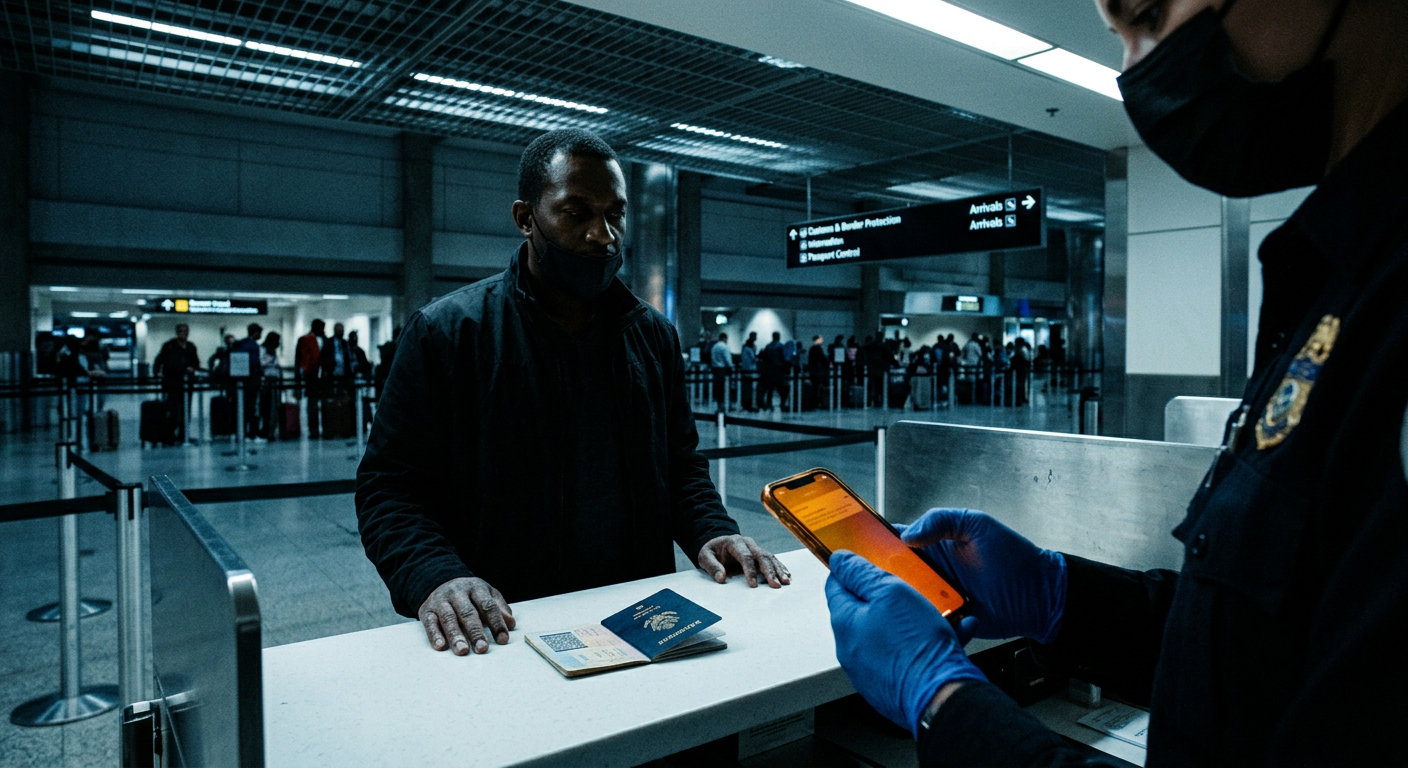
The facts are brief, which is part of the point. On May 8, 2024, Jose Belmonte Cardozo flew from Bolivia into Washington Dulles. A CBP port intelligence officer was waiting for him. At inspection, he produced two iPhones; the officer asked him to unlock them, and he complied. She opened the photo galleries, toggled into the phones’ hidden folders — the ones iOS tucks behind an extra passcode prompt, which an expert affidavit described as “typically used for a person’s most private information” — and found sexually explicit images of children. Roughly two minutes passed between the officer taking the phones and finding the material.
Belmonte Cardozo was indicted on ten federal counts, moved to suppress the evidence as the fruit of an unconstitutional search, lost, entered a conditional guilty plea preserving the appeal, and was sentenced to 18 years.
Let’s be plain: this is an unsympathetic defendant, and the material found was abhorrent. That is precisely why cases like this shape doctrine — the government rarely litigates border-search authority over a journalist’s notes. The rule announced here applies identically to the reporter, the asylum seeker, the businesswoman, and you.
What the court held
Writing for a panel that included Chief Judge Diaz and Judge Agee, Judge Quattlebaum laid out the framework: border searches don’t require warrants; routine border searches don’t require individualized suspicion; only nonroutine searches do. Under the Fourth Circuit’s own precedent in United States v. Kolsuz (2018), a forensic phone search — hooking the device to extraction tools, imaging its contents — is nonroutine and demands individualized suspicion. The open question was where a manual, scroll-with-your-thumbs search falls.
The answer: routine. The court reasoned that a manual search’s intrusiveness depends on its duration and depth, and a two-minute pass through a photo gallery — hidden folder included — falls on the routine side of the line. With that, the Fourth Circuit joined the First, Fifth, Seventh, and Eighth Circuits, all of which have held that manual device searches at the border require no individualized suspicion.
The court was not writing on a blank slate of advocacy. The Knight First Amendment Institute, the Reporters Committee for Freedom of the Press, the ACLU, the EFF, and the National Association of Criminal Defense Lawyers all filed amicus briefs urging the opposite result — EFF argued that Riley v. California, the Supreme Court’s recognition that phones are categorically different from wallets and suitcases, should require a warrant for any border device search, manual or forensic. The panel acknowledged the heightened privacy interest in phones and ruled the other way anyway.
Why “routine” is doing so much work
The border search exception was built for luggage. Its logic — the sovereign’s interest in controlling what physically crosses the border — made sense when a search meant opening a suitcase to look for undeclared goods or contraband.
A modern phone is not a suitcase. It is, as Riley put it, a window into “the privacies of life”: years of messages, photos, location history, medical information, browsing records, financial apps, and the credentials to nearly every account you hold. CBP conducted roughly 55,318 device searches in fiscal year 2025 alone. Under this ruling, in the Fourth Circuit’s territory — which includes Dulles, one of the busiest international gateways in the country — every one of those manual searches can happen on zero suspicion, and the officer may browse into the corners of the phone you deliberately hid.
The duration-and-depth test offers little comfort. Two minutes was enough here; the opinion gives no floor at which a manual search becomes nonroutine, only the assurance that some hypothetical search might. Travelers can’t calibrate their rights to a stopwatch they can’t see.
The circuit math, and what’s next
There is now a lopsided consensus among the circuits that manual border searches need no suspicion — but the deeper split persists on what forensic searches require, ranging from reasonable suspicion (Ninth Circuit, and the Fourth via Kolsuz) to essentially nothing. The Supreme Court has repeatedly declined to take a border device search case. Each new unanimous circuit ruling makes review both more necessary and, paradoxically, less likely — no fresh split, no urgency.
Which means for practical purposes, the rule at the airport is set for years: your phone’s contents are constitutionally naked at the border, up to the point of forensic extraction.
What travelers can actually do
Rights you can’t invoke at inspection have to be exercised before you travel:
- Travel light, digitally. Cross the border with a device containing only what you’d be comfortable showing a stranger. Some professionals — lawyers, journalists, clinicians — increasingly use dedicated travel phones.
- Power down before inspection. A phone that’s off resists casual browsing and forces the encryption question.
- Know the passcode rules. US citizens can refuse to unlock a device — you cannot be denied entry for it, though the device can be seized and detained. Non-citizens face harsher calculus, including visa consequences. Belmonte Cardozo complied with the unlock request; that compliance is what made the two-minute search possible.
- Hidden folders aren’t. This opinion specifically blesses toggling into concealed galleries. Anything on the device is in scope.
- Cloud data is (mostly) out of bounds. CBP policy directs officers to search only data resident on the device, in airplane mode. Log out of accounts and remove apps rather than trusting that policy line, but know it exists.
The Fourth Amendment still crosses the border with you. It just weighs a lot less when it arrives.