
A Tale of Two Germanys: Constitutional Protection Meets Digital Authoritarianism
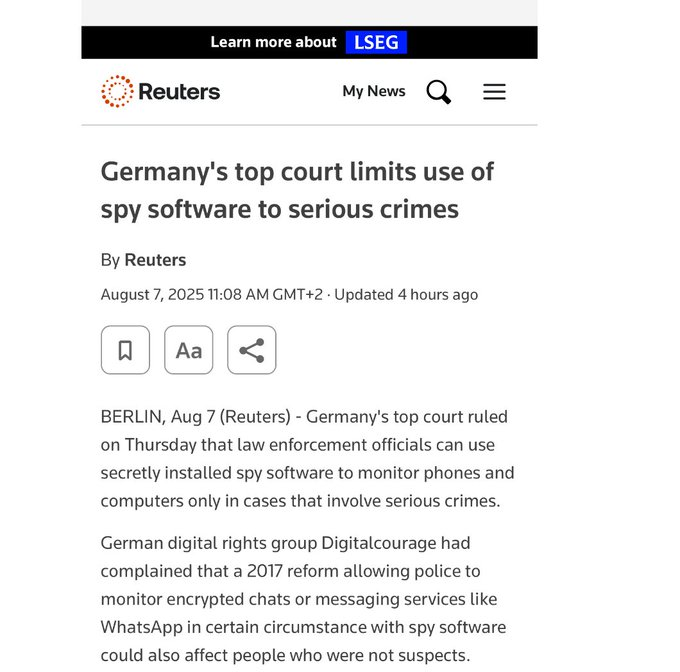
On August 7, 2025, Germany’s Federal Constitutional Court delivered what appeared to be a victory for digital rights, ruling that law enforcement can only use secretly installed spy software (commonly known as “state trojans” or Staatstrojaner) to monitor phones and computers in cases involving serious crimes. The ruling came after digital rights group Digitalcourage challenged a 2017 reform that had expanded police powers to monitor encrypted communications on platforms like WhatsApp, arguing it could affect innocent citizens.
 Yet this apparent win for privacy rights reveals a deeper contradiction at the heart of German digital policy. While the Constitutional Court restricts domestic spy software, Germany simultaneously champions the EU’s most invasive mass surveillance initiatives, creating a schizophrenic approach to digital privacy that leaves citizens more vulnerable than ever.
The Constitutional Court’s Narrow Victory
The Federal Constitutional Court’s decision represents a critical limitation on state surveillance powers, but its scope is narrower than it first appears. The court ruled that the use of state trojans—malware secretly installed on devices to bypass encryption—must be restricted to investigations of serious crimes. This means German police cannot deploy these tools for minor offenses or fishing expeditions.
The case, brought by Digitalcourage, centered on concerns that the 2017 reform of Germany’s Code of Criminal Procedure (Strafprozessordnung) had gone too far. The reform had allowed authorities to use spy software not just against suspected criminals, but potentially against anyone in their digital vicinity—friends, family members, or even random contacts who happened to be in the same WhatsApp group.
The court’s intervention establishes important boundaries: proportionality must be maintained, judicial oversight is mandatory, and the fundamental right to privacy cannot be casually discarded. However, this protection only applies to domestically deployed spy software, leaving a massive loophole that the EU is eager to exploit.
Germany’s Dual Personality on Digital Surveillance
While celebrating this constitutional victory, Germany remains one of the strongest supporters of the EU’s Chat Control 2.0 initiative—a proposal that would mandate the scanning of all private messages before encryption. This cognitive dissonance exposes the fundamental contradiction in German digital policy: protecting citizens from German spy software while subjecting them to EU-mandated mass surveillance.
The irony is stark. German authorities cannot legally install spy software on a citizen’s device without evidence of serious crime and judicial approval, but under EU regulations being pushed with German support, every message sent by every citizen would be automatically scanned by AI systems before being encrypted. The very same communications the Constitutional Court just protected from targeted surveillance would be subject to blanket surveillance at the EU level.
The Network Enforcement Act: Germany’s Censorship Blueprint
Germany’s approach to online content moderation has become a global template for digital censorship. The Network Enforcement Act (Netzwerkdurchsetzungsgesetz or NetzDG), enacted in 2017 and repeatedly strengthened since, requires social media platforms with over 2 million German users to remove “obviously illegal” content within 24 hours of receiving a complaint, or face fines up to €50 million.
What constitutes “obviously illegal” has expanded dramatically beyond its original scope of hate speech and fake news. The law now encompasses:
- Political dissent labeled as “delegitimization of the state”- Scientific debate deemed “medical misinformation”- Satire and humor classified as “offensive content”- Legitimate criticism reframed as “harassment”
The NetzDG has created a censorship-industrial complex where platforms over-remove content to avoid massive fines. According to transparency reports, platforms remove or restrict up to 25% more content in Germany than would be required under a strict interpretation of German law—a phenomenon known as “overblocking.”
The German Digital ID Push: Your Papers, Please, But Digital
Germany is rapidly advancing its digital identity agenda, with the new eID system becoming increasingly mandatory for accessing both government and private services. Starting in 2025, Germans need digital ID verification for:
- Opening bank accounts (even basic accounts)- Accessing age-restricted content online- Using certain social media features- Purchasing items online above certain thresholds- Accessing government services
The system, while marketed as “convenient” and “secure,” creates a comprehensive tracking mechanism for all digital activities. Every verification leaves a data trail, building detailed profiles of citizens’ online behaviors, purchases, and interactions. Unlike the anonymous cash transactions and paper documents of the past, digital ID creates permanent, searchable records of every aspect of daily life.
Russia’s WhatsApp and VPN Restrictions: Separating Fact from Fiction
Social Media Regulation: The Invisible Hand of State Control
German regulation of social media extends far beyond content removal. Platforms operating in Germany must:
- Maintain German-based legal representatives who can be held personally liable for platform content2. Provide quarterly transparency reports detailing all content moderation activities3. Implement “upload filters” to prevent previously removed content from reappearing4. Share user data with German authorities upon request, often without judicial oversight5. Prioritize German law over their global community standards
This regulatory framework has transformed social media companies into quasi-state actors, enforcing government censorship policies while maintaining the fiction of being private platforms. The recent expansion of these requirements to messaging apps and smaller platforms means virtually no digital communication in Germany occurs without potential state oversight.
The Privacy Paradox: GDPR as a Surveillance Tool
Germany, as the driving force behind the EU’s General Data Protection Regulation (GDPR), presents itself as a champion of privacy. Yet GDPR has become a tool for expanding surveillance capabilities. The regulation’s “legitimate interest” and “legal obligation” exceptions have created massive loopholes that authorities exploit to access user data.
German authorities have used GDPR provisions to:
- Force platforms to retain data they would otherwise delete- Access user information under broad “public interest” exceptions- Compel data sharing between platforms and government agencies- Mandate real-name verification under “data accuracy” requirements
The same law meant to protect privacy has become a mechanism for eliminating online anonymity and expanding state surveillance capabilities.
Telegram CEO’s Arrest: A Geopolitical and Economic Powder Keg
The Backdoor Problem: When Encryption Isn’t
Germany’s approach to encryption exemplifies its contradictory digital policy. While the Constitutional Court’s ruling protects against unauthorized access to encrypted communications, German law enforcement agencies continuously push for “lawful access” to encrypted services—essentially, government backdoors.
The German Federal Criminal Police Office (BKA) and Federal Intelligence Service (BND) have repeatedly called for:
- Key escrow systems where encryption keys are stored for government access- Weakened encryption standards that authorities can break when needed- Mandatory decryption capabilities built into all communication platforms- Client-side scanning before encryption is applied
These demands fundamentally undermine encryption’s purpose. A backdoor for “lawful” access is still a backdoor—one that criminals, foreign governments, and malicious actors will inevitably exploit.
The Telecom Data Retention Controversy
Despite multiple court rulings against blanket data retention, Germany continues attempting to implement comprehensive telecommunications surveillance. The latest iteration requires providers to retain:
- IP addresses for 10 weeks- Location data from mobile communications- Connection metadata showing who communicated with whom- Traffic data revealing online activities
While framed as necessary for fighting serious crime, these measures create a surveillance infrastructure that monitors all citizens continuously. Every phone call, text message, and internet session generates data points in a massive surveillance database—data that exists whether you’re suspected of a crime or not.
The Social Scoring Creep
Though Germany doesn’t have an official social credit system like China, various German institutions are implementing scoring mechanisms that achieve similar results:
- SCHUFA credit scoring now incorporates social media data and online behavior- Insurance companies use digital footprints to adjust premiums- Employers increasingly use AI-powered background checks including social media analysis- Government benefits may be affected by online activities deemed “antisocial”
These disparate systems are gradually interconnecting, creating a de facto social scoring system that affects Germans’ access to housing, employment, financial services, and government benefits based on their digital behaviors.
The Complete Guide to Social Media Privacy: Protecting Your Digital Life in 2025
The Platform Liability Trap
Recent German court decisions have established platform liability for user-generated content, fundamentally altering the internet’s structure. Platforms can be held liable for:
- Content they didn’t create- Posts they weren’t aware of- Material uploaded by anonymous users- Links to external content
This liability regime forces platforms to implement aggressive pre-publication filtering, transforming them from neutral conduits into active censors. The chilling effect extends beyond illegal content—platforms now remove anything potentially controversial to avoid legal risk.
The EU Integration: Surrendering Digital Sovereignty
Germany’s digital policies cannot be understood in isolation from its role in the EU. As the EU’s largest economy and most influential member, Germany drives EU-wide digital regulations that then constrain its own policy options. This creates a feedback loop where German initiatives become EU mandates that Germany must then implement, even when they conflict with constitutional protections.
Current EU initiatives strongly supported by Germany include:
- Digital Services Act implementation with enhanced content removal obligations- Chat Control 2.0 for message scanning- Digital Identity Wallet for EU-wide identity verification- AI Act provisions requiring biometric surveillance capabilities
🎧 Related Podcast Episode
Conclusion: The Closing Digital Prison
Germany’s recent Constitutional Court ruling on spy software, while important, is ultimately a Pyrrhic victory in the broader war for digital privacy. While Germans celebrate protection from domestic spy software, they’re being enrolled in comprehensive EU surveillance systems that are far more invasive.
The German model—constitutional protections undermined by EU integration, privacy laws that enable surveillance, and content moderation that amounts to censorship—is being exported globally. Germany’s technical expertise and regulatory influence make it a key architect of the emerging digital surveillance state.
For German citizens, the promise of digital rights rings increasingly hollow. They live in a nation where the Constitutional Court protects them from targeted surveillance while the government builds infrastructure for mass surveillance. Where privacy laws generate more data collection than they prevent. Where freedom of expression online exists only within ever-narrowing boundaries defined by algorithms and liability-averse platforms.
The August 7, 2025 court ruling should be seen not as a victory, but as a warning: even constitutional protections are insufficient against the coordinated assault on digital privacy. As Germany continues down this path, it offers a cautionary tale for the world—how a democracy can sleepwalk into digital authoritarianism while maintaining the facade of constitutional governance.
The question for Germans—and for all of us—is whether recognizing these contradictions will spark resistance before the digital prison doors close permanently. The Constitutional Court has shown that legal challenges can still succeed, but only if citizens understand what they’re fighting for and what they stand to lose. In the battle between constitutional protection and digital surveillance, surveillance is winning—not through dramatic overthrow, but through the slow, bureaucratic erosion of rights that once seemed inviolable.