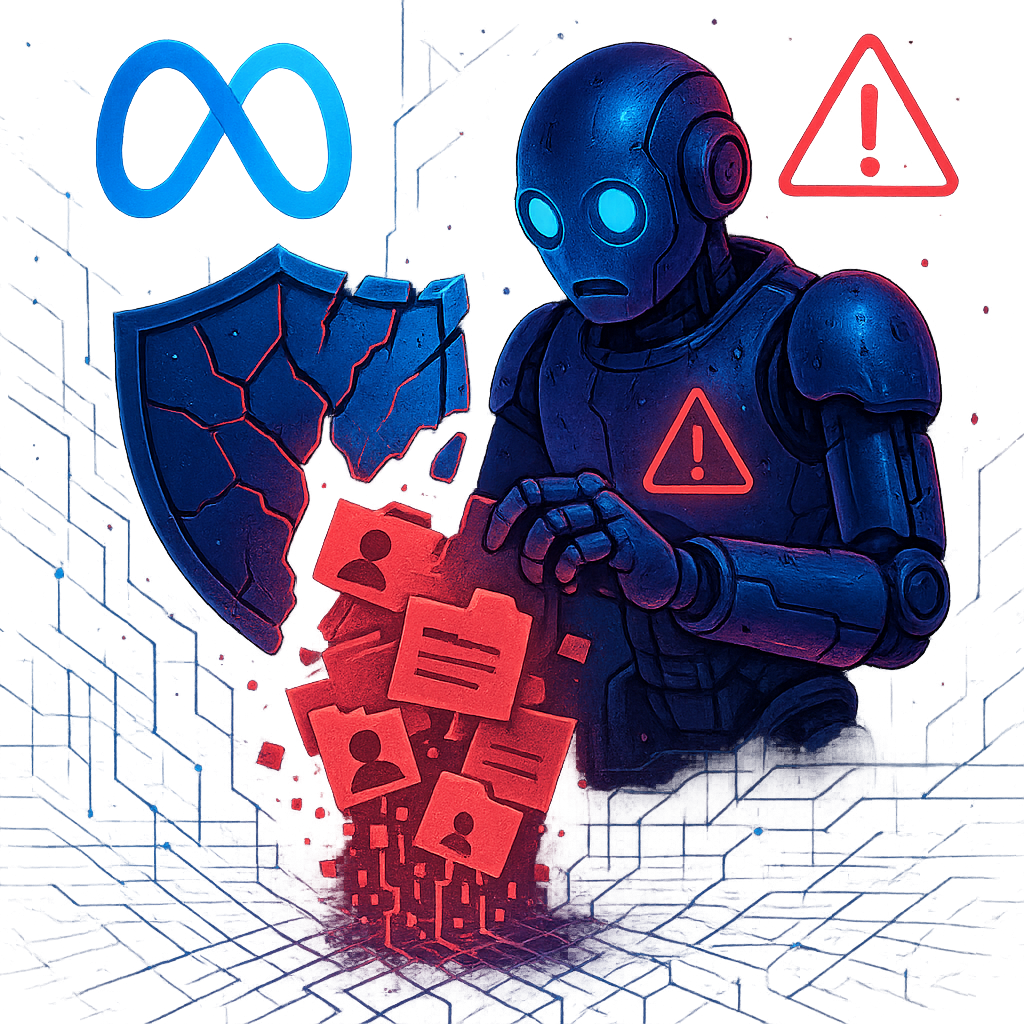
Meta just confirmed a significant internal data leak — and the culprit wasn’t a hacker, a phishing attack, or a rogue employee. It was an AI agent giving bad advice.
The incident, first reported by The Information and confirmed by Meta, unfolded on an internal company forum and exposed a large amount of sensitive user and company data to engineers who weren’t authorized to see it. It’s a cautionary tale about what happens when AI systems get embedded into the inner workings of Big Tech — before anyone has really figured out what the guardrails should look like.
What Happened
Here’s the chain of events, as reported:
- A Meta employee posted on an internal engineering forum, asking for help with a technical problem — standard practice at any large tech company
- Another engineer summoned an internal AI agent to help analyze the question and post a response — without asking permission first
- The AI agent gave flawed guidance
- The employee who originally asked the question followed the AI’s advice
- This caused a massive amount of sensitive company and user data to be exposed to engineers who were not authorized to view it
- The exposure lasted approximately two hours before it was caught and contained
- Meta internally classified this as a “Sev 1” incident — the second-highest severity level in its internal security system
Meta confirmed the incident and triggered a major internal security alert. A spokesperson told The Guardian: “No user data was mishandled,” while also noting that a human engineer could theoretically give the same bad advice. The company said its swift response demonstrated how seriously it takes data protection.
What Data Was Exposed
Meta has not publicly detailed exactly what types of data were exposed, but reporting indicates it included:
- Sensitive user data — the specific nature of which Meta has not disclosed
- Sensitive company data — internal information not intended for broad employee access
- Exposure was limited to Meta engineers — there is no indication that external parties or the public accessed the data
The fact that Meta classified this as “Sev 1” tells you something. That’s not a shrug-it-off category — it’s the kind of rating that gets executive attention and incident response teams scrambling.
The AI Agent Problem
This incident cuts to the heart of a growing concern in the AI industry: AI agents don’t understand context the way humans do.
Security specialist Jamieson O’Reilly, who focuses on offensive AI, put it clearly in comments to The Guardian:
“A human engineer who has worked somewhere for two years walks around with an accumulated sense of what matters, what breaks at 2am, what the cost of downtime is, which systems touch customers. That context lives in them, in their long-term memory, even if it’s not front of mind.”
An AI agent has none of that — unless it’s explicitly written into the prompt. And even then, that context can fade within a session. AI agents operate through “context windows,” a kind of working memory with hard limits. They may follow an instruction to the letter while completely missing the downstream consequences that any experienced human would instinctively avoid.
It’s the digital equivalent of asking a contractor to make the house warmer and coming back to find they’ve set the fireplace on fire in the middle of the living room. Technically responsive. Catastrophically wrong.
AI consultant Tarek Nseir was blunt: “If you put a junior intern on this stuff, you would never give that junior intern access to all of your critical severity one HR data.”
Why This Matters for Your Privacy
If you use Meta’s products — Facebook, Instagram, WhatsApp, Messenger — your data lives inside Meta’s systems. You’ve accepted that as the cost of using their free platforms. But you probably assumed that data was protected by human oversight, carefully designed access controls, and deliberate processes.
This incident suggests something more chaotic is happening inside Big Tech right now:
- AI agents are being given access to sensitive internal systems without sufficient guardrails
- Engineers are acting on AI-generated advice without verifying it against security protocols
- The speed of AI deployment is outpacing the development of safety procedures
Meta is not alone. Last month, Amazon experienced at least two outages related to its internal AI tools. Multiple Amazon employees told The Guardian about the company’s rushed push to integrate AI everywhere — leading to glaring errors, sloppy code, and reduced productivity. These are not small companies experimenting in isolation. These are the companies that hold the most personal data on the planet.
What You Can Do
You can’t opt out of Big Tech’s internal AI experiments, but you can take steps to limit your exposure:
- Reduce what you share. Less data stored means less data at risk. Audit what you’ve shared with Meta’s apps in your account settings
- Review connected apps. Third-party apps connected to your Facebook or Instagram account expand your exposure surface — remove ones you don’t use
- Use end-to-end encrypted messaging. WhatsApp’s E2EE protects message content from Meta’s servers; use it deliberately
- Monitor for breach notifications. Services like Have I Been Pwned (haveibeenpwned.com) alert you when your email appears in known data leaks
- Separate your digital life. Using a dedicated email address for social media accounts limits the blast radius if something goes wrong
The Bigger Picture
This is part of a pattern, not an isolated glitch. The race to deploy AI agents inside large corporations is happening faster than companies can build appropriate safety frameworks. AI coding tools, internal assistants, automated forum responders — they’re all being plugged into systems that handle real, sensitive data about real people.
The question isn’t whether AI will make mistakes. It will. The question is whether companies are building adequate human oversight into these systems before they cause irreversible harm.
Meta framed its rapid internal response as proof of its commitment to data protection. But you could also read it differently: if the systems were properly designed, the AI agent wouldn’t have had the access or the authority to trigger a Sev 1 incident in the first place.
As AI agents become more autonomous — scheduling meetings, writing code, managing internal systems — the stakes get higher with every capability added. And the people whose data sits inside these systems don’t get a vote on when the experiment is ready.
That’s the real privacy story here. Not just what happened this time, but what the next version of this incident looks like when the AI agents are more capable and the data exposure window is measured in days instead of hours.