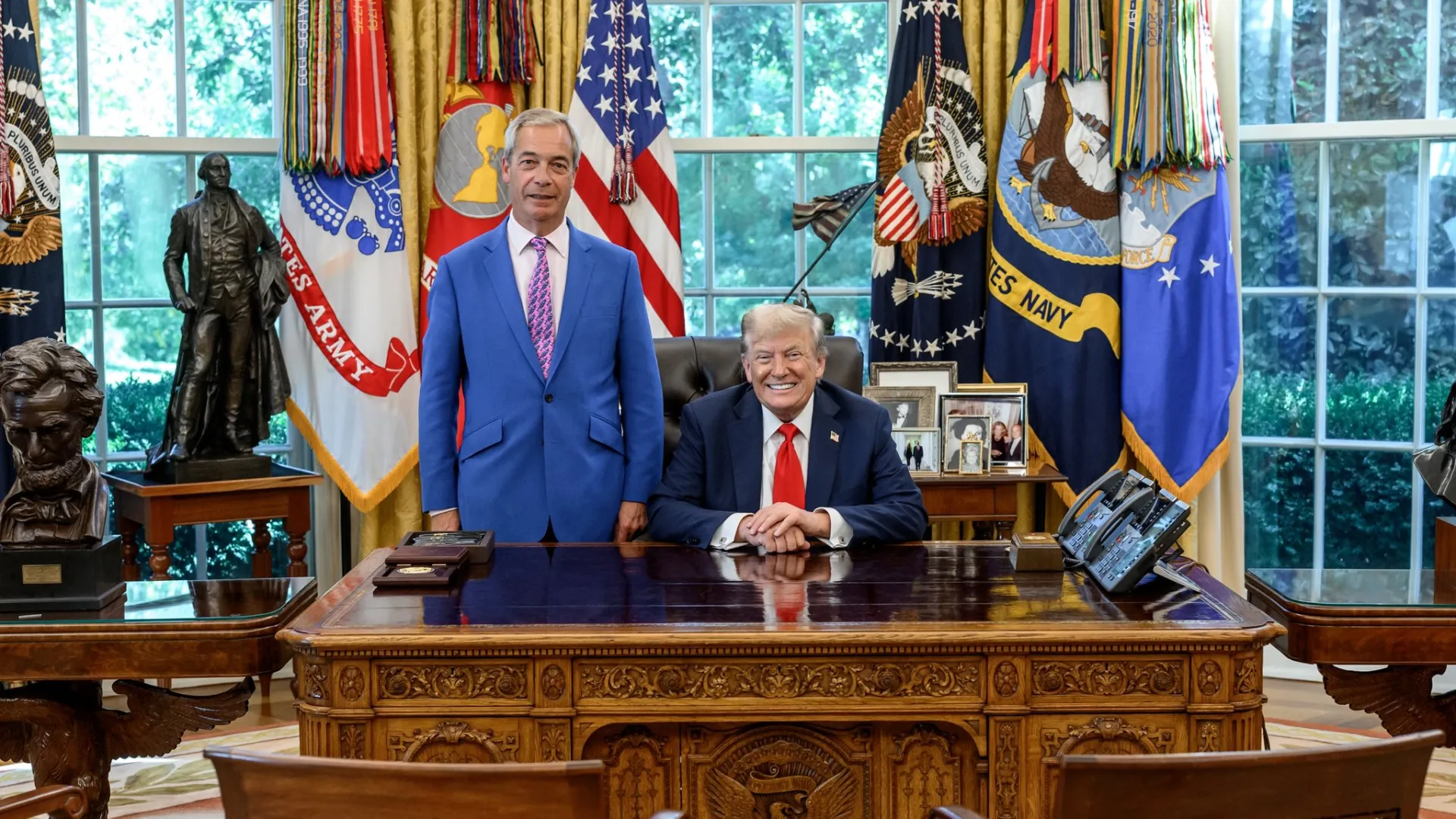
Reform UK Leader Testifies as Trump Administration Takes Hardline Against Foreign Digital Regulations
In a dramatic congressional hearing that has sent shockwaves through transatlantic relations, Reform UK leader Nigel Farage delivered a stark warning to US lawmakers about Britain’s evolving censorship regime and its direct threat to American constitutional freedoms. Appearing before the House Judiciary Committee on September 3, 2025, during a hearing titled “Europe’s Threat to American Speech and Innovation,” Farage detailed how the UK’s Online Safety Act (OSA) is already being weaponized to pressure American platforms into adopting restrictive UK speech codes that would be unconstitutional under the First Amendment.
FTC Chair Warns Tech Giants Against Weakening Data Privacy for Foreign Compliance
The hearing comes at a critical juncture as the Trump administration escalates its confrontation with European digital regulations, with President Trump threatening “substantial additional tariffs” and export restrictions on countries with digital taxes, legislation, or regulations that “discriminate against American Technology”.
The UK’s Extraterritorial Reach: A Direct Threat to American Companies
Farage warned that the OSA “integrates the United Kingdom’s broad, speech-related criminal offenses with sweeping duties imposed on online platforms,” placing enforcement power in the hands of Ofcom, Britain’s communications regulator. The regulatory authority now possesses unprecedented powers that directly threaten American citizens and businesses.
“Ofcom has already threatened four American companies with exactly these penalties. I repeat: regulatory bodies in the United Kingdom are actively threatening to imprison American citizens for exercising their protected Constitutional rights,” Farage told the congressional committee.
UK vs. 4chan: A Digital Sovereignty Showdown
The scope of UK jurisdiction extends to any platform with “links to the UK” - a deliberately vague standard that can include simply having British users, regardless of whether a company has any physical or legal presence in the country. Under this framework, Ofcom’s fines can reach 10% of a company’s global revenue, effectively forcing international platforms to choose between conforming to UK censorship demands or facing financial ruin and market exclusion.
This extraterritorial overreach has already manifested in concrete legal challenges. Just last week, two US-based platforms filed suit in Washington, DC, seeking protection against UK enforcement attempts, highlighting the growing tension between the UK’s speech suppression regime and America’s longstanding protections for political and controversial speech.
                    0:00

                        /1:29


                    1×
Real-World Censorship: The Lucy Connolly Case and Beyond
The abstract threat became tangible with cases like that of Lucy Connolly, which Farage highlighted as emblematic of Britain’s authoritarian drift. Connolly, a 41-year-old childminder, was sentenced to 31 months in prison for posting on X about “setting fire” to hotels housing asylum-seekers during period of civil unrest following a stabbing attack in Southport.
“What Lucy Connolly said in her X message, which was only visible for 3.5 hours, may have been expressed inelegantly, but it was a sentiment that was being felt by a lot of the public at that moment, and it should not have been criminalized. When the government starts regulating speech in this way, it is rarely those that agree with the government who find themselves in court,” Farage stated.
The hearing also addressed the recent arrest of Irish comedian Graham Linehan at London’s Heathrow Airport. Linehan was detained under the Public Order Act on suspicion of inciting violence via social media posts discussing transgender matters. “He’s an Irish citizen. This could happen to any American man or woman that goes to Heathrow that has said things online that the British government and British police don’t like,” Farage warned, adding that this poses a “potentially big threat to big tech bosses” and others.
Trump Administration’s Multi-Pronged Response
The Trump administration has responded to these European digital regulations with unprecedented diplomatic and economic pressure across multiple fronts:
FTC Warning to Tech Companies
Federal Trade Commission Chairman Andrew N. Ferguson sent letters to more than a dozen prominent technology companies, including Apple, Amazon, Microsoft, Meta, and Google, warning them against censoring Americans or weakening data security protections at the behest of foreign governments. Ferguson specifically cited the EU’s Digital Services Act and the UK’s Online Safety Act as laws that “incentivize tech companies to censor worldwide speech,” and the UK’s Investigatory Powers Act, which “can require companies to weaken their encryption measures to enable UK law enforcement to access data”.
The FTC chairman warned that “censoring Americans to comply with a foreign power’s laws” could violate Section 5 of the Federal Trade Commission Act, which prohibits unfair or deceptive practices in commerce.
Sanctions and Tariff Threats
The administration is considering an escalation to direct sanctions. The Trump administration is weighing sanctions against certain European Union and member-state officials involved in enforcing the bloc’s Digital Services Act, with sanctions potentially including visa restrictions. This would mark an unprecedented escalation in the administration’s efforts to push back against what it sees as Europe’s attempt to silence conservative viewpoints.
Secretary of State Marco Rubio has taken a particularly aggressive stance, instructing U.S. diplomats across Europe to raise objections to the Digital Services Act and encourage EU governments and digital regulators to consider amending or repealing it.
                    0:00

                        /1:51


                    1×
Economic Leverage
Trump has deployed his signature tool of trade threats, declaring on Truth Social: “With this TRUTH, I put all Countries with Digital Taxes, Legislation, Rules, or Regulations, on notice that unless these discriminatory actions are removed, I, as President of the United States, will impose substantial additional Tariffs on that Country’s Exports to the U.S.A., and institute Export restrictions on our Highly Protected Technology and Chips”.
The strategy has already shown results. In June, Trump threatened to suspend trade talks with Canada over Ottawa’s plan to impose a digital services tax on technology companies, forcing Canada to abandon the tax.
The Encryption Battleground
One of the most concerning aspects of the UK’s digital overreach involves direct attacks on encryption technologies that protect American users. Farage pointed to growing concerns that UK mandates will lead to the deployment of surveillance tools, such as client-side scanning, that undermine privacy and are incompatible with end-to-end encryption.
The confrontation reached a peak when Director of National Intelligence Tulsi Gabbard announced that the UK had agreed to withdraw its mandate requiring Apple to provide a “backdoor” enabling access to the encrypted data of American citizens. This victory came after intense diplomatic pressure from the Trump administration, demonstrating the effectiveness of coordinated pushback.
Industry analysis warns that “no ‘accredited technology’ currently exists that can both scan at scale and preserve genuine E2EE,” suggesting the UK’s approach risks eroding cybersecurity while offering only the illusion of safety.
The Financial and Innovation Costs
The compliance burden imposed by European regulations extends far beyond content moderation. Startups and smaller companies are especially vulnerable, as the cost of compliance with Ofcom’s complex takedown rules, record-keeping requirements, and risk assessments amounts to a structural disadvantage for any US-based service that refuses to preemptively silence speech the UK might find offensive.
In April, the EU handed out the first fines under the Digital Markets Act, with Apple receiving a 500 million euro ($570 million) penalty and Meta ordered to pay 200 million euros ($230 million). These massive financial penalties demonstrate the real economic consequences American companies face.
Farage’s Call to Action
Farage concluded his testimony with a direct appeal to Congress, calling for decisive action to protect American digital sovereignty:
- Declare that foreign speech laws have no bearing on Americans or American-hosted services, even when accessed overseas- Protect strong encryption without backdoor scanning requirements- Establish safe-harbors for US startups, insulating them from foreign regulatory overreach- Demand due-process guarantees for any foreign content takedown orders
“Americans share the UK’s goals of combating illegal content and protecting children online. But those objectives must not become a back door for importing foreign speech standards that erode First Amendment values, weaken encryption, and stifle US innovation,” Farage emphasized.
The Stakes for American Freedom
The confrontation represents more than a technical dispute over regulatory jurisdiction - it’s a fundamental clash between incompatible visions of free speech. UK law has increasingly adopted a censorial posture, while American law remains anchored to the principle that the government may not ban speech simply because it is offensive or upsetting.
“Ofcom’s ambitions are to ensure that every internet platform in the world, if it is accessible by UK nationals, must implement the Online Safety Act’s ‘illegal content’ rules. This effectively means that American platforms must choose between surrendering their First Amendment rights or complying with the Online Safety Act”, Farage warned.
The Reform UK leader framed the stakes in historical terms, reminding Congress that “every signatory of the American Declaration of Independence was, after all, a British subject” and that “free speech is a fundamentally British value”. However, he acknowledged that “on the question of civil liberties, Britain has, unfortunately, now lost her way”.
His final appeal was both urgent and clear: “Somewhere on this planet of ours, innovators must remain free to build the next generation of platforms without being hamstrung by illiberal and authoritarian censorship regimes that are alien to both American and traditionally British values. Right now, that place is America”.
🎧 Related Podcast Episode
Conclusion: A Defining Moment
As European governments expand their digital censorship regimes and the Trump administration responds with unprecedented diplomatic and economic pressure, the battle over online speech has become a defining issue in transatlantic relations. The outcome will determine whether American constitutional principles can withstand foreign regulatory imperialism or whether the global internet will be governed by the most restrictive jurisdiction.
Farage’s warning to Congress was unambiguous: “British free speech rules, applicable to Britons, are made in Britain, and American speech rules, applicable to Americans, are made in America”. The question now is whether American policymakers will have the resolve to defend that principle against increasingly aggressive foreign attempts to export their censorship standards to American soil.