
The era of simply clicking “Yes, I’m over 18” is rapidly coming to an end. From Steam requiring credit cards in the UK to Xbox implementing facial recognition, the gaming industry is undergoing its most significant regulatory transformation in decades.
The Perfect Storm: Why Now?
The convergence of several factors has created an unprecedented push for stricter age verification across digital platforms:
Rising Youth Mental Health Concerns
Recent CDC data shows that one in ten high school girls contemplated suicide in the past year, with the rate rising to more than one in five among LGBTQ+ youth. The American Academy of Pediatrics has declared a national emergency for children’s mental health, with lawmakers increasingly pointing to social media and digital platforms as contributing factors.
Political Momentum Across Parties
Unlike many tech issues, child protection online has bipartisan support. Over 90 percent of parents agree that existing children’s privacy rules should be extended to teenagers, creating significant political pressure for action.
NextDNS Age Verification Bypass: The DNS Revolution Against Digital ID Laws
Technological Feasibility
Age verification technology has rapidly evolved from simple checkbox systems to sophisticated AI-powered solutions. In 2024, services like Borderage launched using webcam and hand movements to differentiate between minors and adults, with independent associations describing it as “one of the most advanced age verification systems”.
The Global Regulatory Wave
United Kingdom: The Pioneer
The UK’s Online Safety Act, which became fully enforceable on July 25, 2025, represents the world’s most comprehensive approach to age verification. The law:
- Requires platforms to implement “highly effective age assurance” for users accessing mature content- Imposes fines up to £18 million or 10% of global revenue for non-compliance- Covers gaming platforms, social media, adult content, and more
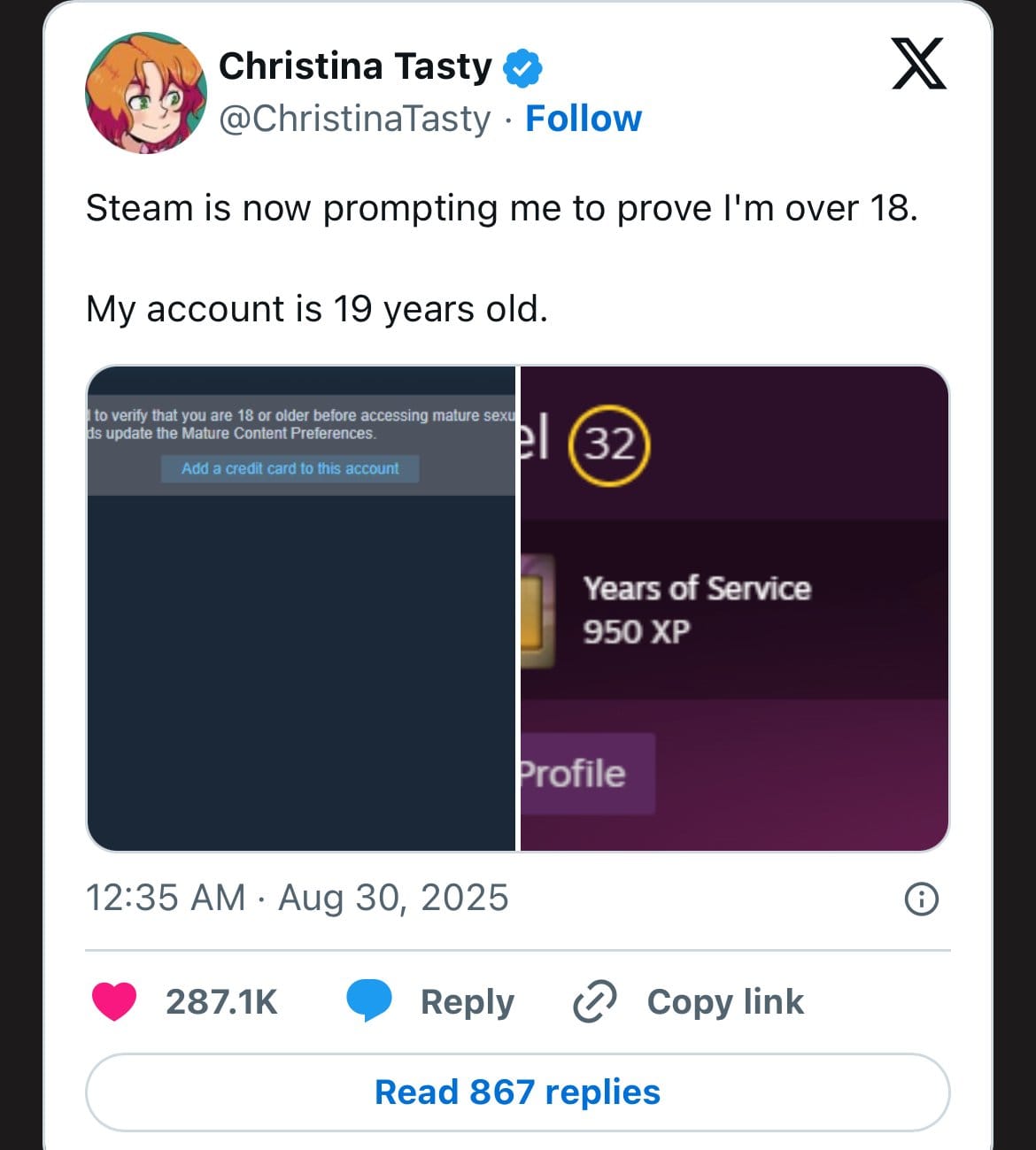
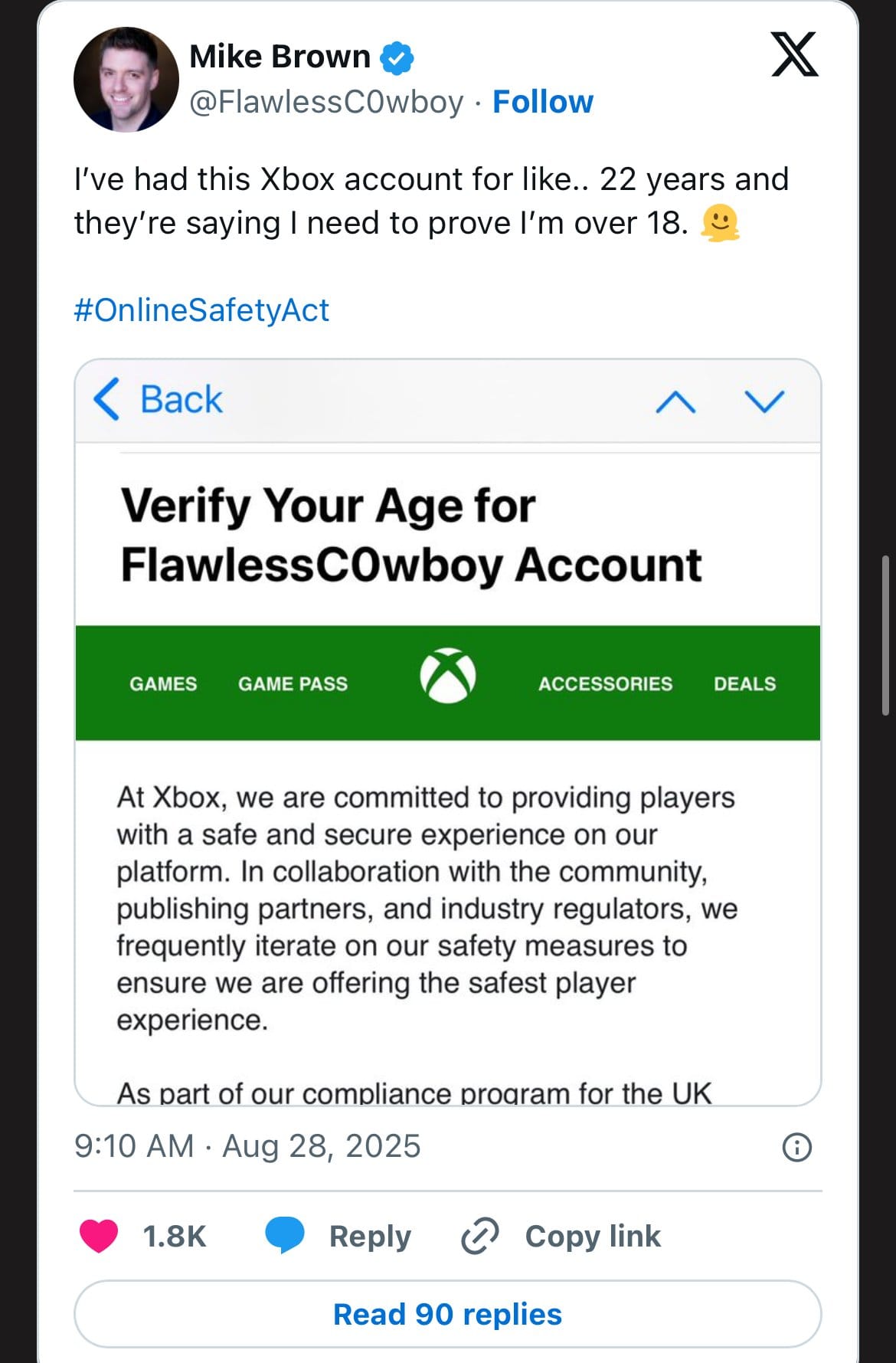
The impact has been immediate and dramatic. Steam now requires UK users to add a credit card to access mature games, while Xbox has implemented age verification for social features. VPN usage in the UK surged by over 6,400% shortly after the law’s enactment, highlighting user resistance.
Gaming platforms specifically affected include:
- Steam: Credit card requirement for mature content- Xbox: Age verification required for voice/text chat and game invites by early 2026- Discord: Age checks required for NSFW servers, even for server owners- Nexus Mods: Facial recognition scans required for adult content
Australia: The Social Media Trailblazer
Australia’s world-first social media ban for under-16s takes effect December 10, 2025, with penalties up to AUD $49.5 million for non-compliant platforms. While primarily targeting social media, the law has implications for gaming platforms with social features.
Key features include:
- No parental consent override - even with permission, under-16s cannot access restricted platforms- Broad platform coverage including YouTube (added in July 2025)- Gaming exemptions for online games and messaging apps
However, Australia’s own government report highlights concerns with selfie-based age verification, noting accuracy problems in a “grey zone” for users within three years of the 16-year age limit, with higher error rates for older adults, non-white users, and females.
United States: A Patchwork Approach
The US regulatory landscape is fragmented across federal and state levels:
Federal Developments
COPPA 2.0, reintroduced in March 2025 by Senators Markey and Cassidy, would expand privacy protections from under-13s to under-17s and ban targeted advertising to minors. The bill has strong bipartisan support and Google’s endorsement but has struggled to pass both chambers of Congress.
Meanwhile, the FTC unanimously agreed to amend the existing COPPA Rule in January 2025, with new requirements taking effect June 23, 2025.
TikTok’s Age Verification Crackdown: What Users Need to Know in 2025
State-Level Actions
By 2025, 19 states including Utah, Louisiana, Texas and Tennessee require age checks for online pornography or social media. This has created a complex compliance landscape where platforms may be blocked in some states but not others.
European Union: The Regulatory Powerhouse
The EU’s Digital Services Act, effective in 2024, explicitly pushes major online platforms to adopt age assurance measures to protect minors. France has been particularly aggressive, with its Age-Verification Decree 2024 leading to Pornhub, YouPorn and RedTube voluntarily geoblocking French users in June 2025.
The Gaming Industry’s Response
Platform-Specific Adaptations
Xbox/Microsoft: Beginning July 2025, UK players over 18 must verify their age to retain full access to social features like voice chat and game invites by early 2026. Microsoft offers multiple verification methods including government ID, age estimation, mobile provider checks, and credit card verification.
Steam/Valve: Valve has implemented a UK-only rule requiring a valid credit card on file to browse or buy mature games. This blunt but effective approach has drawn criticism for potentially excluding legitimate adult players who lack credit cards.
Gaming Companies’ Broader Strategy: Industry interviews reveal many games and XR studios remain notably unprepared, with most missing Ofcom’s mandatory risk assessment deadline and many waiting for additional guidance. However, this “wait and see” approach may prove costly.
Mississippi’s Age Verification Law and the Bluesky Standoff: A Critical Analysis
Technical Implementation Challenges
The gaming industry faces unique challenges in implementing age verification:
- Immersion vs. Friction: For games and XR studios, adding verification points may break immersion, which is crucial for user engagement and retention.2. Social Features Complexity: Multiplayer games with text or voice chat, user-generated content sharing, or VR communal spaces all fall under age verification requirements.3. Global Compliance: As Xbox noted, “there is no one-size-fits-all solution to player safety,” with methods needing to vary across regions.
The Technology Behind Age Verification
Current Methods
Age verification systems generally fall into three categories:
- Document Verification: Government-issued ID checks, including digital IDs2. Biometric Analysis: Facial recognition technology and AI-based systems that analyze hand movements, with some providers claiming 99% success rates3. Behavioral Indicators: Credit card verification, mobile provider checks, and usage pattern analysis
Emerging Solutions
Privacy-preserving methods like facial age estimation and zero-knowledge proofs are being developed to confirm users’ ages without storing sensitive data.
Technical Limitations
Early implementation has revealed significant flaws. Less than 24 hours after the UK Online Safety Act came into effect, users reportedly bypassed Discord’s age verification system using face capture from Death Stranding 2’s Photo Mode.
Industry and User Pushback
Privacy Concerns
VPN apps became the most downloaded on Apple’s App Store in the UK following age verification implementation, and a petition calling for the Online Safety Act’s repeal hit over 400,000 signatures.
Economic Impact
Age verification may significantly limit the number of esports fans since many viewers won’t have access to the actual games, potentially leading to industry stagnation.
Platform Responses
Some platforms have chosen withdrawal over compliance. Several adult content sites now block access where compliance tooling is absent, and many sites voluntarily geoblock users in certain jurisdictions.
The Business Model Impact
Advertising Revenue at Risk
COPPA 2.0 would ban targeted advertising to users under 17, potentially disrupting billions of dollars in revenue from platforms that rely on advertising to minors.
Compliance Costs
Compliance costs could be significant, with worst-case scenarios requiring companies to implement ID verification for all customers through government identification, credit cards, or biometric data.
Market Fragmentation
The patchwork of regulations across jurisdictions is creating market fragmentation, with platforms offering different features in different regions or withdrawing from markets entirely.
Looking Forward: What’s Next?
Regulatory Expansion
Countries like China and South Korea already require age verification for gaming, and some US states have begun requiring it for select websites, signaling that the United States may be next to consider this for online gaming platforms.
Industry Adaptation
The biggest way platforms can avoid losing users is to offer alternative options to ID verification, as many don’t feel comfortable providing personal documents to media companies.
Global Standardization
With coordinated EU guidance, landmark UK and US statutes, and fast-moving markets like Australia, 2025 will cement age verification as a baseline trust signal.
Xbox’s New Age Verification: A Gateway to Digital Censorship?
The Bottom Line
The tweets shown in the images—Christina Tasty’s 19-year-old Steam account requiring age verification and Mike Brown’s 22-year Xbox account facing the same requirement—represent just the tip of the iceberg. We’re witnessing the end of the honor system for age verification online.
For the gaming industry, this represents both a massive compliance challenge and an opportunity to lead in protecting young users. According to a 2024 Deloitte survey, almost half of gamers believe there’s too much bullying and harassment in multiplayer gaming communities, with more than half agreeing that publishers need to take more action.
The companies that adapt quickly and implement user-friendly, privacy-preserving age verification systems will likely gain competitive advantages. Those that resist or delay may find themselves locked out of major markets or facing significant penalties.
As one industry expert noted, “The clock is ticking—and ‘wait and see’ is no longer a compliant strategy.”
The age verification revolution is not coming—it’s here. The only question now is how quickly and effectively the industry will adapt.
The Global Age Verification Disaster: How Privacy Dies in the Name of “Safety”
This analysis is based on current regulatory developments through September 2025 and represents the rapidly evolving landscape of digital age verification requirements worldwide.