
Governments Worldwide Are Using Child Safety and Misinformation as Pretexts to Build Comprehensive Digital Surveillance and Censorship Systems
The internet as we know it is under a coordinated global assault. While public attention focuses on individual laws or isolated controversies, a sophisticated two-pronged attack on digital freedom is underway, using the seemingly unassailable justifications of “protecting children” and “fighting disinformation” to construct the most comprehensive surveillance and censorship apparatus in human history.
This isn’t mere policy coincidence. The simultaneous deployment of child safety legislation and anti-misinformation campaigns across multiple democracies represents a coordinated strategy to dismantle digital rights while maintaining the facade of democratic governance. By examining both tracks of this assault—and how they reinforce each other—we can see the true scope of what amounts to the end of the free internet.
Dutch Regulator Pressures Big Tech on ‘Disinformation’ Ahead of October Election
The Theater of Digital Safety
As we’ve previously documented in The Digital Safety Theater: How Child Protection Became the Trojan Horse for Global Surveillance, the “protect the children” narrative has become the most effective tool for implementing authoritarian digital controls in democratic societies.
The formula is devastatingly simple: identify a genuine problem affecting children online, propose sweeping legislation that goes far beyond addressing that problem, then label anyone who objects as being “against child safety.” It’s a rhetorical trap that has proven nearly impossible for civil liberties advocates to escape.
But child safety theater is just one prong of the assault. Running parallel—and increasingly intertwined—is the “disinformation” censorship campaign that we’ve analyzed across multiple countries. Together, these two narratives create an almost impenetrable justification for total digital control.
The Disinformation Censorship Machine
Our recent analysis of The Global “Disinformation” Censorship Campaign revealed how governments worldwide are using deliberately vague definitions of “misinformation” and “disinformation” to implement comprehensive speech controls. From Ireland’s system that ignores 83% public opposition to the Dutch election manipulation apparatus, these campaigns share striking similarities that suggest coordination.
Similarly, our coverage of Ireland’s Digital Surveillance State and the Dutch Regulator’s Election Pressure Campaign shows how these censorship systems are deployed during critical democratic moments to control what voters can see and discuss.
The Child Safety Surveillance Network
Parallel to the disinformation campaigns, an equally comprehensive surveillance system is being constructed under the banner of child protection. The scope of this assault is staggering:
Telegram CEO’s Arrest: A Geopolitical and Economic Powder Keg
The Age Verification Disaster
The Global Age Verification Disaster: How Privacy Dies in the Name of Safety documents how mandatory age verification systems are destroying online anonymity while creating massive databases of personal information ripe for government exploitation and criminal hacking.
These systems, deployed from the UK to Louisiana, require users to submit government identification, biometric data, or other sensitive personal information merely to access legal content online. The result is the death of anonymous speech—a cornerstone of democratic discourse for centuries.
The UK’s Comprehensive Control System
Britain’s Online Safety Act represents the most sophisticated fusion of child safety rhetoric and comprehensive digital control. As detailed in Digital Compliance Alert: UK Online Safety Act and EU Digital Services Act Cross-Border Impact Analysis, the UK system creates global compliance requirements that extend British censorship worldwide.
The act’s child safety provisions serve as the primary public justification, while the actual surveillance and censorship capabilities far exceed anything necessary for protecting minors. Age verification requirements, content scanning mandates, and algorithmic control systems create a comprehensive apparatus for monitoring and controlling all digital communication.
The EU’s Chat Scanning Surveillance
Perhaps most alarmingly, The EU Could Be Scanning Your Chats by October 2025: Here’s Everything We Know reveals how European authorities plan to implement mass scanning of private communications under the pretext of detecting child abuse material.
This system would represent the end of private digital communication in Europe, with algorithms scanning every message, image, and video before delivery. The child protection justification makes opposition politically toxic, despite the obvious implications for dissidents, journalists, and anyone seeking to communicate privately.
The European Digital Identity Crackdown
The coordination extends beyond individual countries. The European Digital Identity Crackdown: How Five EU Countries Are Following the UK’s Censorship Playbook shows how child safety rhetoric is being used to implement mandatory digital identity systems across Europe.
Ireland’s Digital Surveillance Revolution: Government Moves to Monitor All Private Communications
These systems create permanent digital tracking of all online activity while destroying the possibility of anonymous speech. Once again, child protection provides the seemingly unassailable justification for implementing infrastructure that serves broader surveillance and control purposes.
The American Laboratory: KOSA and Beyond
The United States has become a testing ground for both tracks of the assault, with legislators deploying both child safety and anti-misinformation rhetoric to advance sweeping digital control legislation.
The Screen Act: Mass Surveillance in the Name of Screen Time
The Screen Act: How Protecting Children Became the Trojan Horse for Mass Digital Surveillance reveals how concerns about children’s screen time are being weaponized to implement comprehensive monitoring of all family digital activity.
The proposed legislation would require platforms to track and report detailed information about user behavior, creating vast databases of personal information under the guise of helping parents manage their children’s technology use.
The Deepfake Legislation Complex
A series of bills targeting deepfakes and AI-generated content demonstrates how legitimate concerns about technology abuse are being used to create broader censorship frameworks:
- Rep. Nancy Mace’s RESPECT Act: Strengthening Federal Response to Deepfakes and Revenge Porn- The Take It Down Act: America’s First Federal Law Against Deepfakes and Revenge Porn
While these bills address real harms, their broad definitions of prohibited content and enforcement mechanisms create infrastructure that can easily be expanded to suppress political speech and dissent.
The Louisiana Battlefield: Where Both Campaigns Converge
Louisiana has become a crucial battleground where both tracks of the digital freedom assault are visible simultaneously, providing insight into how child safety and anti-disinformation campaigns reinforce each other.
The Age Verification War
Louisiana Attorney General Liz Murrill has emerged as a key figure in the child safety surveillance campaign, implementing one of the most aggressive age verification systems in the United States. The state’s law requires social media platforms to verify users’ ages and obtain parental consent for minors—creating vast databases of personal information and destroying anonymous access to digital platforms.
NetChoice, representing major tech companies, has filed multiple lawsuits challenging these requirements on First Amendment grounds. The legal battle reveals the fundamental tension between child safety rhetoric and constitutional rights.
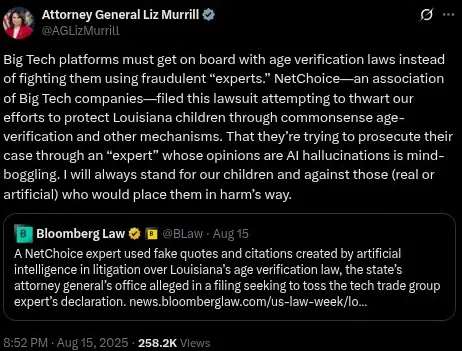
In a devastating blow to the age verification campaign, Louisiana officials discovered that NetChoice’s expert witness used AI-generated fake quotes and citations in his testimony opposing the state’s law. Attorney General Murrill stated: “That they’re trying to prosecute their case through an ‘expert’ whose opinions are AI hallucinations is mind-boggling.”
This scandal reveals the desperation of tech companies to find credible opposition to child safety legislation, while simultaneously demonstrating how the seemingly unassailable nature of “protecting children” makes meaningful opposition nearly impossible.
The Roblox Controversy
The complexity of these issues is further illustrated by Louisiana’s lawsuit against Roblox, the popular gaming platform. As we documented in The 2025 RealSchlep vs. Roblox Controversy: A Deep Dive, the platform has become a focal point for debates about child safety online.
Attorney General Murrill’s lawsuit alleges that Roblox has become “a breeding ground for sex predators” and “prioritizes user growth, revenue, and profits over child safety.” The case highlights genuine child safety concerns while also demonstrating how these concerns are being weaponized to demand comprehensive surveillance and control systems.
The Roblox controversy illustrates the impossible position facing platforms: implement comprehensive surveillance and age verification systems that destroy user privacy, or face accusations of enabling child exploitation.
How the Two Campaigns Reinforce Each Other
The genius of this dual assault lies in how child safety and anti-disinformation campaigns reinforce each other, creating multiple justifications for the same surveillance and censorship infrastructure:
Shared Technical Infrastructure
Both campaigns require the same underlying surveillance capabilities:
- Mass data collection to identify users and track behavior- Content scanning algorithms to detect prohibited material- Real-time monitoring to enable rapid response to “threats”- Cross-platform coordination to track users across services
Mutually Supporting Rhetoric
When critics challenge child safety legislation, supporters invoke anti-disinformation themes: opposition must be “foreign interference” or “misinformation campaigns.” When critics challenge anti-disinformation measures, supporters invoke child safety: critics must want to enable “hate speech” that “harms children.”
Complementary Legal Frameworks
Child safety laws create the surveillance infrastructure, while anti-disinformation regulations provide the content control mechanisms. Together, they create comprehensive systems for monitoring and controlling all digital communication.
Coordinated Implementation
The simultaneous deployment of both types of legislation across multiple jurisdictions suggests coordination. Countries implement child safety measures while their neighbors focus on anti-disinformation, creating a global network of mutually supporting surveillance systems.
The Global Coordination Evidence
The evidence for coordination in this dual assault is overwhelming:
Shared Timeline
- 2023: UK Online Safety Act passed, Ireland begins disinformation strategy- 2024: EU Digital Services Act enforcement begins, multiple countries implement age verification- 2025: Coordinated push for chat scanning, election censorship campaigns, expanded age verification
Common Language
Legislation across different countries uses remarkably similar language, suggesting shared drafting sources or coordination mechanisms.
Technical Standards
Age verification and content scanning systems require technical standards that are being developed through international coordination, creating global surveillance infrastructure.
Enforcement Cooperation
Regulators across different countries are increasingly coordinating enforcement actions, sharing information, and developing joint strategies for controlling digital platforms.
The Authoritarian End Game
The ultimate goal of this dual assault is the creation of a global digital environment where:
All Communication Is Monitored
Through the combination of age verification requirements, content scanning systems, and anti-disinformation monitoring, every digital communication becomes subject to government surveillance.
Anonymous Speech Is Eliminated
Child safety rhetoric justifies mandatory identity verification, while anti-disinformation campaigns provide the enforcement mechanisms to track and punish anonymous critics.
Dissent Is Automatically Suppressed
AI systems trained to detect “harmful content” and “disinformation” will automatically suppress political opposition before it can gain traction.
Democratic Accountability Is Bypassed
Both child safety and anti-disinformation measures are implemented through “independent” regulators and “expert” agencies, removing democratic control over fundamental rights.
The Resistance Strategies
Understanding this dual assault as a coordinated campaign reveals more effective resistance strategies:
Expose the Coordination
Rather than fighting individual pieces of legislation, expose the global pattern and coordinated nature of the assault.
Challenge the Rhetorical Traps
Develop messaging that supports genuine child safety while opposing surveillance systems that enable broader authoritarian control.
Build Technical Alternatives
Support the development of decentralized, privacy-preserving technologies that resist both surveillance and censorship.
International Coordination
Coordinate resistance efforts across borders to match the global coordination of the assault.
Legal Challenges
Mount constitutional challenges that address both child safety and anti-disinformation measures as parts of a broader assault on fundamental rights.
The Stakes Could Not Be Higher
This dual assault represents nothing less than the end of the free internet and the beginning of a new era of digital authoritarianism. The sophisticated use of child safety and anti-disinformation rhetoric makes opposition politically toxic while providing cover for the most comprehensive surveillance system ever constructed.
The window for resistance is rapidly closing. Once these systems are fully implemented and the surveillance infrastructure is in place, dismantling it will become exponentially more difficult. The governments implementing these systems understand this timing, which explains the coordinated rush to implement both tracks simultaneously.
🎧 Related Podcast Episode
Conclusion: The Choice We Face
The dual assault of child safety surveillance and anti-disinformation censorship represents a sophisticated strategy for implementing digital authoritarianism while maintaining the facade of democratic governance. By using seemingly unassailable justifications—protecting children and fighting false information—governments worldwide are constructing comprehensive systems for monitoring and controlling all digital communication.
The coordination evident in this campaign—from the shared timeline and common language to the mutually reinforcing technical standards—reveals that this is not a collection of isolated policy initiatives but a coordinated global strategy to end internet freedom as we know it.
The choice facing free societies is stark: recognize this dual assault for what it is and mount coordinated resistance, or accept the transition to a world where all digital communication is monitored, where anonymous speech is impossible, and where dissent is automatically suppressed by AI systems trained to detect “harmful” content.
The internet was supposed to be humanity’s greatest tool for freedom, communication, and democratic participation. Instead, it is becoming the most sophisticated instrument of social control ever created. Whether it remains a tool for liberation or becomes the foundation for a new form of authoritarianism depends on our ability to see through the rhetorical smokescreens of child safety and anti-disinformation and recognize the coordinated assault on digital freedom for what it truly is.
The fight for the future of human liberty is happening now, and it is happening online. The outcome will determine whether future generations inherit digital tools for freedom or digital chains for control.