
In an era where digital privacy seems increasingly elusive, security questions remain one of the most widely used authentication methods across the internet. Banks, email providers, social media platforms, and countless other services rely on these supposedly “secret” personal details to verify identity and reset passwords. Yet for public figures and high-net-worth individuals, these questions have become a dangerous illusion of security—one that can be shattered with nothing more than a few strategic web searches.
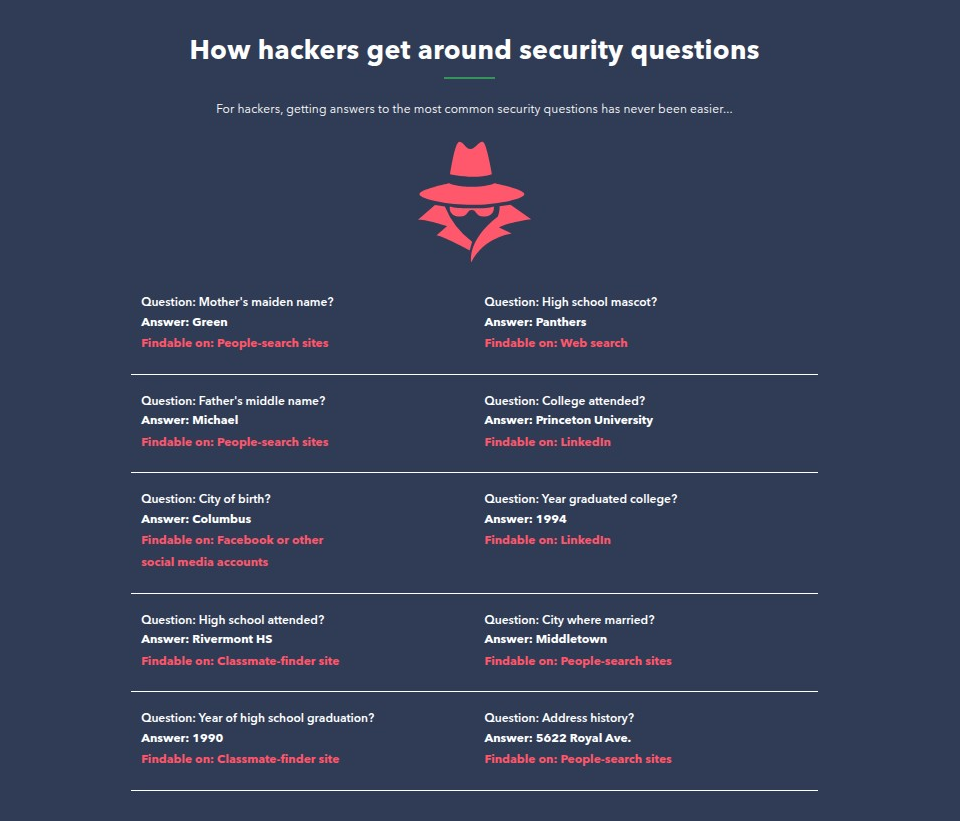 source: https://www.netreputation.com/internet-privacy/
The Mythology of Secret Information
The concept behind security questions seemed foolproof when first introduced: use personal information so intimate and specific that only the account holder would know it. Questions about a mother’s maiden name, childhood pets, or first schools were designed to tap into memories too personal and obscure to be publicly available.
This assumption has proven catastrophically wrong in the digital age.
The Data Broker Ecosystem
Today’s information landscape is dominated by an intricate web of data brokers—companies that collect, aggregate, and sell personal information on a massive scale. These entities operate largely in the shadows, harvesting data from public records, social media platforms, purchase histories, and countless other sources to build comprehensive profiles on virtually every adult in America.
For the average person, this creates privacy concerns. For public figures and wealthy individuals, it creates genuine security vulnerabilities.
People-search sites like Whitepages, Spokeo, and BeenVerified can instantly reveal:
- Full family trees with maiden names- Historical addresses spanning decades- Marriage records with dates and locations- Property ownership information- Phone numbers and email addresses
These platforms often aggregate information from public records, voter registrations, property deeds, and court filings—all technically public information, but now searchable and cross-referenced with unprecedented ease.
Social Media: The Voluntary Information Highway
While data brokers compile information from various sources, social media platforms represent perhaps the most dangerous voluntary disclosure of personal details. LinkedIn profiles routinely contain educational history, graduation years, and career timelines. Facebook and Instagram posts reveal birthplaces, wedding locations, and family relationships.
High-profile individuals face a particularly acute version of this challenge. Their professional achievements, educational backgrounds, and personal milestones are often matters of public interest, reported in news articles, press releases, and biographical summaries that remain searchable indefinitely.
The High-Stakes Target
Public figures face unique vulnerabilities because their personal information often exists in multiple public domains:
- News articles documenting their background and achievements- Corporate filings listing educational credentials and career history- Speaking engagement biographies revealing personal details- Social media presence (often managed by staff who may not consider security implications)
High-net-worth individuals present attractive targets because:
- Their financial accounts and investments represent significant value- They often have complex digital footprints across multiple institutions- Their personal information may be documented in business contexts- They frequently use wealth management services that rely heavily on knowledge-based authentication
Case Study: The Anatomy of an Attack
Consider a hypothetical but realistic scenario involving a prominent business executive. Within minutes of targeted searching, an attacker could potentially discover:
From LinkedIn: College attended, graduation year, current and previous employers From news articles: Birthplace, family background, educational achievements From property records: Current and historical addresses, family members From social media: High school information, family relationships, personal interests From corporate filings: Professional history, board memberships
Armed with this information, the attacker could potentially answer most standard security questions and gain access to email accounts, financial services, or other sensitive systems.
The Search Engine Amplification Effect
Modern search engines have become incredibly sophisticated at connecting disparate pieces of information. A simple search combining someone’s name with terms like “biography,” “education,” or “background” can quickly surface detailed personal information from multiple sources.
Google’s advanced search operators allow for even more targeted information gathering, while specialized search engines and databases provide access to public records, court filings, and professional directories that might not appear in standard search results.
Identity Threat Detection Calculator | Assess Your Risk
Beyond Individual Vulnerability
The implications extend beyond individual account security. When high-profile individuals or executives have their accounts compromised, the consequences can include:
- Corporate espionage and insider trading- Reputational damage and public embarrassment- Access to sensitive business communications- Compromise of family members’ security and privacy- Potential for sophisticated social engineering attacks against associates
The Institutional Response Gap
Many financial institutions and service providers continue to rely heavily on knowledge-based authentication, despite growing awareness of its vulnerabilities. The challenge lies in balancing security with user convenience—more secure authentication methods often create friction that organizations are reluctant to impose on their customers.
Some progressive institutions have begun moving toward multi-factor authentication, biometric verification, and behavioral analysis. However, the transition has been slow, leaving many high-value targets vulnerable to attacks that exploit publicly available information.
Defensive Strategies
For high-profile individuals and those with significant digital assets, several defensive approaches can help mitigate these risks:
Information Audit: Regularly search for your own information online to understand your digital footprint and identify potential vulnerabilities.
Security Question Strategy: When possible, use fictional answers to security questions rather than truthful ones, and store these answers securely.
Multi-Factor Authentication: Enable additional authentication methods wherever available, reducing reliance on knowledge-based verification alone.
Privacy Services: Consider professional privacy protection services that can help remove or suppress publicly available personal information.
Social Media Discipline: Implement strict policies around what personal information appears in public profiles and posts.
Social Media Risk Assessment Tool
The Broader Implications
The ease with which personal information can be weaponized against security questions represents a fundamental breakdown in one of the internet’s most basic security assumptions. As data collection becomes more sophisticated and public information more accessible, the traditional model of knowledge-based authentication becomes increasingly obsolete.
This trend reflects broader challenges in digital privacy and security. The same technologies and data practices that enable personalized services and convenient digital experiences also create new vulnerabilities that disproportionately affect high-profile individuals and those with significant assets at risk.
Looking Forward
The security question vulnerability illustrates why cybersecurity cannot be treated as a purely technical challenge. It requires understanding the broader information ecosystem, including data brokers, social media dynamics, and the persistent nature of digital information.
For organizations serving high-value clients, the message is clear: knowledge-based authentication alone is no longer sufficient. The combination of sophisticated data aggregation and easily accessible search tools has fundamentally altered the threat landscape.
Creator Security Check | Privacy Assessment for Content Creators
As we move forward, the most effective security strategies will be those that acknowledge this new reality and implement multiple layers of protection that don’t rely on the increasingly fragile assumption that personal information can remain secret in our interconnected digital world.
The age of security questions may not be over, but their role as a primary defense mechanism should be reconsidered in light of how dramatically the information landscape has evolved. For those with the most to lose, the time for that reconsideration is now.