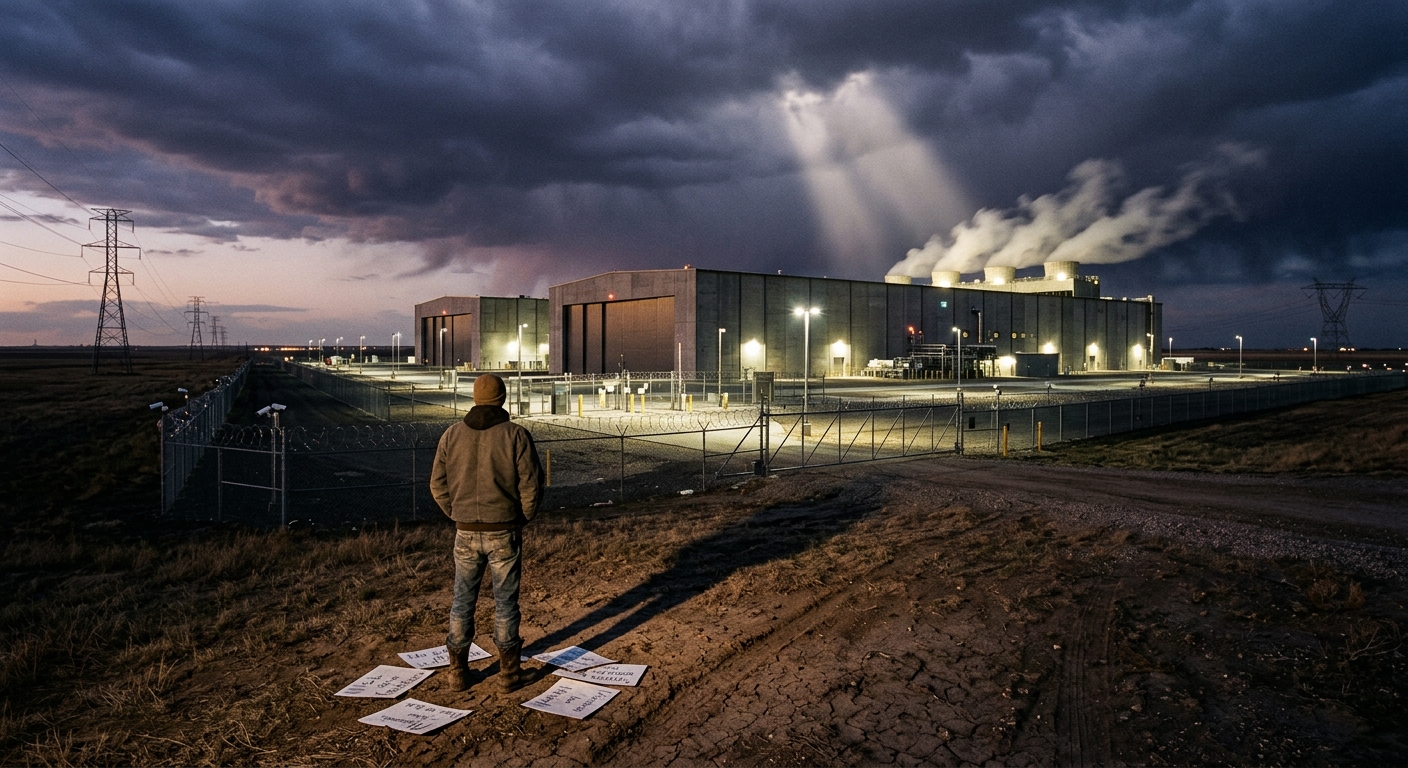
There is a number making the rounds this spring, and it is worth pausing on before it hardens into a talking point. More than seventy-five new data-center projects, the story goes, worth upward of $130 billion, are being rolled out across American cities as part of a federal push to win the AI era. It is a clean, confident figure, the kind that fits in a press release and a campaign slide alike.
The trouble is that the same number turns up in a very different ledger. According to a report from Data Center Watch covered by NBC News and others, opponents blocked or delayed at least seventy-five data-center projects worth roughly $130 billion in the first quarter of 2026 alone, the most disruption in any three-month period since the group began tracking in 2023. The number of active anti-data-center groups more than doubled, from around 396 at the end of 2025 to 833 by March, spread across 49 states. The buildout and the backlash have, almost poetically, converged on the same scale.
So the honest version of the story is not “America is building $130 billion of AI infrastructure.” It is “America is fighting, town by town, over $130 billion of it.” And that fight is not only about electricity bills and reservoir levels, though it is certainly about those. It is about who gets to decide where the country’s machinery of inference and surveillance physically lives.
The federal hand on the scale
The buildout is real, and it is being actively accelerated from the top. In July 2025, the White House issued an executive order titled “Accelerating Federal Permitting of Data Center Infrastructure,” declaring it an administration priority to “facilitate the rapid and efficient buildout” of data centers. The order reaches projects that draw more than 100 megawatts of new electrical load, cost at least $500 million, or are deemed important to national security, and it opens federally owned land for their construction while streamlining the environmental review that normally slows such things down.
Underneath that policy sits an extraordinary private spend. OpenAI’s Stargate program, with Oracle and SoftBank, is a half-trillion-dollar undertaking; its flagship campus in Abilene, Texas is partway built, with new sites announced in Doña Ana County, New Mexico, and elsewhere. Microsoft is pouring more than $7 billion into a campus in Mount Pleasant, Wisconsin. Meta has floated a Louisiana facility that could eventually scale to five gigawatts. xAI is building “Colossus 2” in Memphis, chasing a million GPUs inside and around a converted factory. Analysts now put combined 2026 capital expenditure for Amazon, Alphabet, Meta, and Microsoft in the neighborhood of $700 billion. The federal order does not pay for this; it clears the path.
What the executive order does, in effect, is treat the speed of construction as a public good and the friction of local democracy as an obstacle. That framing should give privacy-minded readers pause, because the same logic, “this is too important to slow down for your objections,” is the logic that has justified every surveillance expansion of the past two decades.
What actually lives in these buildings
It is easy to talk about data centers as if they were neutral warehouses of electricity and heat. They are not. They are where the training happens, and where the inference happens, which means they are where the data is.
The models being trained in Abilene and Memphis and Mount Pleasant are trained on scraped text, images, voices, and behavior, much of it ours, gathered with consent that ranges from grudging to fictional. And once deployed, these same facilities process the live stream of what people type into chatbots, dictate to assistants, and feed into enterprise tools: medical questions, legal worries, the unguarded queries people would never say aloud to another human. A data center is not just compute. It is a place where the most intimate exhaust of modern life is concentrated, copied, logged, and retained.
Concentration is the privacy story here. For most of the internet’s history, surveillance was distributed and messy. The current buildout is a deliberate centralization of compute into a handful of corporate campuses, increasingly sited on federal land under federal priority. When the processing of a nation’s thoughts converges on a small number of sites owned by a small number of firms, operating under expedited national-security framing, the distance between “AI infrastructure” and “surveillance infrastructure” narrows to almost nothing. The pipes that train a chatbot are the pipes that could, with a subpoena or a quiet arrangement, feed something else.
The water, the grid, and the politics they create
The local opposition has not, for the most part, organized around civil liberties. It has organized around water and power, and those grievances are well founded. Large facilities can consume millions of gallons of water a day for cooling, and researchers have found that a striking share of new U.S. data centers are being built in water-stressed regions. Electricity demand from data centers is projected to climb steeply through the decade, and residents in several states have watched utility rates rise as the grid strains to feed campuses that arrived with tax breaks and left bills behind. In Memphis, xAI’s gas turbines drew air-quality complaints from neighbors who never agreed to host a supercomputer.
This is where the privacy angle and the environmental one quietly merge. More than 300 data-center bills were introduced in statehouses in the opening weeks of 2026, and lawmakers in fourteen states floated outright moratoriums, on both sides of the aisle. That legislative energy is, for now, aimed at meters and aquifers. But the same bills create something privacy advocates have long lacked: a lever. A community that can demand disclosure of a facility’s water draw can, in principle, demand disclosure of what it processes, who can access it, and under what legal authority. The fight over land is becoming the only venue where ordinary people get a say over the surveillance apparatus at all.
The decision being made for us
The federal posture is that this infrastructure is too strategically vital to be slowed by local objection. Perhaps the compute race genuinely matters. But “too important to question” is not a standard that has historically protected privacy; it is the standard that has eroded it. When environmental review is compressed, the public-comment process that might also surface data-governance concerns gets compressed along with it.
The convergence of those two $130 billion figures is the real headline. One represents what the state and the hyperscalers intend to build. The other represents how many of their fellow citizens are saying, through the only channels available, not here, not like this, not without answers. The machines have to live somewhere physical, and for now that physical somewhere is still subject to a permit, a vote, a hearing. That may be the last point of leverage we have before the country’s thinking, and a great deal of its watching, is poured permanently into concrete.
Sources: NBC News on the Data Center Watch report; Tom’s Hardware; The White House executive order; CNBC on Stargate; Tom’s Hardware on Big Tech capex; World Resources Institute on community impacts.