In Washington, the surest way to pass something controversial is to wrap it in something nobody can vote against. In June 2026, House Energy and Commerce leaders Brett Guthrie and Frank Pallone did exactly that, consolidating the Kids Online Safety Act, the Children and Teens’ Online Privacy Protection Act (COPPA 2.0), a new data-broker registry, and more than a dozen additional child-safety measures into a single mega-bill: the Kids Internet and Digital Safety Act, mercifully shortened to the KIDS Act. The branding is impeccable. The contents are where the trouble lives.
What got dropped, and what got added
Two changes in the House deal tell you most of what you need to know about where this legislation is heading.
The first is a subtraction. The original KOSA was defined by its “duty of care” — a requirement that platforms take reasonable steps to prevent specific, documented harms to minors, such as the promotion of eating disorders, self-harm, substance abuse, and sexual exploitation. The House package strips that duty of care out. Senate sponsors were furious; Senator Richard Blumenthal called the omission “a blank check to Mark Zuckerberg,” and Senator Marsha Blackburn warned that “tech companies will maintain the status quo of putting profit before the safety of our children.” Whatever one thinks of the duty-of-care concept, its removal means the bill’s most substantive obligation on platform behavior is gone.
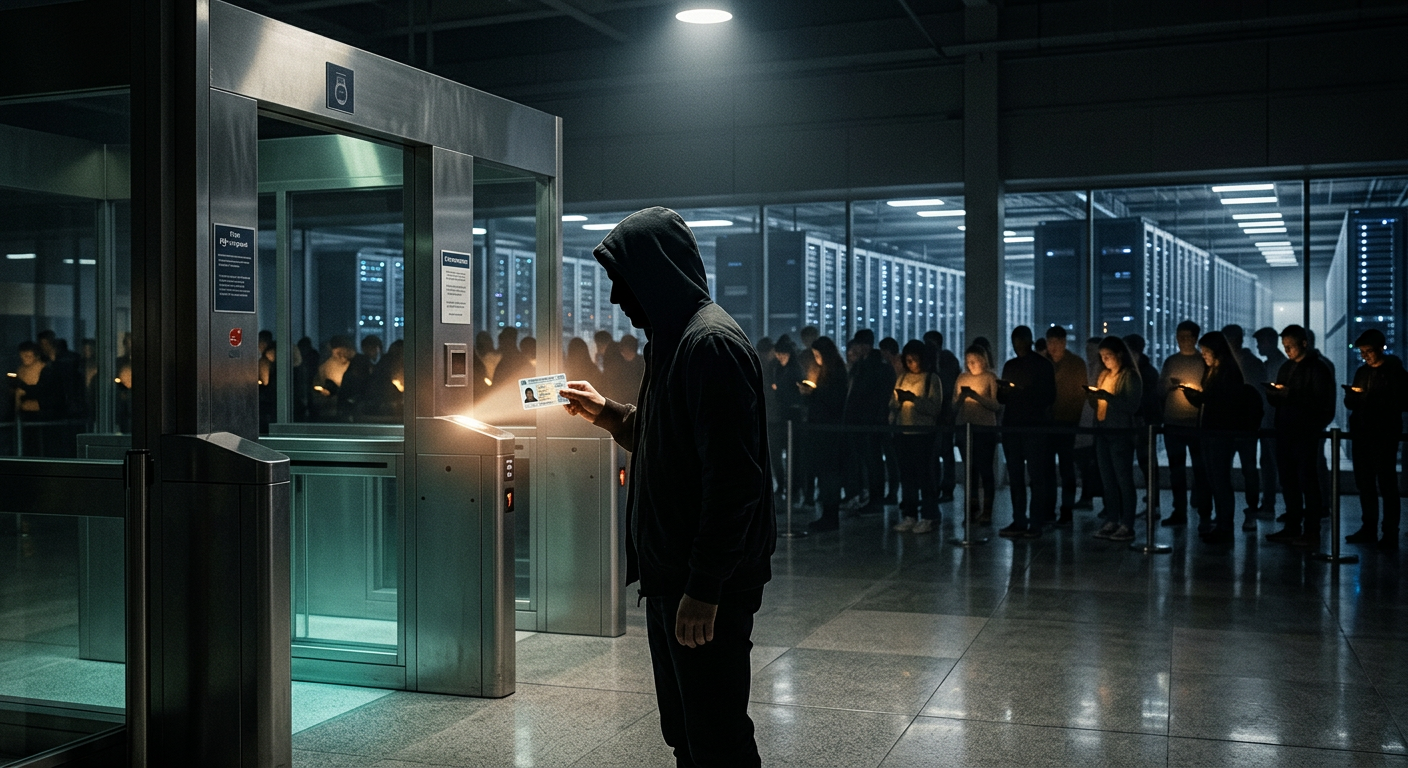
The second is an addition. In place of the duty of care, the bill leans harder into mandatory age verification. As the Electronic Frontier Foundation bluntly summarized it, the KIDS Act “would require age checks to get online.” The practical translation: every adult on a covered platform may need to hand a government ID to a third-party verification company in order to prove they are not a child. The bill also adds age-verification requirements for sexually explicit websites, bans minors from disappearing-message features, and requires AI chatbots to disclose to children that they are not human.
The anonymity tax
Here is the move that should worry anyone who cares about the open internet, regardless of their politics. To enforce rules about what children can do online, the bill makes the entire adult population prove its age. You cannot verify that a user is over 17 without collecting enough information to establish their identity or scan their face. The protection is aimed at minors; the cost is borne by everyone.
This is what we have called the anonymity tax, and the KIDS Act would impose it nationwide. Anonymous and pseudonymous speech is not a loophole — it is a load-bearing feature of American civic life, protected by a long line of First Amendment cases precisely because forcing people to attach their legal identity to their speech chills that speech. A whistleblower, an abuse survivor, a teenager exploring their identity, an immigrant wary of authorities, a critic of a powerful institution — all of them lose something concrete the moment “show ID to participate” becomes the law of the land.
The data nobody asked to create
Mandatory verification doesn’t just check IDs; it manufactures a permanent record. Every age-check creates a data point linking a real human being to the specific platforms they use. Multiply that across hundreds of millions of users and you have built, by statute, a map of American online life that no surveillance agency could have lawfully assembled on its own.
The third-party verification companies that would sit at this chokepoint become some of the most attractive breach targets imaginable — repositories of government IDs, faces, and browsing associations. We have written, over and over, about what happens to honeypots like these. They get breached. They get subpoenaed. They get repurposed. The KIDS Act’s age-verification regime would not be a one-time inconvenience; it would be a standing infrastructure of identity surveillance bolted onto the front door of the internet.
A rare cross-spectrum alarm
What makes this moment notable is who is objecting. Digital rights organizations like the EFF oppose the age-verification mandate on civil-liberties grounds. Some of the bill’s own Senate champions oppose the House version for gutting child protections. Free-speech advocates, privacy engineers, and even some safety groups have converged on the same uncomfortable conclusion: the House compromise manages to be simultaneously weaker on actual platform accountability and stronger on mass surveillance. It is the worst of both trades — less protection for kids, more identity verification for everyone.
Where it goes from here
The bill now faces a Senate fight, and the gap between the chambers is real. But the direction of travel is unmistakable, and it mirrors what is already happening in the UK, Australia, and across U.S. states: a hardening consensus that access to ordinary online life should be conditioned on proving who you are. Each individual law is justified by an unimpeachable goal. Stacked together, they amount to the quiet end of the anonymous internet.
The KIDS Act will be debated as a children’s bill, because that is how it was designed to be debated. But the question every adult should be asking is simpler and more personal: are you prepared to show your papers every time you want to speak online? Because that, stripped of the branding, is what is on the table.