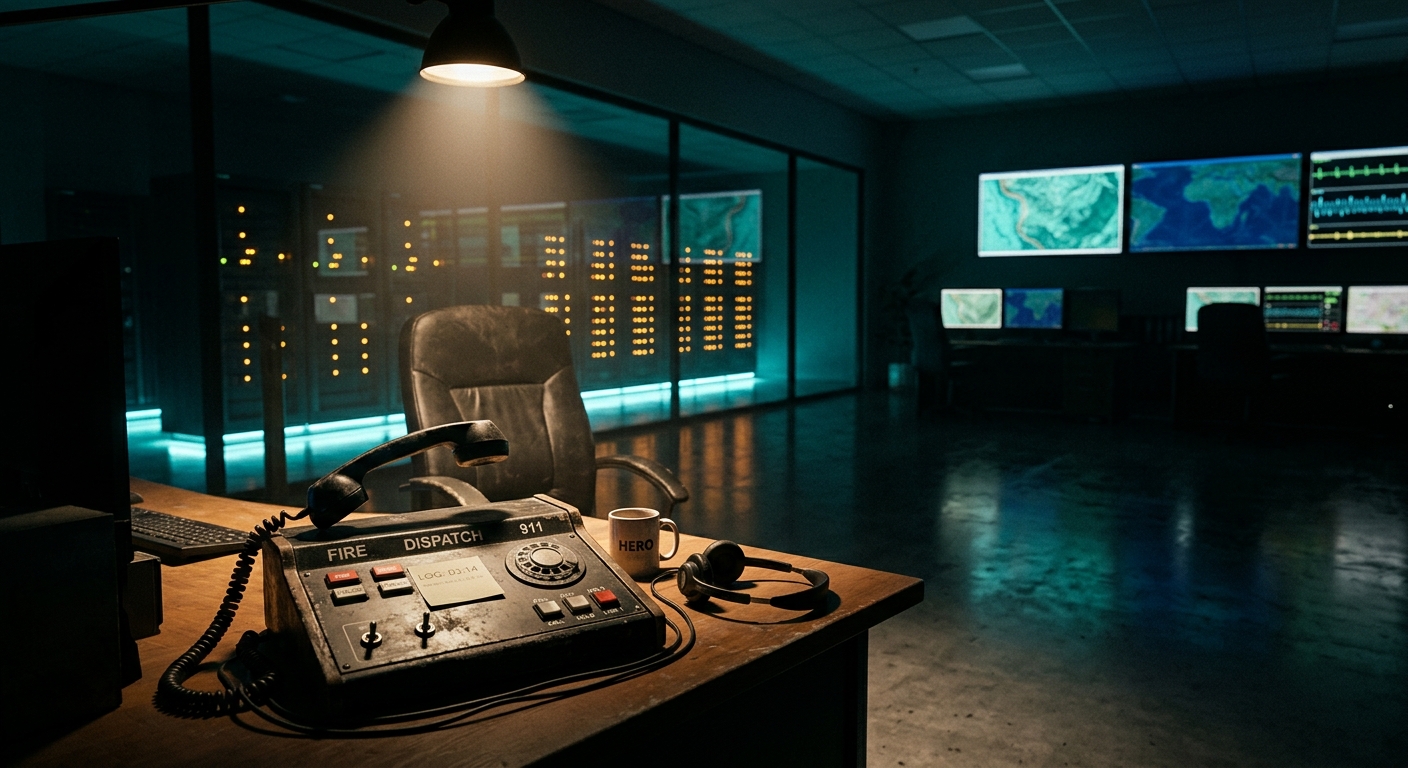
You dial 911. Someone picks up. You describe the worst thing happening to you today, at speed, with the details you would tell nobody else — your address, who is in the house, what is wrong with your body, what someone is doing to you.
In New Orleans, since 2023, the first voice on that line has sometimes been an automated agent. Callers were not notified. The city confirmed it in August 2026, three years in.
In Seattle, callers to 911 medical lines are not told their calls are being monitored and analysed by AI. In Long Beach, a new AI programme reviews dispatch calls and scores how the dispatcher handled them.
None of this is illegal. That is the problem.
What AI Is Actually Doing in 911 Centres
The deployments fall into four broad categories, and they carry very different risks.
Call diversion and triage. Non-emergency calls — a noise complaint, a parking issue, a report filed for insurance — are routed to an automated agent or a different queue. This is where the operational case is strongest. Public safety answering points are chronically understaffed; a large share of 911 traffic is non-emergency; a dispatcher freed from a parking complaint is available for a cardiac arrest.
Live analysis of calls in progress. Speech-to-text, keyword and sentiment detection, automated flagging of indicators the model associates with particular emergency types. This is what Seattle is doing on medical calls.
Post-hoc review and dispatcher scoring. Systems that grade recorded calls on professionalism, tone, follow-up questions, and judgment. This is workplace surveillance of dispatchers that runs on recordings of civilians in crisis.
Aggregation and prediction. Platforms that acquire 911 call centre data to build geospatial heat maps predicting incident trends. This is the category where the data leaves the emergency response context entirely.
Why the Absence of Disclosure Matters More Here
The standard objection to any AI disclosure requirement is that it is a formality — you would have used the service anyway, so what did the notice buy you?
Emergency calls break that argument in four ways.
Consent is structurally impossible. You cannot shop for a different 911. There is one number, it is a monopoly, and you call it at the worst moment of your life. Every other consent framework in privacy law assumes an alternative exists. Here there is none, which is precisely why the disclosure obligation should be higher, not waived as pointless.
The data is the most sensitive category there is. A single 911 call routinely contains health information, precise location, household composition, immigration-relevant details, mental health status, and evidence of crime — including crimes the caller is describing about themselves. HIPAA does not cover a 911 centre. State wiretap and recording statutes were written for recording by humans, not analysis by models.
Accuracy failures are fatal, not annoying. A misrouted support ticket is a bad afternoon. A misclassified emergency is a death. And the error distribution will not be uniform: speech recognition systems have documented, repeatedly measured accuracy gaps across accents, dialects, non-native speakers, and speakers in acute distress — which is the entire population of a 911 line. The people most likely to be misheard are the people already least well served.
It is chilling in the one place chilling effects kill. If people believe an AI is listening, logging, and feeding a database that may reach other agencies, some of them will not call. Undocumented residents, people with warrants, people in domestic violence situations, people who use drugs. Hesitation measured in minutes is the difference between an overdose reversal and a fatality.
The Public Is Already Suspicious
The survey data on this is striking. 81% of Americans believe AI is being used on them secretly, and about six in ten are specifically worried it is shaping sensitive interactions in banking, healthcare, and emergency services. A 2025 survey found 16% of Americans already believed 911 calls were being answered by AI instead of live dispatchers without disclosure.
New Orleans confirms that the 16% were right. Which means the trust cost of these deployments has already been incurred — the suspicion existed before the confirmation, and the confirmation validates it. Agencies deploying quietly to avoid alarming the public have achieved the alarm without the benefit of having been honest first.
The Regulatory Vacuum
There is no federal standard requiring a 911 centre to disclose AI involvement in handling a call. There is no FCC rule, no DOJ guidance conditioning grant funding on disclosure, no NENA standard with force of law.
State AI legislation is moving fast in 2026 — algorithmic decision-making bills, deepfake statutes, employment AI rules, chatbot disclosure requirements. None of it specifically addresses AI in 911 dispatch. The bills that require chatbot disclosure carve out or simply never contemplate emergency services. The bills that regulate consequential automated decisions define “consequential” by reference to employment, housing, credit, insurance, and education — not to whether an ambulance is sent.
Meanwhile the aggregation layer is being actively funded. Federal money is reportedly flowing to platforms that acquire 911 call centre data to build predictive geospatial products. That is call content and metadata from the most sensitive civilian interaction with government, moving into an analytics pipeline that no caller was told about and no local council voted on.
Compare this to the EU AI Act’s Article 50, enforceable since 2 August: a system interacting directly with a person must be designed so the person knows it is AI. Europe’s baseline transparency rule, applied to a customer service chatbot, exceeds what any American jurisdiction requires of a 911 line.
What a Reasonable Rule Looks Like
This is not a hard problem to legislate, which is what makes the vacuum frustrating. Five provisions would cover it:
- Disclosure at the top of the call — a plain sentence, before the caller speaks, if an automated agent is answering or if the call is being analysed by an AI system.
- An unconditional right to a human, reachable immediately, without navigating a menu.
- Purpose limitation on the recording — 911 audio and transcripts used for emergency response and quality assurance only, and not sold, shared with non-emergency agencies, or used to train commercial models without a specific legal authority.
- Published accuracy and equity testing — measured error rates by language, accent, and distress condition, released annually, like any other public safety metric.
- A public procurement vote. The same principle that applies to ALPR contracts: if a technology processes the public’s data, the public’s representatives approve it in open session.
What To Do
-
Ask your city what it has deployed. A public records request to your 911 authority for “contracts, policies, and vendor agreements relating to artificial intelligence, automated call handling, or call analytics” is cheap and specific. In most jurisdictions nobody has asked.
-
Ask the second question: retention and sharing. How long is audio kept, who can access transcripts, and has any 911 data been shared with a third-party analytics platform or a federal programme?
-
Raise it at a council meeting. 911 is usually funded through a local authority or a joint powers board with public meetings. This is the same lever that ended Santa Barbara’s Flock contract.
-
In an emergency, do not hesitate over any of this. Call. The risk of a delayed call is immediate and certain; the risk of the data is diffuse and later. Advocate on Tuesday; dial on the night.
-
Support disclosure bills, not bans. AI triage that gets a human to a cardiac arrest faster is good. The problem is not the technology, it is that it was installed without telling anyone — and that is fixable with one sentence at the start of a call.