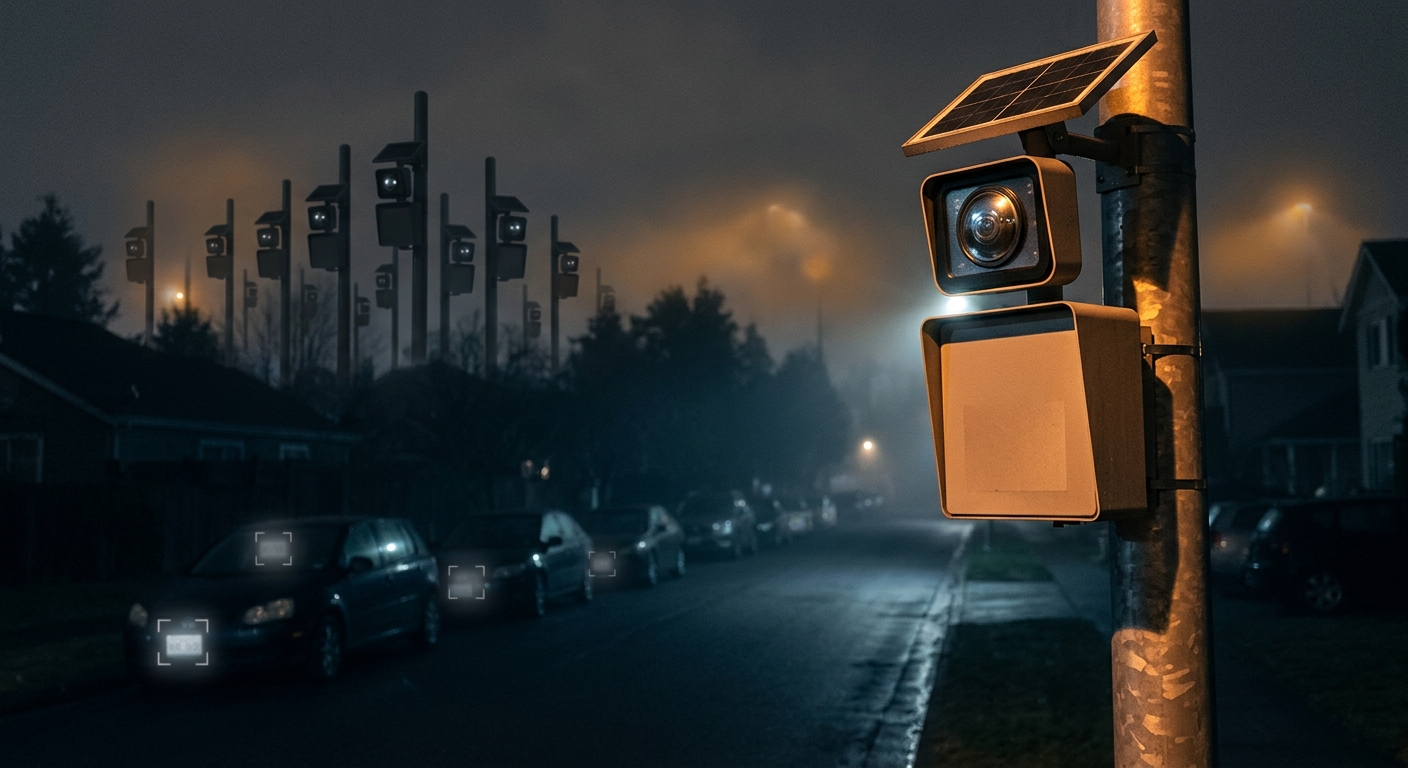
Santa Barbara’s contract with Flock Safety ended on 23 August 2026. Days earlier the City Council had signalled it would not renew, and on the following Tuesday it held a hearing on what comes next: 12 Verkada CB53 outdoor licence plate reader cameras, purchase and licence, $56,810.09.
It is one of the cleanest examples yet of the pattern that has run through American municipal politics all year — cities across the country pausing, cancelling, or declining to renew Flock contracts after residents worked out what a nationwide, queryable, cross-agency plate database actually is. Santa Barbara is not walking away from automated licence plate recognition. It is walking away from one vendor’s architecture, and that distinction is the whole story.
What Residents Objected To
The complaint against Flock was almost never “cameras read plates.” It was the network.
Flock’s value proposition to a police department is that a search does not stop at the city line. A plate captured in Santa Barbara sits in a system that other agencies can query, subject to sharing settings the department configures. Over 2025 and 2026, reporting and audit logs across multiple states showed those settings being used in ways local councils had not contemplated when they voted — including searches connected to federal immigration enforcement, and searches run on behalf of out-of-state agencies investigating conduct that is legal in California.
That is the failure that ended the contract. Not the sensor. The default of outward sharing, and the discovery that a municipal procurement decision had quietly enrolled a city in a national surveillance mesh whose rules were set somewhere else.
We covered the mechanics of that when Flock published its own rulebook and again in the mid-year cancellation wave. Santa Barbara is that wave arriving somewhere with a beach.
What Verkada Changes
The pitch, and it is a genuine one: Verkada’s LPR is your cameras, your organisation, your retention settings, and nobody outside your org queries it. It is a closed-circuit model. Data lands in the department’s own tenant. There is no default national pool. An outside agency wanting a search has to ask a human being in Santa Barbara, and that human being can say no.
That is a real architectural difference and it addresses the exact harm that killed the Flock contract. If your objection was “an out-of-state agency can query our plates without our knowledge,” a closed system answers it.
What Verkada Does Not Change
Four things survive the vendor swap entirely.
The cameras still read every plate. ALPR is indiscriminate by design. It does not scan suspects; it scans everyone, and then discards or retains according to policy. Twelve Verkada readers collect the same category of information about the same uninvolved drivers as twelve Flock readers.
Retention policy is a setting, not a guarantee. “Your retention settings” cuts both ways. A city that can set 30 days can set 365. The control now sits with the council, which is better — but it is a control that can be changed at a future meeting with no vendor to blame.
A closed database is still a database, and still subpoenable. Removing the automatic outward pipe does not remove the legal pipes. Warrants, subpoenas, mutual-aid requests, task force participation, and state information-sharing agreements all still reach a local system. The difference is that each request now leaves a trace and requires a decision — which is meaningful, and is not the same as the data being unreachable.
Verkada has its own history. In 2021 the company suffered a breach in which attackers obtained access to live feeds from roughly 150,000 cameras, including in hospitals, schools, jails and factories. It later settled with the FTC over security claims. A closed system is only as closed as the vendor’s access controls, and the relevant question for Santa Barbara is not the brand on the housing but whether anyone will audit it.
The Right Way to Read This
Santa Barbara did the thing privacy advocates have been asking cities to do for three years: it treated an ALPR contract as a policy decision rather than an equipment purchase, held a public hearing, and voted. The council also committed to reviewing its automated camera policy, which is the part that will matter in 2028 when nobody is watching.
The lesson generalises. Municipal procurement is the single stage of the surveillance pipeline where an ordinary resident gets an actual vote — no federal court, no state legislature, no vendor lobbyist between you and the decision. Most ALPR contracts pass on consent agendas with no discussion at all. The cities that ended up in the news this year are, overwhelmingly, the cities where somebody read the agenda.
But “we switched vendors” is a conclusion that closes a story, and this story is not closed. The measure of whether Santa Barbara actually improved its residents’ position is not the purchase order. It is the four things in the policy:
- What is the retention period, in days, for a plate read that matches nothing?
- Who inside the department can run a query, and does it require a case number and a supervisor?
- What is the process for an outside agency request, and is a log of those requests published?
- Is there an annual public audit with real numbers — searches run, hits, arrests, and denials?
A closed system with no audit is a national database with one extra phone call.
What To Do
-
Find out whether your city has ALPR, and from whom. The DeFlock crowd-sourced map and your city’s agenda archive are the two fastest routes. Search council minutes for “licence plate reader,” “ALPR,” “Flock,” “Verkada,” and “Motorola.”
-
Go to the meeting when the contract renews. These are typically 3–5 year terms on consent agendas. Two minutes of public comment from three residents is, in practice, often enough to move an item to discussion.
-
Ask for the four numbers above in writing. A public records request for the ALPR audit log, retention policy, and outside-agency request log is cheap, and the response — including a non-response — is itself informative.
-
Push for a policy that survives the vendor. The durable protections are: a warrant requirement for non-hit searches, a hard retention cap in the ordinance rather than the settings panel, a published annual audit, and an explicit prohibition on sharing with federal immigration enforcement where state law permits that.
-
Do not accept “it’s closed-circuit now” as the end of the conversation. It is the beginning of a better one.