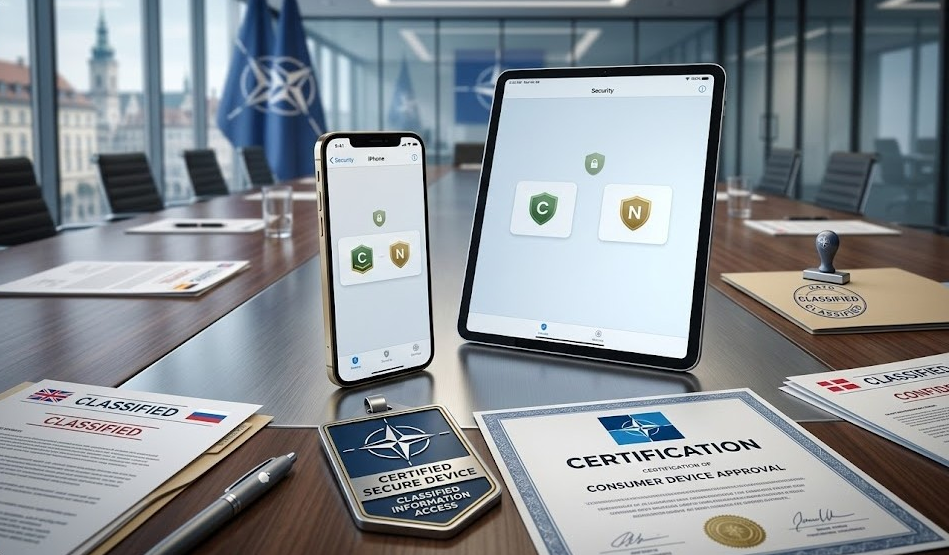
In a landmark announcement that is already sending ripples through the defense, enterprise, and cybersecurity communities, Apple today confirmed that the iPhone and iPad are the first and only consumer devices in compliance with the information assurance requirements of NATO nations. This means an off-the-shelf iPhone running iOS 26 can now legally handle classified NATO-restricted data — no custom hardware, no special software, no proprietary configuration required.
This is not a small deal. This is a paradigm shift in how governments think about consumer mobile security.
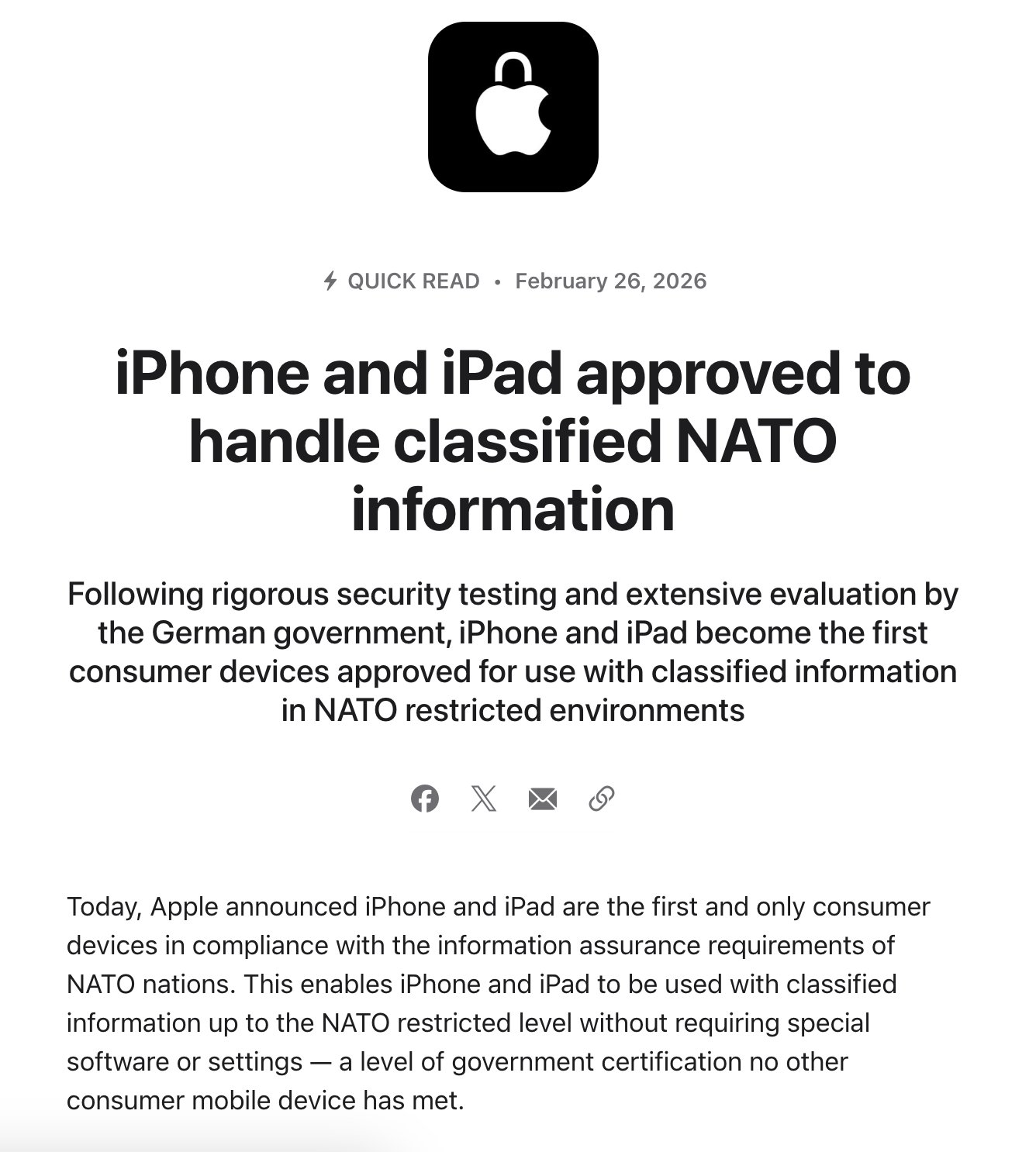
The Full Press Release — And What It Actually Means
Here is what Apple said in its official announcement, and why each piece matters:
“Today, Apple announced iPhone and iPad are the first and only consumer devices in compliance with the information assurance requirements of NATO nations. This enables iPhone and iPad to be used with classified information up to the NATO restricted level without requiring special software or settings — a level of government certification no other consumer mobile device has met.”
The phrase “without requiring special software or settings” is doing a lot of work in that sentence. Every previous attempt to bring consumer-class mobile hardware into classified environments required layering on bespoke software stacks, hardware security modules, or proprietary MDM configurations developed specifically for government use. Apple is saying that the stock security architecture of iOS 26 is itself sufficient. That’s unprecedented.
“Apple designs security into all of its products from the start, ensuring the most sophisticated protections are built in across hardware, software, and Apple silicon. This unique approach allows Apple users to benefit from industry-leading security protections such as best-in-class encryption, biometric authentication with Face ID, and groundbreaking features like Memory Integrity Enforcement. These same protections are now recognized as meeting stringent government and international security requirements, even for restricted data.”
Memory Integrity Enforcement (MIE) is worth calling out specifically. This is a hardware-enforced control on Apple Silicon that prevents unauthorized code from being injected into memory at runtime — a critical mitigation against sophisticated kernel-level attacks. The fact that NATO’s evaluators specifically recognized MIE as a qualifying control is a validation of Apple Silicon’s security architecture at the chip level, not just the software level.
How Did This Happen? The German Government Did the Heavy Lifting
This certification didn’t emerge from a vacuum. The pathway ran through Germany’s Federal Office for Information Security — the BSI (Bundesamt für Sicherheit in der Informationstechnik) — widely regarded as one of the most rigorous national cybersecurity authorities in the world.
From Apple’s announcement:
“iPhone and iPad previously received approval to handle classified German government data on devices using native iOS and iPadOS security measures, following an extensive evaluation by the Federal Office for Information Security (Bundesamt für Sicherheit in der Informationstechnik, or BSI). Now, iPhone and iPad running iOS 26 and iPadOS 26 are certified for such use in all NATO nations. As part of this effort, BSI conducted exhaustive technical assessments, comprehensive testing, and deep security analysis, ensuring Apple’s built-in platform security capabilities met NATO nations’ exacting operational and assurance requirements.”
BSI President Claudia Plattner confirmed the scope of that work directly:
“Secure digital transformation is only successful if information security is considered from the beginning in the development of mobile products. Expanding on BSI’s rigorous audit of iOS and iPadOS platform and device security for use in classified German information environments, we are pleased to confirm the compliance under NATO nations’ assurance requirements.”
The process was sequential: BSI first evaluated and approved the iPhone and iPad for classified German government data, conducting exhaustive technical assessments and deep security analysis. Once that foundational German approval was secured, iOS 26 and iPadOS 26 were submitted to and approved for the NATO Information Assurance Product Catalogue (NIAPC) — NATO’s official registry of vetted cybersecurity products that all 32 alliance members and their military and civil entities can reference for meeting operational security requirements.
Ivan Krstić’s Statement Is the One to Bookmark
Apple’s VP of Security Engineering and Architecture, Ivan Krstić, put the significance of this milestone in direct terms:
“This achievement recognizes that Apple has transformed how security is traditionally delivered. Prior to iPhone, secure devices were only available to sophisticated government and enterprise organizations after a massive investment in bespoke security solutions. Instead, Apple has built the most secure devices in the world for all its users, and those same protections are now uniquely certified under assurance requirements for NATO nations — unlike any other device in the industry.”
The key phrase: “unlike any other device in the industry.” No Android device — not Samsung, not Google Pixel, not any ruggedized mil-spec variant — has achieved this certification for consumer-grade hardware without additional software layers. That competitive moat just got significantly wider.
What the Security Architecture Actually Looks Like
For practitioners, here’s what the NIAPC listing highlights as the core security primitives that earned certification:
Secure Enclave — Apple’s dedicated security processor, isolated from the application processor, handles encryption key management and biometric data. It is a hardware root of trust that cannot be accessed by the OS or any application.
Memory Integrity Enforcement (MIE) — Prevents unauthorized code from being injected into memory at runtime, a critical control against sophisticated kernel-level attacks.
Face ID / Touch ID — Hardware-backed biometric authentication that stores templates exclusively in the Secure Enclave. Biometric data never leaves the device and is never synced to iCloud or Apple servers.
End-to-End Encryption — Device data is encrypted with keys derived from both the device hardware and the user’s passcode, making brute-force attacks computationally infeasible without physical device access.
Pointer Authentication Codes (PAC) — Apple Silicon-specific protection that cryptographically signs return addresses and function pointers, mitigating memory corruption exploits.
The “indigo configuration” referenced in the NIAPC listing is simply a name BSI assigned during the evaluation process — it does not represent a special mode or build. Standard supervised device management (MDM) is what’s required operationally.
Why This Matters for Cybersecurity Professionals
If you work in government contracting, defense, or enterprise security, this certification has implications that extend well beyond military use cases.
The FedRAMP analogy is apt. For those in the US government contracting space, this is comparable to achieving FedRAMP ATO. When a platform earns that certification, its enterprise and commercial customers gain additional confidence in the security posture — even if they never touch a classified workload themselves. Apple just earned the NATO equivalent. Expect enterprise CISOs across all 32 alliance member nations to use this as a reference point in risk assessments and vendor evaluations.
Security by design just got its most authoritative external validation. Apple has long argued that security should be built into hardware and software from the ground up rather than bolted on afterward. NATO just formally agreed with that architectural philosophy. This changes vendor conversations about mobile endpoint security in every government contractor environment touching NATO member nation work.
Android’s response will be worth watching. Google and Samsung both have government-focused security programs — Android Enterprise and Samsung Knox respectively. Neither has achieved equivalent NIAPC certification for consumer hardware without additional software layers. The architectural challenge is non-trivial: Android’s fragmented ecosystem across multiple OEMs makes unified hardware-level certification fundamentally harder than Apple’s vertically integrated stack. This gap may persist for years.
What This Does NOT Mean — Scope Matters
Let’s be precise, because the nuance is important for your clients:
This certification covers NATO RESTRICTED data — one tier below NATO CONFIDENTIAL and two tiers below NATO SECRET. Highly classified intelligence operations are not moving to iPhones. The NIAPC listing specifies that devices using built-in Mail, Calendar, and Contacts apps can provide secure access at this classification tier.
Devices must be properly managed under MDM supervision. This is not a “buy any iPhone at the Apple Store and walk into a classified facility” scenario.
The certification applies specifically to iOS 26 and iPadOS 26. Older OS versions are not covered and would require separate evaluation.
Biometric Tracker - Privacy & Security Analysis
The $AAPL Investor Angle
This announcement hits on a day when AAPL is trading around $274, within today’s range of $270.55–$275.12, against a 52-week range of $169.21–$288.62. The stock has had a strong run — up roughly 32% over the past year — riding the Q1 FY2026 earnings report that posted record revenue of $143.8 billion (up 16% YoY), record iPhone revenue of $85.3 billion (up 23% YoY), and record EPS of $2.84 (up 19% YoY). The current analyst consensus price target sits around $293.
The NATO certification is not a Q2 earnings driver. It is a long-cycle strategic asset. Here’s what it actually does for the investment thesis:
It expands the total addressable market in government and defense. NATO member nations collectively represent 32 countries, enormous defense budgets, and hundreds of thousands of government personnel who previously had no cost-effective path to a certified secure mobile platform. That procurement pipeline just opened.
It reinforces the premium pricing moat. Apple already commands the highest average selling prices in mobile. Government certification at the NATO level gives enterprise and government procurement officers a concrete compliance rationale — not just a preference — for standardizing on iOS over Android.
It creates downstream services revenue. Government and defense deployments require MDM, Apple Business Manager, and Apple platform security tooling. Every certified device is also a services customer.
It complicates competitive entry. Samsung and Google now face a certification gap that requires years of government evaluation processes to close, in an environment where regulators and procurement officers are already familiar with Apple’s certification record.
For investors, this is not a near-term catalyst. It is a durable competitive advantage that widens Apple’s enterprise and government revenue channel at a moment when the company is already posting record results across every major geography and product line.
What to Watch Next
Enterprise adoption curves across NATO member states. Defense contractors and government agencies will now have a cleaner justification path for standardizing on iOS in classified environments. Watch for MDM vendor updates and procurement announcements in the UK, Germany, France, Canada, and the US.
Classification tier expansion. NATO RESTRICTED is the entry point. The question is whether Apple pursues NIAPC certification at the NATO CONFIDENTIAL tier, which would require additional controls and potentially hardware-level changes.
Five Eyes alignment. Australia, the UK, Canada, New Zealand, and the US are all NATO allies or close partners. Expect conversations within those intelligence-sharing frameworks about whether this NATO certification accelerates domestic government approvals in each country.
Android’s counter-move. Google has significant incentive to pursue equivalent certification. Whether the fragmented Android ecosystem can achieve it without mandating Samsung Knox or another specific hardware stack will be the central technical challenge.
Bottom Line
Apple just achieved something no other consumer electronics company has done: earned certification to handle classified military alliance data using stock consumer hardware, assessed by one of the world’s most demanding government security agencies.
For the cybersecurity community, the lesson is architectural. Security-by-design, when executed at sufficient depth across silicon, firmware, and software — and maintained with the discipline of a vertically integrated platform — can meet standards that previously required nation-state investment to achieve. Apple Silicon’s Secure Enclave, Memory Integrity Enforcement, and Pointer Authentication Codes weren’t built for NATO. They were built for every user. NATO just confirmed they’re good enough for classified operations too.
That’s the bar Apple just cleared. The rest of the industry should be taking notes — and the rest of the procurement world should be paying attention.