Two Teenagers Lead Constitutional Fight as December 10 Deadline Looms
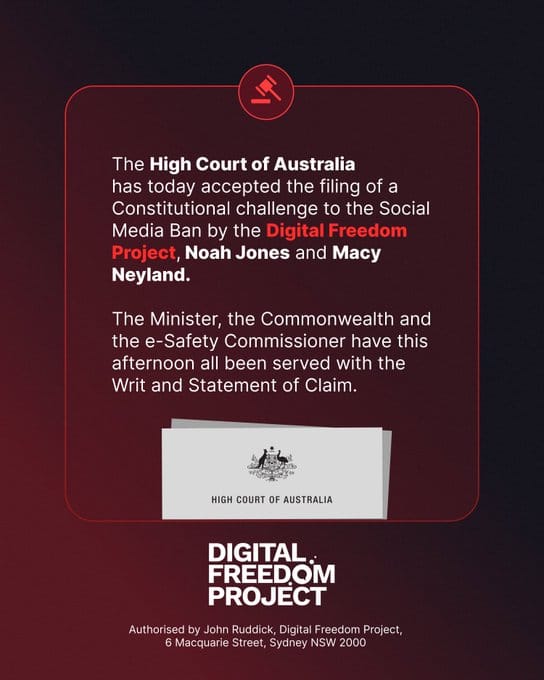
November 27, 2025 — In a dramatic development that could reshape Australia’s controversial under-16 social media ban, the High Court of Australia has accepted a constitutional challenge filed by the Digital Freedom Project alongside two teenage plaintiffs, Noah Jones and Macy Neyland. The case, formally designated S163/2025 in the Sydney Registry, was filed on November 27, 2025, with just two weeks until the December 10 implementation deadline. This legal action raises fundamental questions about the balance between child protection and constitutional rights in the digital age.
The formal defendants in the case are the Commonwealth of Australia, the eSafety Commissioner, and the Minister for Communications and Sport, with all State and Territory Attorneys-General notified due to the constitutional questions raised.
Download: 6927e145e148f5a16dfc018e_SEALED Writ of Summons - DFP v Commonwealth of Australia 6927e145e148f5a16dfc018e_SEALED Writ of Summons - DFP v Commonwealth of Australia.pdf418 KB.a{fill:none;stroke:currentColor;stroke-linecap:round;stroke-linejoin:round;stroke-width:1.5px;}download-circle
The Challenge: Freedom of Political Communication vs. Child Safety
The Digital Freedom Project, led by NSW Libertarian Party parliamentarian John Ruddick, argues that the social media ban violates an implied constitutional right that goes to the heart of Australia’s democratic system: the freedom of political communication.
This implied right, established through landmark High Court cases in 1992, stems from sections 7 and 24 of the Australian Constitution, which require that the Parliament be “directly chosen by the people.” The courts have consistently held that for representative democracy to function, citizens must have the freedom to engage in political discourse.
“The legislation is grossly excessive,” the Digital Freedom Project stated in announcing the challenge. “This is a blatant attack on the rights of young Australians and we can’t accept it. All Australians, including young people, have a Constitutional implied right to freedom of political communication. This legislation improperly robs 2.6 million young Australians of that right.”
The constitutional challenge centers on three key arguments:
- Political Communication Barrier: By removing young Australians from major social media platforms, the law prevents them from participating in political discourse and expressing their views on government and political matters.2. Excessive Means: The blanket ban represents a disproportionate response to legitimate concerns about online safety, going further than necessary to achieve its stated protective purpose.3. Fundamental Rights Violation: The law trespasses on constitutional rights that are essential to Australia’s system of representative and responsible government.
Meet the Plaintiffs: The Digital Natives Fighting Back
The court filing provides detailed profiles of the two teenage plaintiffs who are serving as representative parties for all affected young Australians.
Noah Jones: The Civic-Minded Student
Noah Jones, a 15-year-old secondary school student from metropolitan New South Wales, sues through his litigation guardian, his mother Renee Jones. According to the Statement of Claim:
- He is actively engaged in learning about current affairs, politics, and public issues- He participates in civic discussion primarily through online media, social platforms, and in-person events- He regularly uses TikTok, X (formerly Twitter), YouTube, and Instagram to receive information, news, and commentary on political matters- He engages in political discussions with family members, peers, teachers, adult relatives, Members of Parliament, and local councillors- His engagement with public and political issues through social media forms “a substantial part of his civic education, personal development, and participation in democratic life”
“We are the true digital natives and we want to remain educated, robust, and savvy in our digital world,” Noah said in a public statement. “We’re disappointed in a lazy government that blanket bans under-16s rather than investing in programmes to help kids be safe on social media. They should protect kids with safeguards, not silence.”
Macy Neyland: Privacy and Regional Perspectives
Macy Neyland, also 15, from regional New South Wales, sues through her litigation guardian, her mother Carly Neyland. Her situation highlights unique dimensions of the privacy concerns. According to the court filing, Macy:
- Will turn 16 just before the law takes effect but must still surrender privacy and anonymity to continue using social media- Uses online platforms to follow journalists, discuss policy, and participate in campaigns- Views anonymity as “essential for young people, especially girls in small communities, to express opinions safely and participate freely in public discourse”- Faces compromised privacy if required to upload personal identification like passports or driver’s licenses- Will lose online anonymity, making her identifiable to social media companies and potentially others- Faces greater exposure to local judgment or harassment in her small regional community if her identity becomes known- Must choose between keeping her privacy and maintaining access to online platforms
The court filing states that Macy “believes the law unjustly treats all young users as risks rather than responsible participants and that less intrusive measures, such as parental oversight, education, and privacy-protective tools, could achieve safety without undermining privacy or political communication rights.”
Macy drew a stark comparison in her public statement: “Young people like me are the voters of tomorrow… we shouldn’t be silenced. It’s like Orwell’s book 1984, and that scares me.”
Her message is direct: “If you personally think that kids shouldn’t be on social media, stay off it yourself, but don’t impose it on me and my peers.”
The Law Under Challenge: What’s at Stake
The Online Safety Amendment (Social Media Minimum Age) Act 2024, which passed Parliament in November 2024, represents the world’s most comprehensive age-based social media restriction. Starting December 10, 2025, the law will:
- Ban under-16s from creating or maintaining accounts on designated social media platforms- Apply to major platforms including Facebook, Instagram, TikTok, Snapchat, YouTube, X (Twitter), Reddit, Kick, Threads, and Twitch- Impose massive penalties of up to AU$49.5 million (approximately $32 million USD) on platforms that fail to take “reasonable steps” to prevent underage access- Remove parental consent options — unlike many online safety measures, parents cannot override the restriction- Affect over 1 million accounts held by Australian teenagers under 16
Importantly, the law places the enforcement burden entirely on platforms, not families. Young people and their parents face no penalties for accessing age-restricted platforms. Meta has already begun removing teenage accounts from Instagram, Facebook, and Threads, starting December 4 — a week ahead of the legal deadline.
The Government’s Response: Standing Firm
Communications Minister Anika Wells made clear the government will not back down from the challenge. “Despite the fact that we are receiving threats and legal challenges by people with ulterior motives, the Albanese Labor government remains steadfastly on the side of parents, and not of platforms,” Wells told Parliament. “We will not be intimidated by threats. We will not be intimidated by Big Tech.”
Prime Minister Anthony Albanese framed the issue simply: “Our social media ban is about making sure kids have a childhood.”
The government points to research showing social media’s documented harms to young people’s mental health, body image, and social development, including rising rates of anxiety, depression, and cyberbullying. However, critics note the rushed legislative process provided minimal time for consultation with affected young people or thorough examination of alternatives.
The Constitutional Framework: Australia’s Implied Freedom
Understanding the legal challenge requires grasping a uniquely Australian constitutional concept. Unlike the United States’ First Amendment or explicit rights in many other democracies, Australia’s Constitution contains no express right to freedom of speech. Instead, the High Court has recognized an implied freedom of political communication that exists as a necessary incident of the system of representative government.
This implied freedom:
- Is not a personal right but operates as a restriction on legislative and executive power- Protects communication about government and political matters essential to informed voting- Applies continuously, not just during election periods- Extends to various forms of expression including protests, signs, images, and even physical presence in certain contexts- Limits both Commonwealth and State laws that would impermissibly burden political discourse
The High Court applies a three-part test to determine whether legislation violates the implied freedom:
- Burden Question: Does the law effectively burden freedom of communication about government or political matters?2. Legitimate End Question: Is the law’s purpose and means compatible with maintaining the constitutional system of representative government?3. Proportionality Question: Is the law reasonably appropriate and adapted to advance that legitimate purpose?
Previous cases have established that laws restricting political communication require compelling justification. The Digital Freedom Project argues the social media ban fails this test by using excessive means that are not reasonably necessary to achieve child protection goals.
The Specific Legal Arguments: Why the Ban is Unconstitutional
The Statement of Claim filed with the High Court makes several sophisticated constitutional arguments that go beyond simple free speech concerns. Here are the key legal contentions:
1. The Burden on Political Communication
The plaintiffs argue that the Minimum-Age Provisions impose a severe burden on political communication by young Australians in several ways:
Essential Democratic Participation: The court filing emphasizes that social media enables 13-to-15-year-olds to:
- Share information about and discuss political issues and governmental policies- Inform themselves about what their political representatives are doing- Criticize, comment on, and advocate for or against government policies- Formulate and advocate for governmental policies to members of parliament, political parties, and citizens entitled to vote- Mobilize young people to engage in political discussion and activity
Educational Necessity: The Statement of Claim argues this communication is “necessary for their education in political and governmental matters and in preparation for their exercise of voting rights in choosing political representatives upon them becoming entitled to vote.”
Representative Government Function: Critically, the plaintiffs contend that young people’s political communication is also “necessary for the education of their political representatives about the opinions, concerns and preferences in relation to political and governmental matters of young Australians and to enable those representatives to properly and effectively formulate government policies for the benefit of young people, presently and in the long term.”
Constitutional Integrity: The exercise of this freedom “is necessary for the integrity and efficacy of the system of representative and responsible government mandated by the Constitution.”
Inadequate Substitutes: The filing explicitly rejects the notion that “logged-out viewing” provides any meaningful alternative, stating it “does not provide a meaningful substitute for the interactive functions which are integral to and necessary for contemporary modes of free political communication by persons aged between 13 and 15 years of age.”
2. Disproportionate and Unsuitable Response
While the plaintiffs accept that protecting children from online harms is a legitimate government purpose compatible with representative democracy, they argue the ban fails the proportionality test on three grounds:
Suitability Failure: The law is “not rationally targeted at the specific features of social media platforms which generate the harms from which they are intended to protect children.” Instead, it sacrifices “a considerable sphere of freedom of expression and engagement for 13 to 15 year olds in social media interactions… without any discrimination and not rationally connected to the identified harms.”
The filing notes the identified harms are:
- Harmful content available to account holders- Design features and functions that encourage vulnerable young people to spend increasing time online- Addictive platform features
Yet the ban doesn’t target these specific harms — it simply removes all access regardless of whether young people are engaging with harmful content or addictive features.
Necessity Failure: The Statement of Claim identifies “obvious and compelling, reasonably practicable, less-restrictive alternatives” including:
- Parental-consent requirements (particularly for 14-15-year-olds)- Legislating an enforceable duty-of-care/design-safety obligations on providers- Limiting the definition of “age-restricted social media platforms” to only include platforms that operate harmful design features- Strengthened reporting and takedown standards- Digital literacy programs in schools
Adequacy Failure: The filing argues that “categorically excluding an entire age cohort from access to their primary fora for online social interaction, including political communication, is an oppressive, overreaching and inappropriate means to achieve the object of child protection, and fails to impose any incentive for social media platform providers to ameliorate the actual harmful features of their services delivered to young Australians.”
3. International Human Rights Violations
Beyond constitutional arguments, the Statement of Claim invokes international human rights obligations, arguing the law is “incompatible with, and a clog on” multiple rights:
- Article 19 of the International Covenant on Civil and Political Rights: Freedom of opinion and expression- Articles 12 and 13 of the Convention on the Rights of the Child: The right to have opinions included in decision-making processes relating to their lives- Article 31 of the CRC: The right to engage and participate in cultural and artistic life- Article 17 of the CRC: The right to access information and material from diverse sources
The filing argues the restrictions are “not reasonable and proportionate to achieving a legitimate objective in a way that justifies the blanket restriction on these rights.”
4. Specific Impact on Vulnerable Communities
The court filing specifically identifies groups of young people who will be disproportionately harmed:
- Members of LGBTIQA+ community- Children in rural and regional communities (like Macy)- Disabled children- Neuro-divergent children- Migrant children- Users of anonymous online mental health services for children and adolescents
This highlights that the ban doesn’t just affect political communication broadly, but specifically removes critical support networks and communication channels for the most vulnerable young Australians.
5. The Digital Freedom Project’s Standing
The first plaintiff, the Digital Freedom Project Incorporated, is an incorporated association established in NSW whose objects include “promoting and protecting the participation of young Australians in public affairs and political communication, particularly online.”
The filing notes DFP “operates a programme through its website promoting freedom of speech and communication, including on political and governmental matters” and “has members who are under 16 years of age and who (prior to commencement of the measures pleaded below) used account-based features of major social media platforms to receive, impart and organise communications on governmental and political matters including with DFP’s own programmes.”
This establishes organizational standing separate from the individual plaintiffs.
The Relief Sought: What Victory Would Mean
The plaintiffs are asking the High Court for three forms of relief:
A. Declaration of Invalidity: A declaration that the Minimum-Age Provisions are invalid as they burden the implied freedom of communication on governmental and political matters.
B. Injunctions: Orders restraining the eSafety Commissioner and the Minister from taking steps to enforce the provisions (including issuing notices or compliance actions against platforms) to the extent such steps would prevent or hinder political communication by or to persons under 16.
C. Alternative Reading Down/Severance: If the Court doesn’t strike down the entire law, orders that it be “read down or severed so as not to apply to political communication” — essentially creating an exception for political discourse.
This alternative relief is particularly interesting because it would require platforms to distinguish between different types of content and usage, creating a “political communication carve-out” that could be extraordinarily difficult to implement in practice.
Broader Implications: A Global Test Case
Australia’s bold legislative experiment is being watched closely by governments worldwide grappling with similar concerns about social media’s impact on young people. The outcome of this High Court challenge could influence policy decisions in multiple jurisdictions:
The UK has implemented its own age verification requirements under the Online Safety Act, though not as comprehensive as Australia’s outright ban. UK regulations now require robust age checks for pornographic content and harmful material, with significant penalties for non-compliance.
The European Union is debating age restriction measures under the Digital Services Act, with guidelines released in July 2025 establishing comprehensive frameworks for child safety across member states.
Malaysia has announced plans to ban social media accounts for children under 16 starting in 2026, directly inspired by Australia’s approach.
United States states are considering various age restriction measures, though the patchwork of children’s privacy laws creates a complex compliance landscape. Florida has already prohibited social media accounts for children under 14.
If Australia’s High Court upholds the ban, it could inspire similar legislation globally. Conversely, if the Court finds it unconstitutional, it would serve as a cautionary tale for other nations.
The Privacy Paradox: Age Verification Concerns
While marketed as protecting children, the social media ban raises significant privacy concerns that extend far beyond teenagers. To enforce age restrictions, platforms will need to implement age assurance technologies that could fundamentally transform how all Australians access the internet.
The Australian government’s Age Assurance Technology Trial, conducted by the UK-based Age Check Certification Scheme, evaluated various methods including:
- Facial age estimation using AI analysis of uploaded photos- Government ID verification through driver’s licenses or passports- Age inference based on existing account data and behavioral patterns- Device-level verification at operating system or app store level- Third-party age verification services that create centralized identity databases
Each approach presents distinct privacy trade-offs. Document-based verification requires sharing sensitive government-issued identification. Facial scanning raises biometric privacy concerns. Third-party services create honeypots of personal data vulnerable to breaches.
The Australian Human Rights Institute has noted that less restrictive alternatives exist that could achieve child protection goals without significant negative impacts on privacy rights, freedom of expression, and access to information.
Critically, the legislation prohibits platforms from using government Digital ID services or government-issued identification as the sole verification method, requiring alternative options. However, the sheer scale of verification needed — potentially affecting millions of existing accounts plus all new account creation — means massive amounts of personal information will flow through age assurance systems.
As one comprehensive analysis notes, this is “not simply a ban on social media for children—it’s the framework for a mandatory age verification infrastructure that will fundamentally transform how all Australians access the internet.”
What’s Exempt: The Arbitrary Lines
Not all digital platforms fall under the ban. The government has specifically exempted services deemed essential for education, health, and basic communication, including:
- Messaging apps like WhatsApp, Signal, and iMessage- Gaming platforms and their communication features- YouTube in browser mode (viewable without logged-in accounts)- Educational platforms and health services- Email services
Critics argue this distinction is somewhat arbitrary. Why is WhatsApp acceptable but Instagram Direct Messages are not? Why can young people engage in political discussions in Minecraft but not on Twitter? The selective approach suggests the government is attempting to preserve digital connectivity benefits while eliminating what it sees as the most harmful aspects of social media engagement.
The Enforcement Reality: Can It Actually Work?
The Digital Freedom Project spokesperson Sam Palmer noted uncertainty about whether the group would seek a court injunction to prevent the age restriction from taking effect on December 10 before the case is fully heard. This raises questions about the practical timeline and enforcement reality.
Meanwhile, platforms are already moving to comply:
- Meta began warning Australian teenagers under 16 on November 20 to download their digital histories and prepare for account deactivation, with removals starting December 4- Snapchat announced all users under 16 will have accounts locked starting December 10, despite disagreeing with the classification- YouTube reportedly threatened its own High Court challenge on grounds the ban burdens political communication- Other platforms are developing age assurance systems to demonstrate compliance
The eSafety Commissioner has indicated a proportionate and risk-based compliance approach, initially focusing on services with the greatest number of users and highest risks of harm. This suggests some leeway during the transition period, but the December 10 deadline remains firm.
However, technological realities present challenges:
- VPN usage can mask Australian location, potentially allowing access through foreign IP addresses- Shared devices with logged-in adult accounts may still provide access- Alternative platforms not covered by the ban could attract underage users- Age verification evasion through fake IDs or borrowed credentials remains possible
The law requires platforms to “continuously monitor and improve systems” to demonstrate effectiveness, but whether technology can truly prevent determined teenagers from accessing social media remains an open question.
The Mental Health Debate: Protection or Harm?
The social media ban crystallizes a fundamental tension in modern society: how to protect children from genuine online harms without restricting their rights to information, expression, and participation in digital life.
Supporters argue:
- Social media platforms were designed for adults and aggressively marketed to children without adequate safety measures- Age restrictions are comparable to limits on alcohol, cigarettes, and driving — reasonable protections during developmental stages- Rising rates of anxiety, depression, and cyberbullying among young people justify strong intervention- Current approaches of self-regulation and parental supervision aren’t working
Professor Michael Salter from UNSW Arts, Design and Architecture, a leading authority on child sexual exploitation and abuse, supports this view: “Social media was made by adults, for adults, and aggressively marketed to children. A social media ‘ban’ is no different to the age ‘bans’ that we apply to alcohol, cigarettes or driving a car.”
Critics counter:
- The law silences young people’s voices on political and social issues affecting their future- Social media provides crucial support networks, particularly for LGBTQ+ youth, those in rural areas, and young people facing mental health challenges- A director of mental health services noted “73% of young people across Australia accessing mental health support did so through social media”- The ban may drive teenagers toward less regulated, more dangerous corners of the internet- The rushed legislative process lacked meaningful consultation with affected young people- Investment in digital literacy, platform accountability, and improved safety features would be more effective than blanket restrictions
An open letter signed by 140 experts specializing in child welfare and technology opposed the plans, citing concerns about privacy invasion through identification-based age checks and potential harm to young people who rely on online support networks.
Jurisdiction: Why the High Court?
The case has been filed directly in the High Court of Australia under two constitutional bases:
- Section 76(i) of the Constitution: Matters arising under the Constitution or involving its interpretation (conferred by the Judiciary Act 1903)2. Section 75(v) of the Constitution: Matters against officers of the Commonwealth (specifically the eSafety Commissioner and Minister for Communications and Sport)
This direct filing in the High Court, rather than starting in lower courts, reflects the fundamental constitutional nature of the challenge. The case number S163/2025 in the Sydney Registry will be the designation for what could become a landmark constitutional decision affecting millions of Australians.
Procedural Next Steps: What Happens Now
The High Court has formally accepted the filing and served the Minister, the Commonwealth, and the eSafety Commissioner with the Writ and Statement of Claim dated November 25, 2025. Because the matter raises constitutional questions, all State and Territory Attorneys-General have also been notified and may choose to intervene in the proceedings.
The case is being handled by senior counsel M S White SC and A E Maroya, with Pryor Tzannes & Wallis Solicitors & Notaries representing the plaintiffs. The use of Senior Counsel indicates the gravity and constitutional significance of the challenge.
The Court will issue procedural directions for the case in due course. Constitutional challenges typically involve:
- Preliminary procedural hearings to establish timelines and discovery requirements2. Written submissions from all parties and potential interveners3. Oral arguments before the full High Court bench4. Judgment which may take several months after hearings conclude
The timeline remains uncertain, raising the possibility that the law could take effect on December 10 while constitutional questions remain unresolved. This would create a complex situation where platforms must comply with a potentially unconstitutional law, risking massive fines for non-compliance but also facing legal uncertainty about the law’s validity.
Supporting the Challenge: Why This Matters
The Digital Freedom Project has emphasized that this is “a critical step in defending Australians’ rights online” and noted that “your support is more important than ever.” The organization is seeking public backing for the constitutional challenge.
Beyond the specific question of social media access for teenagers, this case raises fundamental issues about:
- The scope of implied constitutional freedoms in the digital age- The balance between child protection and civil liberties- Government authority to regulate online communication- The role of young people in democratic participation- Privacy implications of age verification infrastructure- The effectiveness of technology-based enforcement of behavioral restrictions
As NSW Greens Senator Mehreen Faruqi observed, approximately 2.4 million young Australians will lose access to major social platforms “just as school holidays start,” forcing a massive social experiment with uncertain outcomes.
Global Context: The Censorship Continuum
Australia’s social media ban doesn’t exist in isolation. It’s part of a broader global trend toward age-based restrictions and content controls ostensibly aimed at protecting children online. However, critics warn that age verification infrastructure, once established, could be repurposed for broader internet censorship.
The pattern is familiar across democratic nations: governments racing to regulate online speech under the banner of protecting children, combating “misinformation,” or ensuring “online safety.” As detailed in analysis of EU and UK regulations, these frameworks increasingly export censorship standards beyond national borders through the “Brussels Effect” — where EU regulations become de facto global standards.
Age verification requirements for accessing content are particularly concerning because they:
- Eliminate anonymous access to information- Create detailed databases of individuals’ online activities- Establish infrastructure that could be expanded to verify age for any content deemed inappropriate- Set precedents for identity requirements across the internet- Disproportionately impact marginalized groups who rely on anonymous access for safety
Whether Australia’s High Court will recognize these broader implications in evaluating the social media ban’s constitutional validity remains to be seen.
Key Takeaways from the Court Filing
The Statement of Claim filed with the High Court reveals several critical dimensions of this constitutional challenge that go beyond media headlines:
- This is about democracy, not just social media: The case fundamentally argues that young people’s participation in political discourse is essential to representative government itself, not just a nice-to-have feature.2. The ban is broader than harmful content: By targeting all account-based access rather than specific harmful features or content, the law operates as a blanket restriction on communication rather than a targeted protection measure.3. Privacy concerns are constitutional concerns: Macy Neyland’s situation demonstrates that age verification requirements affect everyone, not just those under 16, creating privacy burdens that extend across the population.4. Vulnerable communities lose most: The court filing specifically identifies that LGBTQ+ youth, rural children, disabled and neuro-divergent young people, and migrant children will lose critical support networks and communication channels.5. Less restrictive alternatives exist: The plaintiffs have identified specific, practical alternatives that could address online harms without categorically excluding young people from their primary forums for political participation.6. International human rights are implicated: Beyond Australian constitutional law, the challenge invokes multiple international human rights instruments protecting children’s rights to expression, participation in decisions affecting them, and access to information.7. The timing creates urgency: With the law taking effect December 10 and the case filed November 27, there’s a narrow window for any injunctive relief before platforms begin mass account deactivations.
🎧 Related Podcast Episode
Conclusion: Democracy’s Digital Dilemma
As the December 10 deadline approaches, Australia faces a defining moment in how democracies navigate the tension between child protection and fundamental rights in the digital age. The High Court challenge forces a reckoning with difficult questions:
Can a law that silences 2.6 million young Australians from political discourse be compatible with constitutional requirements for representative democracy? Are the means employed — a blanket ban affecting all teenagers regardless of maturity or circumstance — reasonably appropriate and adapted to achieve child safety goals? What privacy costs are acceptable in pursuit of age verification compliance?
John Ruddick of the Digital Freedom Project argues: “It is not the government’s role to parent children, it should be up to families to decide when their children are ready for social media. This is the most draconian legislation of its type in the world.”
Yet the government maintains its position is about protecting childhood itself, not silencing young voices.
Whatever the High Court decides, the case will establish important precedents about constitutional freedoms in the digital age, the scope of government authority to regulate online communication, and the balance between collective protection and individual rights. The world is watching Australia’s experiment — not just for its impact on teenagers and social media, but for what it signals about democracy’s future relationship with digital communication.
For those who believe in freedom of expression, privacy rights, and the principle that young people deserve a voice in decisions affecting their future, supporting this constitutional challenge represents a critical stand against government overreach, regardless of how well-intentioned the underlying child protection concerns may be.
The outcome will determine whether Australia’s bold experiment becomes a model for protecting children online or a cautionary tale about the dangers of sacrificing fundamental rights in the name of safety.
Learn More:
- Digital Freedom Project — Supporting the constitutional challenge- High Court Case: The Digital Freedom Project Incorporated & Ors v. Commonwealth of Australia & Ors [S163/2025] — Filed November 27, 2025, Sydney Registry- Australia’s World-First Social Media Ban: What’s Really Happening — Comprehensive analysis- Beyond COPPA: U.S. Children’s Data Privacy Laws — Global context on children’s online regulations- Global Child Safety Legislation Wave: July-August 2025 — International regulatory trends- Kids Online Safety Act (KOSA): Protecting Children in the Digital Age — U.S. legislative approaches
Court Documents:
- Writ of Summons and Statement of Claim filed November 27, 2025- Case Number: S163/2025 (High Court of Australia, Sydney Registry)- Plaintiffs’ Counsel: M S White SC, A E Maroya- Solicitors: Pryor Tzannes & Wallis Solicitors & Notaries
This article was published on November 27, 2025, based on analysis of the Writ of Summons and Statement of Claim filed in the High Court of Australia. We will continue to monitor and report on developments in this landmark constitutional case.