Following the Money in an Age of Opacity
In an era where privacy and transparency often seem at odds, one area where Americans across the political spectrum agree is the need for greater visibility into political funding. Recent revelations about protest funding, combined with new government designations of terrorist organizations, have brought the issue of “dark money” networks back into sharp focus.
The No Kings Movement: A Case Study in Funding Opacity
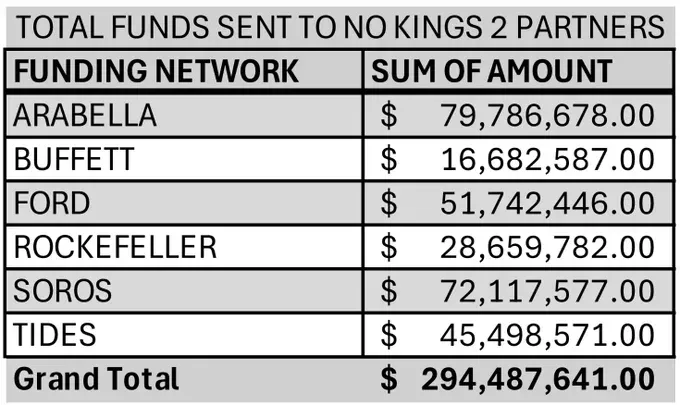
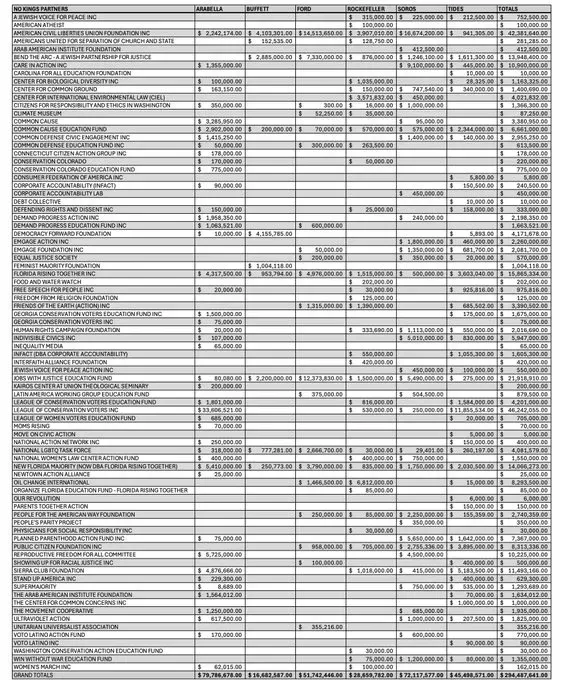
The “No Kings” protest movement, which organized demonstrations in June and October 2025 against the Trump administration, has become a focal point in debates about political funding transparency. According to research released by Representative Anna Paulina Luna, approximately $294.5 million was traced to official No Kings 2.0 partners and organizers through several major funding networks.
The funding breakdown revealed connections to some of the largest philanthropic and activist networks in American politics:
- Arabella Advisors Network: $79.8 million- Soros-affiliated Networks: $72.1 million- Ford Foundation Network: $51.7 million- Tides Foundation: $45.5 million- Rockefeller Networks: $28.7 million- Buffett-affiliated Groups: $16.7 million
What is the Arabella Network?
Arabella Advisors has emerged as one of the most significant—and controversial—players in progressive political funding. Founded in 2005 by Eric Kessler, a former Clinton administration official, Arabella manages a network of nonprofits that have collectively raised over $6.5 billion since inception.
The network operates through several 501(c)(3) and 501(c)(4) organizations, including the Sixteen Thirty Fund, New Venture Fund, Windward Fund, and Hopewell Fund. In 2020 alone, the network raised $2.4 billion—more than the Democratic and Republican National Committees combined. By 2022, that figure had grown to $3 billion.
Critics across the political spectrum have raised concerns about Arabella’s model. The Atlantic called it “the indisputable heavyweight of Democratic dark money,” while Politico described it as a “dark-money behemoth.” Even the left-leaning Washington Post has called for greater disclosure requirements for such organizations.
The “Pop-Up Group” Phenomenon
One particularly concerning aspect of these funding networks is the proliferation of what researchers call “pop-up groups”—websites and organizations designed to look like grassroots movements but are actually projects of larger nonprofit networks. These entities can obscure the true sources of political funding and the coordination behind seemingly independent movements.
Foreign Funding Concerns
Representative Luna and the House Oversight Committee have also raised alarm bells about potential foreign influence. Luna announced plans to subpoena China-based billionaire Neville Singham regarding his alleged funding of the Party for Socialism and Liberation, a Communist political party that organized protests in Los Angeles.
The committee is investigating potential links between Singham and the Chinese Communist Party, with Luna stating that these entities may be “purposely trying to create division within the United States.”
Luna also highlighted funding from Christy Walton, the Walmart heiress, for full-page New York Times advertisements promoting “No Kings Day” demonstrations, organized by the group Indivisible.
The Privacy Paradox
From a privacy and civil liberties perspective, these revelations present a paradox. On one hand, Americans have a right to privacy in their political activities and associations. On the other hand, when massive sums of money flow through complex networks of nonprofits to influence elections and policy, transparency becomes essential for democratic accountability.
The current 501(c) nonprofit structure allows for significant anonymity:
- Domestic grants over $5,000 must be disclosed on Schedule I of Form 990- Foreign grants only require disclosure of the region and general purpose on Schedule F—not the specific recipients- Individual donors to 501(c)(4) organizations can remain completely anonymous
In 2023 alone, the three principal Arabella-managed 501(c)(3) organizations made over $97.4 million in grants to foreign recipients with minimal transparency requirements.
Government Response: New Terrorist Designations
The Trump administration has responded to concerns about organized violence and criminal networks with sweeping new designations:
Antifa Designation (September 2025)
President Trump signed an executive order designating Antifa as a “domestic terrorist organization.” The order describes Antifa as “a militarist, anarchist enterprise that explicitly calls for the overthrow of the United States Government” and directs federal agencies to “investigate, disrupt, and dismantle all illegal operations conducted by Antifa” and to investigate their funding sources.
Legal experts note that this designation is unprecedented, as there is no formal legal process for designating domestic groups as terrorist organizations—only foreign ones. Critics worry this could be used to suppress legitimate political dissent, while supporters argue it’s necessary to combat organized political violence.
Cartel Designations (January-February 2025)
The administration also designated eight Latin American criminal organizations as Foreign Terrorist Organizations (FTOs) and Specially Designated Global Terrorists (SDGTs):
- Tren de Aragua (Venezuela)- MS-13 (El Salvador/US)- Sinaloa Cartel- Cártel de Jalisco Nueva Generación (CJNG)- Cártel del Noreste (formerly Los Zetas)- Gulf Cartel- La Nueva Familia Michoacana- Cárteles Unidos
These designations carry significant consequences: it becomes illegal to provide “material support” to these organizations, with penalties up to life imprisonment if death results. The broad definition of “material support”—including financial services, training, or expert advice—raises concerns about unintended consequences for businesses operating in affected regions.
Chicago: A Microcosm of Larger Issues
FBI Director Kash Patel recently claimed that 110,000 gang members operate on Chicago’s streets—approximately 4% of the city’s population. This figure, used to justify federal troop deployments, echoes a 2020 estimate from Chicago’s then-police superintendent David Brown of 117,000 gang members.
However, Chicago has been embroiled in controversy over its gang database, which a 2019 audit found listed 134,242 people as gang members—95% of whom were Black or Latino. Critics argued the database was “racist and discriminatory” and led to employment discrimination. Mayor Brandon Johnson ultimately had the database scrapped, arguing it never made Chicago safer.
This controversy highlights a broader tension: how do we balance public safety with concerns about civil liberties, racial profiling, and due process?
The “No Kings” protest was completely organic, don’t let anyone tell you otherwise 😉 pic.twitter.com/dqA8UJnHb4— Rep. Anna Paulina Luna (@RepLuna) October 20, 2025
The Transparency Imperative
Regardless of one’s political views, several principles should unite Americans concerned about privacy, transparency, and democratic accountability:
1. Equal Standards for All
Dark money is problematic regardless of which side uses it. If we’re concerned about Arabella’s $3 billion network, we should be equally concerned about dark money operations on the right, such as those documented by groups like OpenSecrets and the Brennan Center.
2. Nonprofit Reform
The massive gap in disclosure requirements between 501(c)(3) private foundations (which must disclose all grants) and 501(c)(3) public charities (which don’t have to disclose foreign grants) makes little sense from a transparency standpoint.
3. Foreign Funding Scrutiny
Whether it’s Chinese billionaires funding American activist groups or Swiss billionaires like Hansjörg Wyss channeling $475 million through Arabella network organizations, foreign money in American politics deserves heightened scrutiny and disclosure requirements.
4. Proportional Response
While addressing organized crime and political violence is legitimate, designations with such far-reaching consequences must be carefully calibrated to avoid suppressing legitimate political activity or creating collateral damage for innocent parties.
5. Public Accessible Data
Tax filings and political finance records should be easily searchable and analyzable by journalists, researchers, and citizens. Transparency means more than technical compliance—it means genuine public accessibility.
The Road Forward
The debates surrounding the No Kings protests, dark money networks, and terrorism designations all point to a fundamental tension in American democracy: how do we protect both privacy and transparency, both security and liberty?
Some potential reforms that could address these concerns include:
- Mandatory disclosure of all grants over a certain threshold, regardless of whether they’re domestic or foreign- Shorter reporting windows for political spending disclosures- Enhanced scrutiny of fiscal sponsorship arrangements that may obscure funding sources- Clear legal frameworks for domestic terrorism designations with appropriate due process protections- Regular audits of nonprofit compliance with existing disclosure requirements- Better enforcement of existing campaign finance and nonprofit laws
🎧 Related Podcast Episode
Conclusion
The $294 million in funding traced to No Kings organizers represents just one example of a much larger phenomenon. Whether it’s Arabella’s multi-billion dollar network, the Koch brothers’ political operations, or any of the countless other dark money groups across the political spectrum, Americans deserve to know who is funding the political movements shaping our society.
At the same time, we must be vigilant against designations and enforcement actions that, however well-intentioned, could chill legitimate political speech and association. The solution is not less transparency and more secrecy—it’s more transparency for everyone, with strong protections for individual privacy rights and legitimate political activity.
In an age where privacy is increasingly under threat, we must distinguish between the privacy rights of individuals and the transparency obligations of powerful political organizations. Dark money networks that move hundreds of millions of dollars to influence American politics and policy should operate in the light, not in the shadows.
Note: This article is based on publicly available information, government sources, news reports, and tax filings. Claims about specific funding arrangements and political motivations should be evaluated critically, as they remain subject to ongoing investigation and debate.
Sources and Further Reading
- Capital Research Center reports on Arabella Advisors- OpenSecrets tracking of political spending- Congressional Research Service reports on FTO designations- Executive Orders 14157 (Cartels) and the Antifa designation order- House Oversight Committee materials- IRS Form 990 filings for major nonprofit organizations- News reporting from The Atlantic, Politico, Washington Post, New York Times, NPR, and other outlets