Britain has quietly constructed a digital surveillance state while demonstrating a justice system so backwards that social media posts now carry harsher penalties than child rape.
The United Kingdom has entered a new era of digital authoritarianism that would make George Orwell’s Big Brother proud. As the Online Safety Act continues its implementation throughout 2025, the government has simultaneously unleashed an “elite police squad” to monitor anti-migration sentiment on social media while maintaining a justice system that consistently delivers harsher sentences for online speech than for the most heinous crimes against children.
The Internet Bill of Rights: A Framework for Digital Freedom in the Age of Censorship
The Digital Thought Police
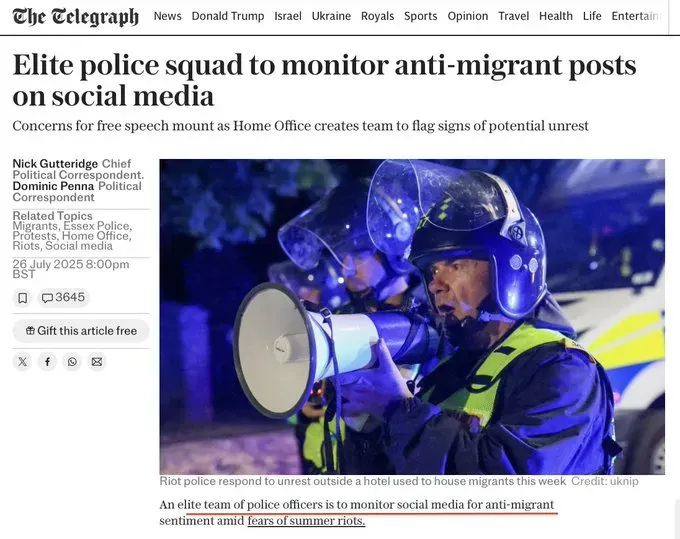
The UK Home Office has formed an elite team of police officers to monitor social media for “anti-migrant sentiment” as part of a new investigative unit designed to “identify early signs of potential civil unrest.” This National Internet Intelligence Investigations team will operate from the National Police Coordination Centre (NPoCC) in Westminster, drawing officers from forces across England and Wales.
The same agency that enforced COVID lockdowns is now tasked with “maximising social media intelligence” - a euphemism for mass surveillance of British citizens expressing dissent about immigration policy. Critics have branded the social media plans as “disturbing” with worries over it leading to censorship and restrictions of free speech.
 Meanwhile, the Online Safety Act has created a comprehensive censorship apparatus that goes far beyond child protection. Major websites and services such as Bluesky, Discord, Tinder, Bumble, Reddit, and X have introduced age verification systems that effectively create digital ID requirements for anonymous internet use. Proton VPN recorded a surge of more than 1,400% in UK signups within hours of the Online Safety Act taking effect on July 25, 2025 - a clear indication that British citizens are scrambling to escape government surveillance.
The Surveillance Infrastructure
The Online Safety Act represents far more than content moderation - it’s the legal foundation for a comprehensive digital surveillance state. While we have been told there’s no intention to read our personal messages, the government still admits there is at present no way to scan phones without breaking end-to-end encryption, and it reserves for itself the right to do so.
Age assurance often translates to mandatory digital identification systems that require users to verify their age through personal data, potentially including facial recognition, government-issued IDs, or other biometric markers. In practice, this means building a digital infrastructure that links individuals’ online activity to their real-world identity, drastically undermining privacy and anonymity on the internet.
Biometric Data: The Future of Personal Identification or a Privacy Nightmare?
The Electronic Frontier Foundation has warned that the OSB will lead to a much more censored, locked-down internet for British users. The bill could empower the government to undermine not just the privacy and security of U.K. residents, but internet users worldwide.
The Perversion of Justice
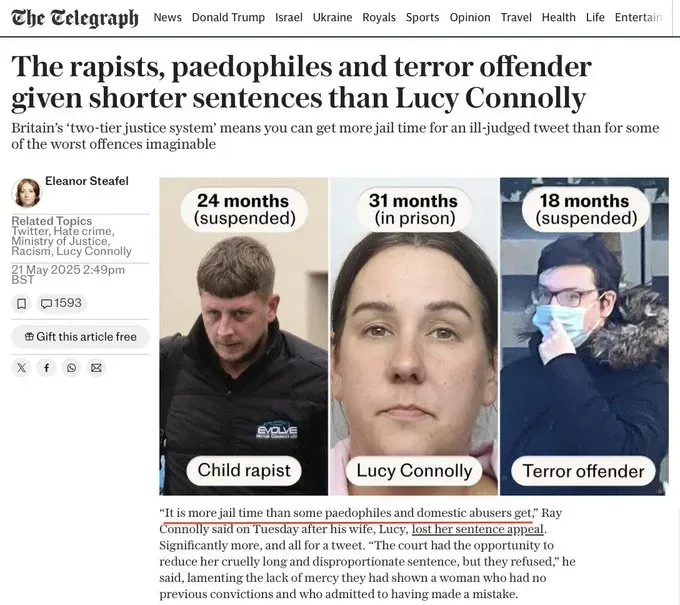
While the UK government constructs this digital panopticon to monitor citizens’ thoughts about immigration, its justice system demonstrates a moral inversion that defies comprehension. The case of Lucy Connolly - a childminder with no prior criminal record - epitomizes this dysfunction.
Connolly was sentenced to 31 months’ imprisonment for a social media post made in an emotional state following the Southport attack, which she deleted three hours after posting. Her crime was posting: “Mass deportation now. Set fire to all the fucking hotels full of the bastards for all I care. While you’re at it, take the treacherous government and politicians with them.”
Compare this to the systematic rape and abuse of children by grooming gangs, where perpetrators consistently receive lighter sentences than Connolly did for her deleted tweet.
Women’s Safety App Tea Suffers Massive Data Breach, Users’ IDs Exposed on 4chan
The Scale of Injustice
Members of a 2013 Telford grooming gang received lighter sentences than Connolly, with four of the seven men who pleaded guilty to various grooming offences receiving shorter sentences than her 31 months. Bannaras Hussain, a leading figure of the notorious Rotherham rape gang who was jailed for nineteen years after pleading guilty to ten charges including rape, indecent assault, and actual bodily harm against victims as young as eleven, was released on licence in December 2024 after serving only nine years.
This represents a justice system where a respected childminder with no previous criminal record receives more time behind bars for an impulsive social media post than some of the most heinous child abusers in British history.
The disparities extend beyond grooming gangs. Judge Melbourne Inman, who sentenced Connolly to 31 months, previously allowed a habitual child pornography offender to walk free from court without any prison time in 2021. The defendant, Anh La, was found to have 1,000 images and videos of child pornography accrued over a 10-year period, with more than 200 Category A images involving “penetrative sexual activity, sexual activity with an animal or sadism.”
BBC’s Huw Edwards received a suspended sentence after pleading guilty to making indecent images of children - another example of the two-tier justice system where speech crimes warrant imprisonment while actual crimes against children result in freedom.
The Broader Pattern
This isn’t an isolated aberration but a systematic pattern. Government statistics suggest that ethnic minority defendants are more likely than white defendants to receive an immediate custodial sentence, rather than a community sentence, for the same seriousness of offence, with ethnic minorities having a consistently higher average custodial sentence length for equivalent offences.
Yet somehow, in this supposedly “racist” justice system, a white British mother receives one of the harshest sentences on record for a social media post while predominantly ethnic minority grooming gang members walk free after serving minimal time for horrific crimes against white British children.
The number of offenders sentenced to immediate custody increased by 8% compared to the previous year, from 71,000 to 77,000 in the year to September 2024, with notable increases seen for theft (27%) and public order offences (20%). Meanwhile, the highest custody rate continued to be for sexual offences (56%) and robbery (55%) - but these statistics mask the reality that many serious sexual offenders serve minimal time compared to thought criminals.
The Death of Anonymity
The Online Safety Act’s age verification requirements effectively eliminate anonymous internet use in the UK. The introduction of digital ID systems for age verification creates a centralized repository of highly sensitive personal data; data that will become a prime target for hackers, corporations, and state surveillance.
This digital identification system, combined with the new police surveillance units monitoring social media, creates an infrastructure for total digital control. Citizens can no longer express dissent anonymously online without risking identification, arrest, and imprisonment.
Major Sex Trafficking Takedowns 2024-2025: A Global Crackdown on Digital Exploitation
A Government in Denial
Rather than address the legitimate concerns driving public frustration with mass immigration, the government’s response is to criminalize the expression of those concerns while ignoring the actual crimes committed by those they seek to protect from criticism.
While mostly peaceful, the government is reportedly deeply concerned of a potential re-run of last summer’s riots, which broke out in the wake of a second-generation Rwandan teen, Axel Rudakubana, who killed three schoolgirls. The government took a hard-line approach to what Prime Minister Starmer branded as “far-right” outpouring of anger, arresting over 1,280 people, including some who merely posted on social media.
Shadow Home Secretary Chris Philp said: “Two-tier Keir can’t police the streets, so he’s trying to police opinions instead. They’re setting up a central team to monitor what you post, what you share, what you think, because deep down they know the public don’t buy what they’re selling.”
PII Compliance Navigator | U.S. State Privacy Law Sensitive Data Categories
International Pressure and Trade Wars
The authoritarian overreach hasn’t gone unnoticed internationally. Reports emerged that a visiting US State Department delegation that met with UK’s regulator and Online Safety Act’s enforcer Ofcom expressed concerns about the legislation’s potential to suppress free speech. U.S. Vice-President J.D. Vance has already expressed concern about the erosion of free speech in Britain, and the potential for English courts prosecuting U.S. citizens is not likely to improve relations between the countries.
The UK risks damaging its “Special Relationship” with the United States over its commitment to digital authoritarianism and speech suppression.
Behind Closed Servers: The Hidden Crisis of Adult Entertainment Platform Security Breaches
The Road Ahead
Britain stands at a crossroads. The government can continue down the path of digital surveillance and thought policing while protecting actual criminals from consequence, or it can restore sanity to its justice system and respect for fundamental rights.
The British justice system appears to be at sixes and sevens, and the public is waking up to this fact. Nearly half of Britons (46%) think that life in prison is the appropriate sentence for child rapists, with 30% backing the death penalty. Yet these same citizens face imprisonment for expressing frustration with a system that protects the perpetrators while criminalizing the victims’ supporters.
The Online Safety Act and its accompanying surveillance apparatus represent the death of British liberty - not through foreign invasion or economic collapse, but through the slow strangulation of free speech and privacy by a government more interested in protecting its failed policies than protecting its people.
Until the UK reverses course on both digital surveillance and its inverted justice priorities, it will remain a cautionary tale of how quickly a free society can transform into an authoritarian state - one tweet, one thought crime, one surveillance program at a time.
The author encourages readers to use VPN services and encrypted communications to protect their privacy and fundamental right to anonymous expression, as these basic human rights are under direct assault by the British government.