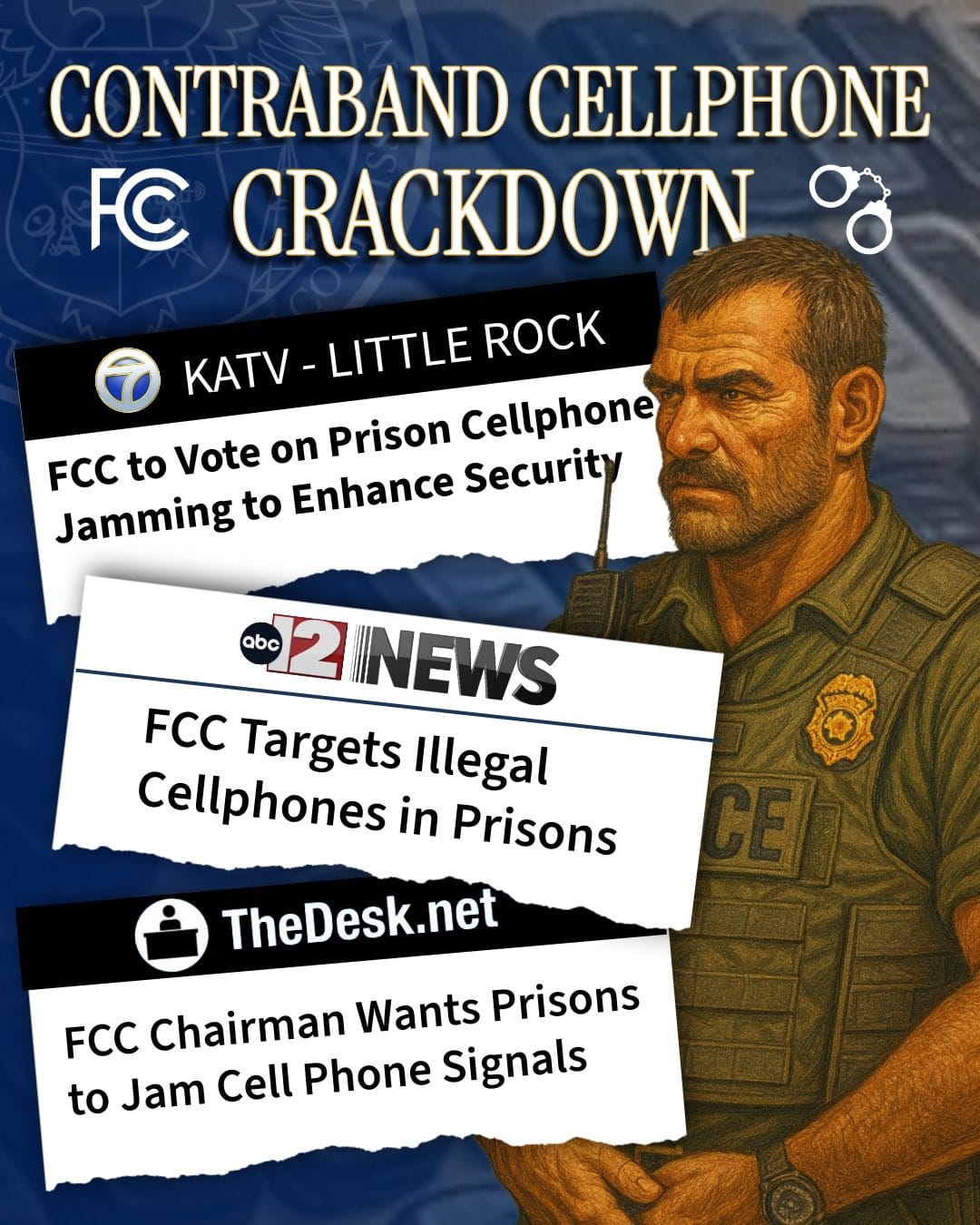
Agency takes unprecedented step to empower state and local corrections facilities to jam illegal phone signals
September 30, 2025
In a landmark decision that could reshape prison security nationwide, the Federal Communications Commission voted today to advance new regulations that would allow state and local correctional facilities to jam signals from contraband cellphones for the first time in U.S. history.
The proposal, which passed with approval from Chairman Brendan Carr and Commissioners Gomez and Trusty, aims to address what law enforcement officials describe as a growing public safety crisis. Thousands of smuggled cellphones have enabled incarcerated individuals to coordinate violent crimes, order murders, and run criminal enterprises from behind bars.
The Scope of the Problem
The scale of contraband cellphone infiltration into America’s prisons has reached alarming proportions. Georgia authorities alone confiscated more than 15,500 cellphones in 2024, with over 8,000 seized in 2023. Research suggests that as many as one in four incarcerated individuals possess or have access to an illegal cellphone.
These devices command premium black market prices within prison walls. Inmates pay up to $1,000 per phone, with correctional officers sometimes accepting bribes of several hundred dollars per device to smuggle them inside.
The consequences extend far beyond prison walls. In Atlanta, two 13-year-old boys were killed in a drive-by shooting ordered by an incarcerated gang leader using a contraband cellphone. In Tattnall County, Georgia, an imprisoned leader of the “Yves Saint Laurent Squad” gang used a contraband phone to order a hit that resulted in the death of an 88-year-old veteran.
Prison experts warn that cellphones represent perhaps the worst type of contraband because they provide inmates an easy, continuing connection to their criminal networks on the outside.
What the Proposal Entails
The Notice of Proposed Rulemaking represents a significant policy shift. Under current federal law, jamming technology—which creates a dead zone for cellphone reception—has been strictly prohibited for non-federal entities due to concerns about public safety interference.
The FCC’s proposal seeks to clarify that while jamming authorized radio transmissions remains illegal, signals from illegal mobile devices smuggled into prisons are not authorized and can therefore be actively blocked by FCC-approved equipment.
Key provisions include:
- Voluntary Implementation: The proposal would not mandate jamming technology for any correctional facility. Prison officials could choose whether to adopt these solutions based on their specific needs and circumstances.- Equipment Authorization Process: Any jamming solution deployed would require FCC approval and equipment authorization to ensure it meets technical standards.- Carrier Cooperation: The FCC would facilitate collaboration between corrections departments and wireless carriers, with a licensing structure available if good-faith negotiations fail.- Interference Prevention: The proposal prioritizes preventing harmful interference to legitimate wireless communications, particularly for Americans living, working, or traveling near prisons.
Years in the Making
The path to today’s vote has been long and contentious. Georgia Attorney General Chris Carr led a multi-year effort to change federal policy, fighting the previous administration to address what he characterized as a major public safety concern.
In February 2025, Carr met with the Trump administration’s FCC to discuss the urgency of the issue. The following month, he led a bipartisan coalition of 31 state attorneys general urging Congress to pass complementary federal legislation.
Chairman Carr noted that federal facilities have already recognized the value of cellphone jammers, with several federal penitentiaries, including at least one in Georgia, already using such devices.
“Prisoners with contraband cellphones are ordering murders, and this has to stop now,” Attorney General Carr stated in response to today’s vote. “We have heard from law enforcement throughout the state that our most effective solution is to jam the signal and make contraband cellphones obsolete.”
Technical and Safety Concerns
The proposal addresses longstanding concerns about jamming technology that have prevented its authorization in state facilities. Critics have historically warned that poorly designed or improperly deployed jamming systems could:
- Interfere with 911 emergency calls in surrounding communities- Disrupt police and firefighter radio communications- Block legitimate cellphone use by prison staff and visitors- Create security vulnerabilities for authorized users
Previous testing of jamming technology yielded mixed results. While some systems successfully blocked targeted signals, others caused significant problems—including one instance where a jamming system disabled cellphone service for approximately 200,000 nearby residents.
The FCC’s proposal specifically addresses these concerns by requiring rigorous technical protections and seeking public comment on how to achieve the right balance between security and preventing harmful interference.
Existing Alternatives
Prison officials currently employ various methods to combat contraband cellphones, though with limited success. These include physical searches, body scans, and netting installed along prison borders to deter people from throwing phones over fences or using drones for delivery.
The FCC has also established a Contraband Interdiction System (CIS) process, which allows correctional institutions to capture and drop calls from contraband phones and obtain identification information about targeted devices. However, this approach has proven less effective than many officials hoped.
Privacy and Civil Liberties Concerns
Not everyone views the proposal as positive progress. Prison advocacy groups warn that correctional authorities often seek to control information coming out of prisons, and that contraband phones have recently been used to report critical stories about prison conditions that the public needs to hear.
One incarcerated individual quoted in media reports noted that while some prisoners use contraband phones for criminal activities, the vast majority use them to stay connected with their families during long sentences or to pursue educational opportunities. “The most serious threat to politicians has been the exposure of the truth,” the source claimed.
Critics also note that prisoners already face prohibitively expensive costs for using authorized prison phone systems, which has created strong incentives for the contraband phone market.
Implementation Timeline
If the rulemaking process moves forward as expected, correctional facilities that opt to use jamming technology could begin implementation as early as 2026. The FCC will first seek public comment on the technical specifications and safeguards needed to ensure the systems work as intended without causing collateral damage to legitimate communications.
Twenty-three state attorneys general have signed letters supporting the proposal, suggesting widespread interest among states in adopting this technology once it becomes available.
Looking Ahead
The proposal represents a turning point in how American correctional facilities approach prison security in the digital age. For decades, prisons have struggled to keep pace with rapidly evolving technology that allows incarcerated individuals to maintain sophisticated criminal operations from their cells.
Whether cellphone jamming proves to be the solution that law enforcement hopes—or creates new problems that critics fear—will depend largely on the technical standards and oversight mechanisms established through the FCC’s rulemaking process.
What remains clear is that the current situation, with tens of thousands of contraband cellphones flowing into prisons annually and enabling serious crimes, has become untenable for correctional officials and the communities they serve.
The public comment period will provide an opportunity for all stakeholders—from corrections officials and wireless carriers to civil liberties advocates and technology experts—to shape the final regulations that could redefine prison communications for decades to come.
For more information about the FCC’s Notice of Proposed Rulemaking (FCC 25-65), visit the Federal Communications Commission website.