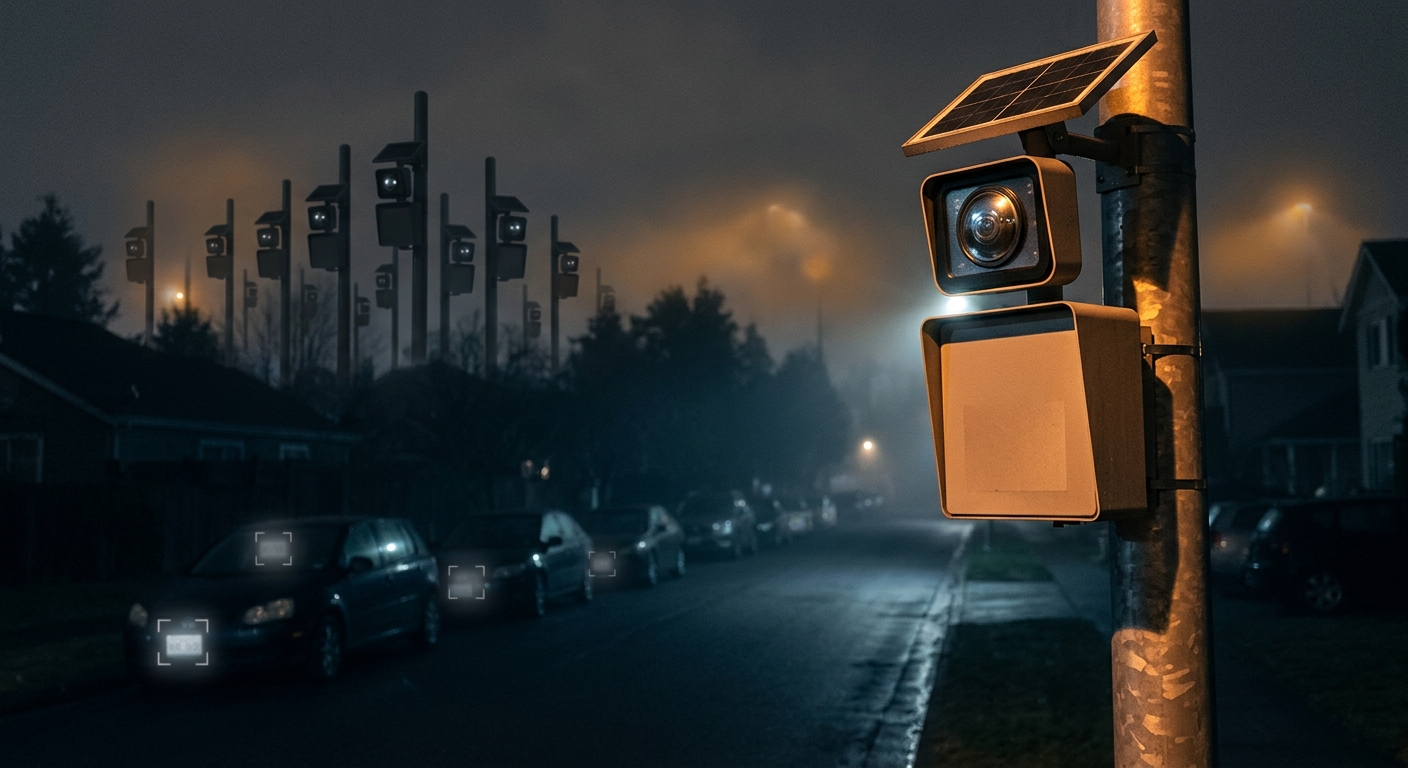
Flock Safety has announced a package of accountability and security changes to its automatic licence plate reader network. It arrives after a year of escalating documentation of misuse, and the changes are real. They are also, in the most literal sense, the company grading its own homework.
What prompted it
The trigger was not a policy debate. It was a pattern of individually documented abuse.
Investigations identified at least fifty officers across the country accused of using Flock’s plate network to stalk people they knew personally — ex-partners, current partners’ exes, family members, acquaintances. In August 2026 a North Carolina officer was arrested for running Flock plate searches 31 times to track her boyfriend’s ex-wife. Her own department caught her during an audit, which is the one encouraging detail in the story and also the reason the reforms centre on audit tooling.
Alongside that: wrongful stops at gunpoint triggered by plate reader hits, and searches run for purposes with no law enforcement basis at all.
This sits on top of the structural problems already surfaced this year — more than 100,000 cameras and federal access questions, and retail deployments feeding the same network.
What Flock changed
Default retention drops from 30 days to 7, unless data is tagged for preservation.
Audit tooling becomes mandatory for all customers. Flock’s Audit Assistance, which detects abnormal search activity and flags it for administrator review, moves from optional to required.
Case numbers required on all law enforcement searches by the end of 2026 — every query must be tied to a specific matter.
Proactive lockouts: a user’s ability to search the database is automatically suspended when their behaviour meets defined criteria for abnormality.
Taken on their own terms, these are the right four things. Retention reduction shrinks the historical corpus available for retrospective tracking. Case numbers create accountability at the point of query. Audits detect what policy alone cannot. Lockouts move enforcement from after-the-fact review to interruption.
Anyone who has argued for these controls should acknowledge that a vendor implementing them under public pressure is a better outcome than a vendor refusing to.
Why it is not enough
The word “warrant” does not appear.
That is the whole critique, and it is not a rhetorical one. Every change Flock announced governs how a search is performed and logged. None governs whether a search requires independent authorisation. An officer with a case number, whose behaviour looks normal to the anomaly detector, can still query the movements of any vehicle in a nationwide network on nothing more than their own judgment.
Case numbers are a paperwork control. The North Carolina officer could have opened a case number. Anomaly detection catches statistical outliers — 31 searches on one plate is an outlier; three searches is not, and three searches is enough to establish where someone sleeps.
Seven-day retention is a meaningful reduction and also a default, revisable by the customer through preservation tagging and revisable by Flock through a product decision. Nothing in it is durable. A policy is not a right. It survives exactly as long as the commercial and reputational conditions that produced it, and it applies only to the vendor that wrote it — competitors in the ALPR market are under no obligation to match any of it.
The category problem
ALPR data has slid into a legal gap that no court has definitively closed.
Individually, a plate read is a photograph of a car on a public road — historically not a search under the Fourth Amendment, because there is no reasonable expectation of privacy in a licence plate displayed in public.
Aggregated across 100,000-plus cameras and stored for weeks, it is a comprehensive record of a person’s movements: where they worship, whose house they park outside overnight, which clinic they visit, which meeting they attend, which protest they drove to. Carpenter v. United States recognised precisely this transformation for cell-site records — that a sufficiently comprehensive, effortless, retrospective movement record is different in kind from any single data point.
Several state courts have started applying that reasoning to ALPR. Massachusetts and Colorado have moved in that direction. There is no national rule, so the default remains: a database of everyone’s movements, queryable by any credentialed officer, on their own say-so.
Reducing retention from 30 days to 7 makes the Carpenter argument harder to win, incidentally, by shrinking the aggregate. That is a genuine privacy improvement and a genuine strategic complication for litigators.
What it means in practice
Self-regulation arrives when regulation is imminent, and stops the moment it recedes. Flock is in front of state legislatures and city councils across the country. These reforms are the argument that statute is unnecessary. They are being made in that context and should be read in it.
Audit tooling is the most durable change here — because it is the one that generates evidence. The North Carolina arrest happened because of an audit. Mandatory audit infrastructure across every customer means more misuse becomes visible, and visible misuse is what moves legislatures.
Consent was never obtained from anybody. No driver agreed to be enrolled. Cities and retailers made the decision on behalf of everyone who drives past. Municipal procurement remains the only place a member of the public gets a vote.
Local rejection works. Norman, Oklahoma’s council rejected Flock cameras twice. Dozens of other jurisdictions have declined or cancelled contracts. That is the mechanism that actually removes cameras.
What you can do
-
Find out whether your city has Flock or another ALPR system. Community-run mapping projects track deployments, and camera contracts are public records. Most residents have no idea.
-
Show up to the council meeting. ALPR contracts are approved locally, frequently on consent agendas with no discussion. This is one of the very few surveillance decisions where a member of the public can directly change the outcome.
-
File a public records request for search audit logs. Ask how many searches were run, by whom, with what case numbers, and how many were flagged. Departments rarely publish this. Requesting it is how misuse gets found.
-
Ask for a written policy, not the vendor’s. The binding question is what your department requires — warrant, supervisor approval, or nothing — not what Flock’s product allows.
-
Support state ALPR legislation with a judicial authorisation requirement. Retention limits are useful; the durable protection is a warrant standard for querying, and no vendor is going to write that one for you.