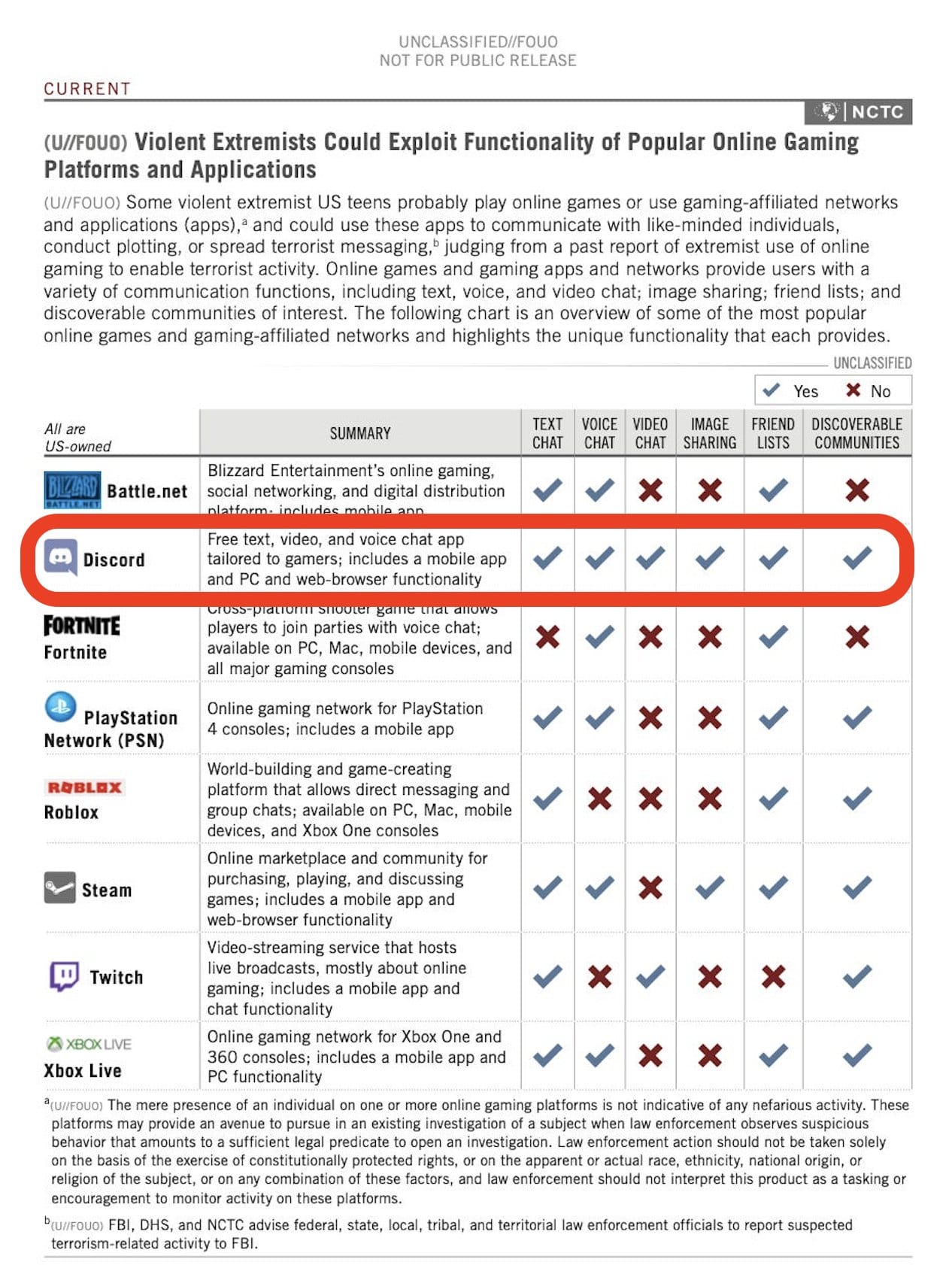
The worlds of online gaming and federal law enforcement are colliding in ways that most players never anticipated. A recently leaked intelligence briefing from the National Counterterrorism Center (NCTC) has revealed the extent to which federal agencies are monitoring popular gaming platforms—and what this means for user privacy deserves serious examination.
The Surveillance Framework
The leaked NCTC document examines how violent extremists might exploit gaming platforms, listing popular services including Battle.net, Discord, Fortnite, PlayStation Network, Roblox, Steam, Twitch, and Xbox Live. But the document represents just the tip of the iceberg when it comes to government interest in gaming spaces.
According to a Government Accountability Office report, gaming companies have established mechanisms to coordinate with the FBI and Department of Homeland Security to identify and report content related to domestic violent extremism. The DHS intelligence office holds meetings where companies can share information about online activities promoting domestic violent extremism or even activities that violate the companies’ terms of service.
How the System Works
Through the FBI’s 56 field offices and hundreds of resident agencies, the Bureau receives tips from gaming companies about potential law-breaking and extremist views for further investigation. The relationship is bidirectional: the FBI also conducts briefings to gaming companies on purported threats.
Discord, for example, utilizes a Government Request Portal specifically designed for law enforcement to submit data requests and communicate with the company. Roblox maintains direct communication channels with organizations such as the FBI and the National Center for Missing and Exploited Children for immediate escalation of serious threats.
The scope extends beyond reactive reporting. Some platforms proactively escalate potential safety threats—including terrorism, violent extremism, or individualized threats of violence—through direct integrations with the FBI.
The Privacy Implications
Massive Data Collection
Gaming platforms collect far more personal information than many users realize. Applications and devices may collect users’ banking information and track users’ location, interaction with games, devices, and other applications, as well as biometric data such as eye posture, voice, and heart rate.
Modern game devices pose serious threats to consumer privacy through their potential for surveillance and user profiling. Research has shown that gaming data can reveal sensitive information about users’ biometric identity, age, gender, emotions, skills, interests, consumption habits, and personality traits.
A significant privacy concern arises when game profile data within one platform—such as network registration information—is linked to other personal information such as usernames and passwords from social media accounts.
Children Are Particularly Vulnerable
The privacy stakes are especially high for younger users. Approximately 58% of online game users are under the age of 16, making them more vulnerable to certain tactics, and privacy policy disclosures may not be effective for this demographic.
The largest fine ever imposed under the Children’s Online Privacy Protection Act—$275 million—was levied against a gaming company in 2023, demonstrating that regulators are taking these concerns seriously.
The Double-Edged Sword
The coordination between gaming platforms and law enforcement exists for legitimate safety reasons. In January 2025, U.S. authorities arrested a Texas resident after another Roblox user reported in-game threats of violence to the FBI. The individual had used Roblox chat to discuss planning attacks and was quickly identified through platform cooperation with law enforcement.
However, the same mechanisms that enable the reporting of genuine threats also create a surveillance infrastructure with troubling implications for privacy and civil liberties.
What Categories Are Being Monitored?
Since 2019, the U.S. government has employed five domestic terrorism threat categories: racial/ethnically motivated violent extremism, anti-government/anti-authority violent extremism, animal rights or environmental violent extremism, abortion-related violent extremism, and all other domestic terror threats.
These categories are so broad that questions arise about where the line is between responsible intervention and potential Big Brother overreach when someone expresses strong political opinions online. There is no federal law that criminalizes “domestic violent extremism” as a specific category of crime, yet it has become a primary focus of monitoring efforts.
The Transparency Problem
The GAO warns that FBI and DHS lack an overarching strategy to align their work with gaming companies with broader agency missions, stating that without a strategy or goals, the agencies may not be fully aware of how effective their communications are with companies.
Research has concluded that transparency regarding gaming companies’ data practices could be much improved, especially regarding sharing with third-party affiliates. Many platforms use vague, PR-friendly language in public statements rather than providing clear information about their data-sharing practices with government agencies.
What Users Can Do
Understand Platform Policies
Take time to read the privacy policies and terms of service for the platforms you use, particularly sections about data sharing with law enforcement and third parties.
Minimize Data Exposure
Choose a username that doesn’t include your real name or other identifying information, and consider using different email addresses, profile pictures, and strong passwords for gaming versus other online activities.
Review Privacy Settings
Each console system or game company has different privacy defaults and options that determine how much information other users can see about you and your contacts. Take the time to configure these settings restrictively.
Be Cautious About Communications
As games transition from in-game conversations to real life, privacy and safety concerns may increase, particularly when platforms link a player’s online presence to a specific location.
Educate Young Gamers
Parents and guardians should have open conversations with children about online privacy, the information they share, and the permanence of digital communications.
The Bigger Picture
The gaming industry’s cooperation with federal law enforcement reflects a broader trend of tech platforms serving as intermediaries in government surveillance. While legitimate safety concerns exist—particularly around child exploitation and credible threats of violence—the infrastructure being built has implications that extend far beyond these specific use cases.
With many millions of users across all age groups and income levels, video games have become the world’s leading entertainment industry, and the associated privacy risks are comparable to those stemming from social media platforms.
As gaming continues to grow more social, more immersive, and more integrated into daily life, the privacy implications of these platforms will only become more significant. Users deserve clear information about how their data is collected, used, and shared—including with government agencies.
The current system operates largely in the shadows, with vague disclosures and inconsistent practices across platforms. Greater transparency, stronger privacy protections, and meaningful oversight are essential to ensure that efforts to address legitimate safety concerns don’t come at the unacceptable cost of pervasive surveillance of millions of gamers.
This article examines developments in gaming platform surveillance based on publicly available government documents and reports. Users concerned about their privacy should review the specific policies of platforms they use and consider how much personal information they wish to share in gaming environments.