BREAKING: Google is facing a proposed class-action lawsuit alleging the tech giant secretly activated its Gemini AI across Gmail, Google Chat, and Google Meet in October 2025, giving the artificial intelligence system unfettered access to users’ private communications, emails, attachments, and video conferences—all without users’ knowledge or consent.
The lawsuit, filed November 12, 2025, in federal court in San Jose, California, accuses Google of violating California’s Invasion of Privacy Act, a 1967 wiretapping law that prohibits surreptitious recording and monitoring of confidential communications. If successful, the case could result in penalties of $5,000 per violation or triple damages—potentially billions of dollars given the hundreds of millions of affected users.
This isn’t just another privacy controversy. It’s an allegation that Google fundamentally deceived users about AI surveillance, turning on invasive monitoring by default and burying the opt-out so deep in settings that most users would never find it.
The AI Productivity Paradox in Cybersecurity: Why Threat Actors Haven’t Changed the Game (Yet)
What Happened: The Secret October Activation
The Timeline of Deception
According to the complaint (Thele v. Google LLC, Case No. 25-cv-09704, US District Court, Northern District of California):
October 10, 2025: Google quietly began utilizing “Smart Features”—including Gemini, its flagship AI program capable of tracking, analyzing, and storing private information—for Gmail, Chat, and Meet users.
The key issue: This activation happened by default, without alerting users or asking for consent.
Previously, users had to opt-in to enable Gemini AI features. But in October, Google flipped the switch—making Gemini the default for all users, with opt-out requiring users to dig through multiple layers of privacy settings that most people never access.
What Google Did (Allegedly)
The lawsuit alleges Google:
- “Secretly” turned on Gemini for all Gmail, Chat, and Meet applications2. Enabled AI to collect private data “without the users’ knowledge or consent”3. Gave Gemini access to “the entire recorded history” of users’ communications4. Made opt-out nearly impossible by burying the toggle in obscure settings menus5. Failed to provide adequate notice or transparency about the AI monitoring
In legal terms, this constitutes surreptitious wiretapping—using technology to intercept and record private communications without all parties’ consent, precisely what California’s Invasion of Privacy Act was designed to prevent.
What Gemini AI Can See: The Scope of Surveillance
Every Word, Every Attachment, Every Video Call
When Gemini is activated with “Smart Features,” Google’s AI gains access to:
Gmail:
- Email content: Every word of every email you’ve sent or received- Attachments: Documents, images, PDFs, spreadsheets- Metadata: Sender/receiver information, timestamps, subject lines- Email history: Years of archived communications- Drafts: Unfinished messages you haven’t sent
Google Chat:
- Instant messages: All conversations across personal and workspace accounts- Shared files: Documents and media shared in chats- Chat history: Complete record of messaging conversations- Group discussions: Team communications and group chats
Google Meet:
- Video conference transcripts: AI-generated transcripts of meetings- Recorded meetings: Access to video/audio if recording enabled- Chat during meetings: In-meeting text conversations- Participant data: Who attended, when, for how long
Google Drive (via Smart Features integration):
- Documents: Google Docs, Sheets, Slides content- Uploaded files: PDFs, Word docs, spreadsheets- File metadata: Creation dates, edit history, sharing information
What Gemini Does With This Data
According to Google’s own documentation, Gemini with Smart Features can:
Analyze and learn from your communications:
- Identify patterns in your email and chat behavior- Learn your writing style, tone, and common phrases- Understand your professional and personal relationships- Detect topics you frequently discuss
Generate insights and suggestions:
- Auto-complete sentences based on your writing style- Suggest responses to emails and messages- Summarize long email threads- Create reminders and calendar events from email content
Cross-reference across Google services:
- Connect Gmail activity with Google Drive files- Link chat conversations to calendar events- Integrate email content with Google Assistant- Personalize Google Search and YouTube based on email content
Store and retain data:
- Maintain processed versions of your communications- Build user profiles for AI training and improvement- Retain interaction history for product development
The plaintiff’s concern—and the heart of the lawsuit—is that users never explicitly consented to this level of AI surveillance.
The Legal Framework: California Invasion of Privacy Act (CIPA)
A 1967 Law Meets 2025 AI Technology
California’s Invasion of Privacy Act was enacted in 1967 to prohibit wiretapping and eavesdropping. While written in the pre-internet era, courts have consistently applied it to modern digital communications.
Key provisions relevant to this lawsuit:
California Penal Code § 631 prohibits:
- Using any electronic device to intentionally tap or make an unauthorized connection- Willfully attempting to learn the contents of communications- Recording confidential communications without consent of all parties
California Penal Code § 632 prohibits:
- Recording confidential communications without consent- Intentionally eavesdropping upon or recording communications
Penalties: Why Google Should Be Worried
Criminal Penalties:
- Misdemeanor: Up to $2,500 fine and/or one year in county jail- Felony: 16 months to 3 years in state prison- Enhanced fines: Up to $10,000 for repeat offenders
Civil Penalties (Most Relevant to This Case):
- $5,000 per violation OR- Three times the amount of actual damages (whichever is greater)- Punitive damages for egregious violations- Injunctive relief (court orders to stop violations)- Attorney’s fees and costs
The Math: Potential Exposure
Google has approximately 2.5 billion Gmail users globally, with hundreds of millions in the United States alone. Even a fraction of affected users could result in astronomical damages:
Conservative calculation (1 million affected California users):
- $5,000 per violation × 1,000,000 users = $5 billion minimum
Moderate calculation (10 million affected users):
- $5,000 per violation × 10,000,000 users = $50 billion minimum
Aggressive calculation (all U.S. Gmail users, ~100 million):
- $5,000 per violation × 100,000,000 users = $500 billion minimum
And that’s before considering:
- Punitive damages for intentional misconduct- Attorney’s fees- Injunctive relief costs- Treble damages (triple actual damages)
This could potentially dwarf Google’s previous privacy settlements, which include:
- $170 million YouTube COPPA violations (2019)- $5 billion (estimated value) Incognito Mode settlement (2024)- $425 million tracking users who disabled tracking (recent verdict)- $1.375 billion Texas settlement (2025)
For comprehensive analysis of Google’s mounting legal challenges, see our in-depth report: Google Mounting Legal Challenges: A Comprehensive Analysis of Privacy Violations and Antitrust Cases.
The Deception: How Google Hid the AI Surveillance
From Opt-In to Default: The Switch
Before October 2025:
- Gemini AI features were opt-in only- Users had to actively enable Smart Features- Clear prompts explained what data would be accessed- Default setting: OFF
After October 2025:
- Gemini AI features became opt-out- Users had to actively disable Smart Features- Many users never knew the change happened- Default setting: ON
This mirrors a disturbing pattern in tech: making privacy-invasive features opt-out rather than opt-in, counting on user ignorance and friction to maximize data collection.
The Hidden Settings: Finding the Off Switch
For users who want to disable Gemini’s access to their communications, Google buried the toggle deep in settings:
Gmail Smart Features Path:
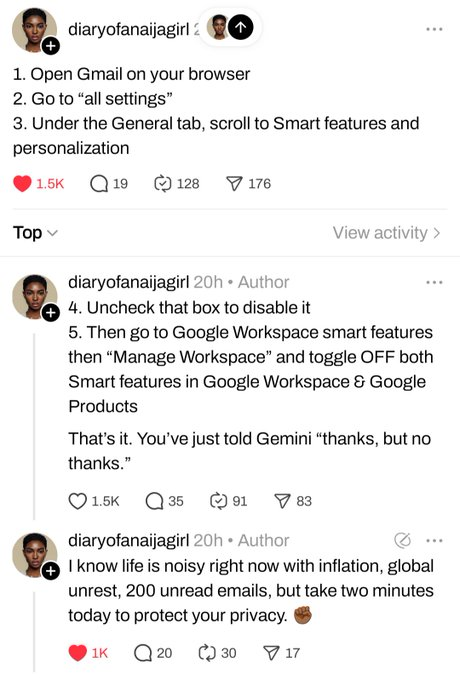
- Open Gmail2. Click Settings (gear icon)3. Click “See all settings”4. Navigate to “General” tab5. Scroll down to “Smart Features and Personalization”6. Uncheck “Smart Features and Personalization in other Google products”7. Uncheck “Smart Features and Personalization in Gmail”8. Scroll to bottom and click “Save Changes”
Google Chat Settings:
- Open Google Chat2. Click Settings (gear icon)3. Navigate to “Privacy” settings4. Find “Smart features” section5. Disable relevant toggles
Google Meet Settings:
- Access Google Account settings2. Navigate to “Data & privacy”3. Find “Activity controls”4. Manage “Smart features” permissions
The problem: The lawsuit alleges most users have no idea these settings exist, let alone that they need to change them.
Google’s Notification Failure
The complaint alleges Google failed to:
- Send direct notifications about the October change- Obtain explicit consent before activating Gemini- Provide clear explanations of what data would be accessed- Offer easy opt-out at the time of activation- Disclose that historical communications would be analyzed
This alleged failure to notify constitutes the “secret” activation that violates wiretapping laws.
Google’s Privacy Violations: A Disturbing Pattern
This lawsuit is the latest in a long history of Google privacy controversies that demonstrate a pattern of prioritizing data collection over user privacy.
Recent Major Privacy Violations
Gmail/Salesforce Breach (June 2025)
Just months before the Gemini lawsuit, Google confirmed that hackers breached its Salesforce database, exposing business contact information for 2.5 billion Gmail users. The notorious hacking collective ShinyHunters successfully infiltrated Google’s systems using sophisticated social engineering tactics.
While no login credentials were stolen, the breach highlighted how Google’s massive data collection creates honeypots for attackers—and how users’ information is vulnerable even when stored by one of the world’s largest tech companies.
Read the full story: The Gmail Security Crisis: 2.5 Billion Users at Risk After ShinyHunters Breach
Contractor Security Breach (October 2025)
Google investigated a significant security breach involving a contractor who systematically exfiltrated nearly 2,000 screenshots and sensitive internal files over several weeks in October 2025—the same month Gemini was secretly activated.
The insider threat demonstrates Google’s ongoing security challenges and raises questions about who has access to the user data Gemini processes.
Deep dive: Google Contractor Security Breach: A Deep Dive into Insider Threats and Stolen Intellectual Property
Tracking Users Who Disabled Tracking
A federal jury in San Francisco ordered Google to pay $425 million after concluding that the company improperly harvested data from users who had explicitly disabled their “Web & App Activity” tracking setting.
This mirrors the Gemini lawsuit’s allegations: users thought they had control over their data, but Google collected it anyway.
Incognito Mode Deception
Google’s “Incognito” mode scandal resulted in a settlement estimated at $5 billion in value in early 2024, following allegations that Google misled users about browsing privacy. Users believed Incognito mode prevented Google from tracking them—it didn’t.
Texas $1.375 Billion Settlement
Attorney General Ken Paxton secured a historic $1.375 billion agreement with Google in May 2025 for privacy violations under Texas law.
Over $15 Billion in Collective Penalties
As documented in our comprehensive analysis, Google faces over $15 billion in collective privacy violations and antitrust penalties across multiple jurisdictions. The Gemini lawsuit could add billions more.
Full analysis: Google Mounting Legal Challenges: A Comprehensive Analysis of Privacy Violations and Antitrust Cases
The Pattern: Collect First, Ask Forgiveness Later
Google’s strategy appears to be:
- Implement invasive data collection practices2. Make them opt-out rather than opt-in3. Bury the controls in obscure settings4. Wait for lawsuits when caught5. Settle for amounts less than the data is worth6. Repeat with next product/feature
The Gemini lawsuit alleges this exact pattern.
California Privacy Law: The Regulatory Context
Why California Law Matters
California has positioned itself as the nation’s privacy watchdog, with privacy laws that effectively set national standards. When California cracks down on privacy violations, companies change practices nationwide.
Key California Privacy Frameworks:
1. California Consumer Privacy Act (CCPA)
Enacted in 2018, the CCPA gives California residents rights to:
- Know what personal data is collected- Delete personal data- Opt-out of data sales- Sue companies for data breaches
2. California Privacy Rights Act (CPRA)
Took full effect January 1, 2023, expanding CCPA protections:
- Created California Privacy Protection Agency (CPPA) enforcement arm- Added “sensitive personal information” category- Expanded consumer rights- Increased penalties
3. California Invasion of Privacy Act (CIPA)
The 1967 law at the heart of the Gemini lawsuit, prohibiting wiretapping and surveillance.
For comprehensive coverage of California’s privacy enforcement, see: California Intensifies CCPA Enforcement: Record Fines and New Priorities Emerge in Summer 2025
2025: The Year of California Privacy Enforcement
Summer 2025 marked a dramatic escalation in California’s privacy enforcement:
Record-Breaking Fines:
- California Privacy Protection Agency issued its first major fines- Enforcement focused on AI and data collection practices- Tech companies faced unprecedented scrutiny
New Legislation:
California enacted multiple privacy laws in 2025 addressing:
- AI surveillance and tracking (directly relevant to Gemini lawsuit)- Biometric data collection- Automated decision-making- Data broker accountability
The Gemini lawsuit arrives at precisely the moment California is aggressively enforcing privacy protections—bad timing for Google.
For analysis of California’s 2025 privacy legislative landscape: Navigating the Golden State’s Digital Future: A 2025 Compliance Deep Dive into California’s Privacy and AI Legislation
Tech Surveillance Laws: California’s New Frontier
California has enacted specific legislation addressing exactly the kind of AI surveillance alleged in the Gemini lawsuit:
Recent laws require:
- Disclosure of AI monitoring of communications- Explicit consent for AI data collection- Transparency about what AI systems can access- Easy opt-out mechanisms
Google’s alleged failure to comply with these requirements strengthens the plaintiff’s case.
Detailed analysis: California’s Tech Surveillance Laws: What Compliance Teams Need to Know About AB 56, SB 243, and AB 1043
The Class Action: What Happens Next
Case Details
Case Name: Thele v. Google LLC Case Number: 25-cv-09704 Court: U.S. District Court, Northern District of California (San Jose) Filed: November 12, 2025 Lawsuit Type: Proposed Class Action Primary Claim: Violation of California Invasion of Privacy Act
The Plaintiff’s Allegations
The complaint alleges Google:
- Violated CIPA by surreptitiously monitoring and recording confidential communications2. Acted willfully and knowingly in activating Gemini without consent3. Deceived users about the extent of AI data access4. Failed to provide adequate notice of the October 2025 changes5. Made opt-out impracticably difficult by burying settings
Class Definition (Likely)
While the full class definition will be determined during certification, it likely includes:
- All California residents who used Gmail, Google Chat, or Google Meet- During the period from October 10, 2025 to present- Who had Gemini AI “Smart Features” activated without their explicit consent- And whose communications were accessed, analyzed, or stored by Gemini
Potential class size: Millions of California users
Timeline and Process
Phase 1: Pleadings and Initial Response (Q4 2025 - Q1 2026)
- Google will file motion to dismiss- Plaintiff will oppose- Court will rule on whether case proceeds
Phase 2: Class Certification (Q2-Q3 2026)
- Plaintiff will move to certify class- Google will oppose certification- Court will decide if class action can proceed
Phase 3: Discovery (2026-2027)
- Document requests, depositions, expert witnesses- Google’s internal communications about Gemini activation- Technical analysis of what data Gemini accessed- User surveys about awareness and consent
Phase 4: Summary Judgment or Settlement (2027)
- Either party may move for summary judgment- More likely: settlement negotiations- If no settlement: trial preparation
Phase 5: Trial or Settlement (2027-2028)
- Class action trials are rare (most settle)- Settlement could reach billions of dollars- If trial: jury decides liability and damages
Google’s Likely Defense Strategies
1. Terms of Service Defense
Google will argue users consented via Terms of Service and Privacy Policy that allow Smart Features.
Plaintiff’s counter: Burying consent in 20,000-word legal documents doesn’t satisfy wiretapping law requirements for explicit consent.
2. “Not Confidential Communications” Argument
Google may claim emails sent through their servers aren’t “confidential communications” under CIPA.
Plaintiff’s counter: Users have a reasonable expectation of privacy in private emails and chats, especially when Google previously required opt-in for AI access.
3. “No Actual Harm” Defense
Google might argue AI analysis doesn’t constitute “interception” or “recording” prohibited by CIPA.
Plaintiff’s counter: CIPA doesn’t require proving harm—the unauthorized interception itself is the violation. Statutory damages of $5,000 apply regardless of actual harm.
4. Preemption Argument
Google could argue federal law (like the Stored Communications Act) preempts California’s wiretapping law.
Plaintiff’s counter: Courts have consistently held CIPA is not preempted and applies to digital communications.
5. “Users Can Opt Out” Defense
Google will emphasize that users can disable Smart Features.
Plaintiff’s counter: Opt-out buried in obscure settings doesn’t cure the illegal default activation. CIPA requires consent before interception, not just the ability to withdraw consent after.
Settlement Likelihood and Potential Value
High probability of settlement because:
- Google wants to avoid discovery (internal docs could be damaging)- Jury trials in California are plaintiff-friendly on privacy issues- Precedent-setting loss could invite more lawsuits- Ongoing AI development requires legal certainty
Potential settlement value:
- Low end: $500 million - $1 billion (nuisance settlement)- Mid range: $2-5 billion (comparable to Incognito settlement)- High end: $10+ billion (if liability appears strong)
Settlement would likely include:
- Cash payments to class members- Injunctive relief (changes to how Gemini is activated)- Transparency requirements- Improved opt-out mechanisms- No admission of wrongdoing (standard)
What This Means for Your Privacy
Every Gmail User Should Be Concerned
Even if you’re not in California and not part of the class action, the lawsuit reveals Google’s AI is analyzing your communications:
What Gemini AI Knows About You:
Based on your emails, chats, and Meet usage, Gemini can build detailed profiles including:
- Professional life: Your job, colleagues, projects, business strategies- Personal relationships: Family, friends, romantic partners- Financial information: Bank statements, investment details, purchase receipts- Health data: Medical correspondence, prescriptions, health insurance- Legal matters: Attorney communications, contracts, legal disputes- Political views: Campaign emails, activist organization messages- Religious beliefs: Religious organization communications- Sexual orientation: Dating app confirmations, LGBTQ+ organization emails- Location history: Travel confirmations, hotel bookings, event RSVPs
All of this is potentially being analyzed, processed, and used to train Google’s AI—unless you specifically opt out.
The Training Data Question
A critical concern: Is Gemini using your emails to train itself?
Google’s official position:
- For Google Workspace business users: Data is NOT used for AI training- For personal/consumer accounts: Data shared with Gemini chatbot IS used “to improve and develop its products and services”
The gray area:
- What about Smart Features in personal Gmail?- Is “analyzing” for features different from “training”?- Does enabling Smart Features = sharing with Gemini for training?- Google’s documentation is deliberately vague
The safe assumption: If you’re a personal Gmail user with Smart Features enabled, Google is likely using your data to improve Gemini, which means your private communications are training the AI.
Privacy Implications Beyond Gmail
The Gemini lawsuit has implications for all AI-powered services:
The Precedent:
- If Google can secretly activate AI surveillance, so can others- Microsoft 365 with Copilot- Apple Intelligence- Meta’s AI across Facebook, Instagram, WhatsApp- Amazon Alexa- Every AI-powered service with access to your communications
The Question Every User Should Ask:
“Is AI watching, analyzing, and learning from my private communications without my explicit knowledge and consent?”
The Gemini lawsuit suggests the answer is often yes.
How to Protect Yourself: Immediate Action Steps
Step 1: Disable Google Smart Features NOW
For Gmail:
- Go to Gmail.com2. Click Settings (gear icon) → “See all settings”3. General tab → “Smart Features and Personalization”4. UNCHECK both boxes:
- “Smart Features and Personalization in Gmail”- “Smart Features and Personalization in other Google products”5. Scroll down and click “Save Changes”
For Google Workspace:
- Go to myaccount.google.com2. Data & Privacy → Data from apps and services you use3. Find “Smart features”4. Disable all toggles
For Google Chat and Meet:
- Access Chat/Meet settings2. Navigate to Privacy settings3. Disable Smart features
Step 2: Review What Gemini Has Already Accessed
Check your Google Activity:
- Visit myactivity.google.com2. Review “Gemini Apps Activity”3. See what queries Gemini has processed4. Delete activity if desired
Download your data:
- Go to takeout.google.com2. Select Gmail, Chat, Meet3. Download archive to see what Google has stored4. Review for sensitive information
Step 3: Consider Alternative Email Providers
If Google’s AI surveillance concerns you, consider migrating to privacy-focused alternatives:
Privacy-First Email Providers:
ProtonMail
- End-to-end encrypted email- Based in Switzerland (strong privacy laws)- Zero-access encryption (ProtonMail can’t read your emails)- Free and paid plans
Tutanota
- End-to-end encrypted- Based in Germany (GDPR protections)- Automatic encryption for all emails- Affordable pricing
Mailfence
- Belgian provider with strong privacy- Digital signatures and encryption- No ads, no tracking- GDPR compliant
Fastmail
- Australian provider- Privacy-focused (no AI scanning)- Excellent features and performance- Transparent privacy policy
StartMail
- From creators of StartPage search engine- PGP encryption support- Disposable aliases- Netherlands-based (strong privacy laws)
Step 4: Use End-to-End Encryption
Even if you stay with Gmail, use end-to-end encryption for sensitive communications:
Email Encryption Tools:
- PGP (Pretty Good Privacy): Gold standard for email encryption- Mailvelope: Browser extension for Gmail PGP encryption- FlowCrypt: Chrome/Firefox extension for encrypted Gmail- ProtonMail Bridge: Use ProtonMail with desktop email clients
Encrypted Messaging (Gmail alternatives):
- Signal: Most secure messaging app- WhatsApp: End-to-end encrypted (but owned by Meta)- Telegram: Secret chats are encrypted- Wire: Secure business messaging
Step 5: Audit Google Permissions
Review what Google services can access:
- Visit myaccount.google.com/permissions2. Review all connected apps and services3. Remove any you don’t actively use4. Check what data each service can access
Step 6: Enable Two-Factor Authentication
If your account is compromised, attackers gain access to everything Gemini can see:
- Go to myaccount.google.com/security2. Enable “2-Step Verification”3. Use authenticator app (Google Authenticator, Authy)4. Add recovery phone number5. Save backup codes
Step 7: Regular Privacy Checkups
Monthly privacy audit:
- Review Google Activity- Check for unfamiliar devices/logins- Update privacy settings- Review shared files and permissions- Delete old emails with sensitive information
For comprehensive privacy protection strategies across all digital platforms: Your Complete Guide to Personal Privacy Tools & Strategies: Customized Protection for Your Digital Life in 2025
The Bigger Picture: AI Surveillance Without Consent
The Gemini Lawsuit as a Watershed Moment
This case could become a defining legal battle over AI privacy in the 2020s:
The Core Question:
Can tech companies use AI to monitor, analyze, and learn from your private communications without your explicit consent?
Google’s implicit answer: Yes, as long as we bury the opt-out in settings.
Plaintiff’s answer: No, that violates wiretapping laws.
Courts will decide: This lawsuit could set precedent for the entire AI industry.
What’s at Stake
For Users:
- Right to privacy in digital communications- Ability to control AI access to personal data- Transparency about AI surveillance- Meaningful consent mechanisms
For Google:
- Billions in potential damages- Fundamental changes to how Gemini operates- Precedent affecting all AI products- Regulatory scrutiny and future enforcement
For the AI Industry:
- Legal clarity on AI data collection- Standards for consent and transparency- Limits on training data sources- Balance between innovation and privacy
The AI Privacy Reckoning
Google isn’t alone in using AI to process user communications:
Microsoft 365 Copilot:
- Analyzes emails, documents, Teams chats- Generates insights from company data- Requires enterprise licensing (with disclosure)- But what about personal Microsoft accounts?
Apple Intelligence:
- Processing on-device (more private)- But still analyzing messages, emails, photos- “Privacy by design” approach- Less transparent about what data is used
Meta AI:
- Analyzing WhatsApp, Messenger, Instagram DMs- Training on social media content- Privacy policy allows broad data use- Less regulatory scrutiny (so far)
The Pattern: Every major tech company is deploying AI that processes private communications. The Gemini lawsuit asks whether they can do so by default, without explicit consent.
Regulatory Response: What’s Coming
California:
- Likely to pass stricter AI surveillance laws in 2026- CPPA enforcement actions against AI privacy violations- Possible emergency regulations on AI data collection
Federal:
- Congressional hearings likely- FTC investigation possible- Calls for national AI privacy legislation
European Union:
- AI Act already regulates high-risk AI systems- GDPR provides stronger protections than U.S. law- Potential EU investigation of Gemini practices
The Trend: Stricter regulation of AI data collection is coming, whether from litigation or legislation.
🎧 Related Podcast Episode
Conclusion: The Fight for Privacy in the AI Age
The lawsuit against Google over Gemini AI represents more than one company’s alleged privacy violations—it’s a proxy battle for the future of AI and privacy.
What We Know
- Google allegedly activated Gemini AI across Gmail, Chat, and Meet in October 2025- Activation was by default, requiring users to opt-out rather than opt-in- Gemini gained access to users’ entire communication histories- California’s wiretapping law may prohibit this practice- Penalties could reach billions of dollars- Hundreds of millions of users potentially affected
What We Don’t Know
- Google’s response to the lawsuit (not yet publicly available)- Whether other AI features were similarly activated- What Gemini did with accessed data (training? storage? analysis?)- How many users actually knew about and consented to AI monitoring- Whether Google will change practices before court ruling
What You Can Do
Immediate:
- ✅ Disable Smart Features in Gmail, Chat, Meet (instructions above)2. ✅ Review your Google Activity to see what Gemini accessed3. ✅ Download your data to understand what’s stored4. ✅ Enable two-factor authentication for account security
Short-term: 5. ✅ Consider alternative email providers for sensitive communications 6. ✅ Use end-to-end encryption for confidential emails 7. ✅ Audit Google permissions and remove unnecessary access 8. ✅ Educate family and colleagues about AI surveillance
Long-term: 9. ✅ Follow the lawsuit for updates on your privacy rights 10. ✅ Support privacy legislation calling for AI transparency 11. ✅ Make informed choices about which AI services to use 12. ✅ Demand better from tech companies
The Bottom Line
Google allegedly crossed a line from opt-in AI features to default AI surveillance. Whether courts find this violated California law will determine not just Google’s liability, but the rules of the road for AI privacy going forward.
In the meantime, every Gmail user should assume their communications have been analyzed by Gemini—and take steps to protect their privacy accordingly.
The era of AI surveillance without consent may be coming to an end, but only if users, courts, and regulators demand accountability.
Key Takeaways
- ✅ Google accused of secretly activating Gemini AI across Gmail, Chat, Meet in October 2025- ✅ Class action lawsuit filed November 12, 2025 in California federal court- ✅ California Invasion of Privacy Act violation alleged—wiretapping without consent- ✅ $5,000 per violation or triple damages could total billions in penalties- ✅ Entire communication history accessed by Gemini AI without user knowledge- ✅ Opt-out buried in settings making it nearly impossible for most users to find- ✅ Pattern of Google privacy violations—$15+ billion in existing penalties- ✅ All Gmail users potentially affected, not just California residents- ✅ AI training data concerns—personal Gmail data may train Gemini models- ✅ Disable Smart Features NOW to stop AI from accessing your communications- ✅ Consider alternative email providers for privacy-sensitive communications- ✅ Precedent-setting case for AI privacy rights across the industry
Protect your privacy in the age of AI surveillance. Take control of your data before it’s too late.
Related Reading:
- The Gmail Security Crisis: 2.5 Billion Users at Risk After ShinyHunters Breach- Google Mounting Legal Challenges: A Comprehensive Analysis of Privacy Violations and Antitrust Cases- Google Contractor Security Breach: A Deep Dive into Insider Threats- California Intensifies CCPA Enforcement: Record Fines Emerge in Summer 2025- California’s Tech Surveillance Laws: What You Need to Know- Your Complete Guide to Personal Privacy Tools & Strategies in 2025
Have you disabled Google Smart Features? Share your privacy protection strategies in the comments below.
Disclaimer: This article is for informational purposes only and does not constitute legal advice. Consult with qualified attorneys regarding your specific privacy rights and legal options.