The Silent Revolution in Human Identification
While you read this article, your unique biological and behavioral patterns are being captured, analyzed, and stored by systems you may never see. Your walking pattern through a shopping mall. The way you type on your keyboard. The unique thermal signature of your face. Even the chemical composition of your breath.
Welcome to the age of ubiquitous biometric surveillance – and why we built a tool to help you understand and protect yourself.
Announcing the Biometric Risk Tracker 2025
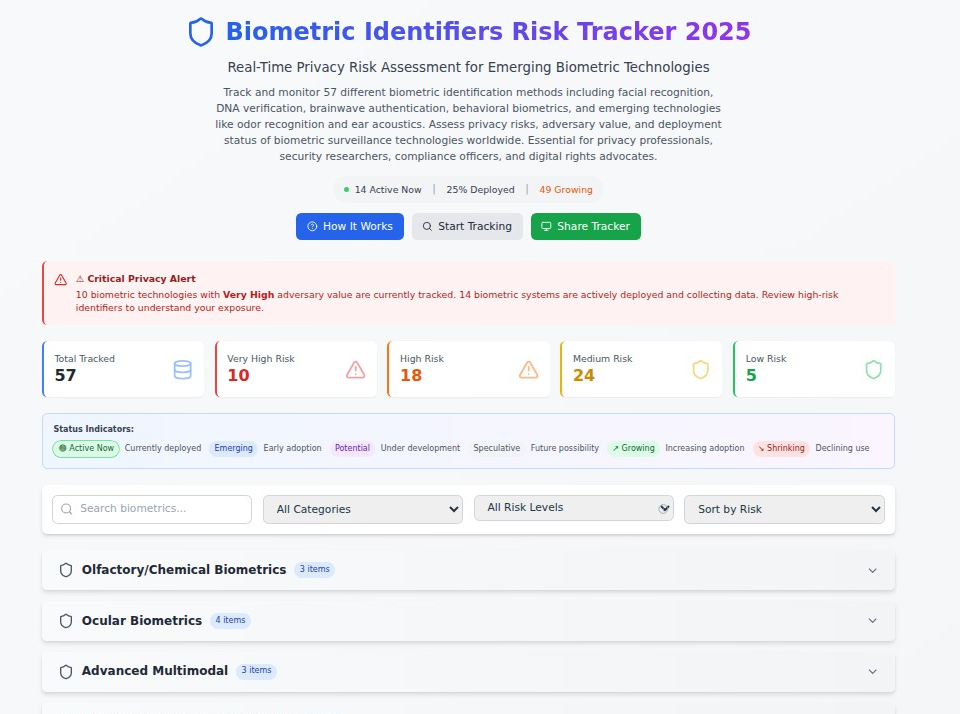
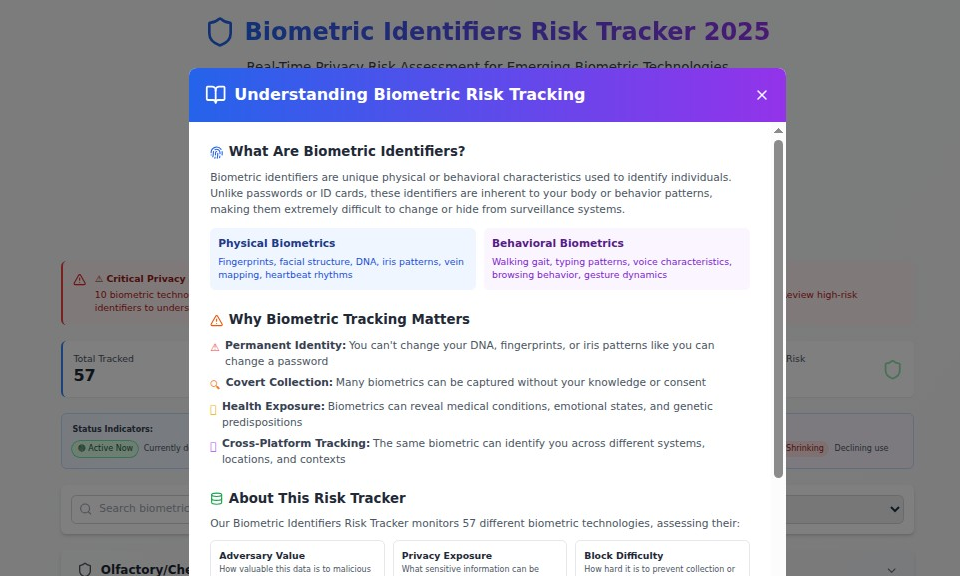
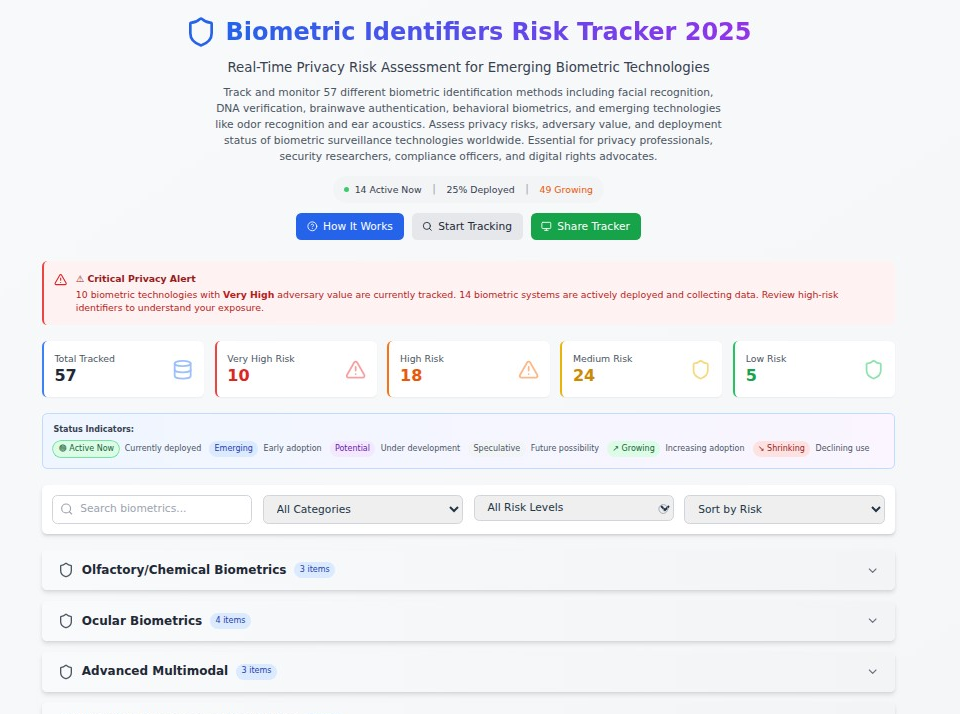
Today, we’re proud to launch the Biometric Risk Tracker 2025, a comprehensive monitoring platform that tracks 57 different biometric identification technologies and their implications for your privacy. This free, open resource is designed for privacy advocates, security researchers, compliance officers, and anyone concerned about the invisible ways they’re being identified and tracked.
US State Breach Notification Requirements Tracker
Why We Built This
The biometric surveillance landscape has exploded beyond fingerprints and facial recognition. Modern systems can identify you by:
- The sound resonating in your ear canal when you wear earbuds- The pattern of blood vessels in your retina, readable from a distance- Your unique body odor captured by electronic noses- The electrical signals your muscles generate before you even move- Your DNA from trace amounts left on surfaces
Most people have no idea these technologies exist, let alone that many are actively deployed. Our tracker changes that.
What Makes Our Tracker Different
1. Comprehensive Coverage: 57 Biometric Technologies
We’ve cataloged everything from mainstream facial recognition to experimental brain-wave authentication. Each technology is assessed across multiple dimensions:
- Adversary Value: How valuable is this data to bad actors?- Block Difficulty: Can you prevent collection?- Sensitive Information: What does it reveal about you?- Deployment Status: Is it active now, emerging, or still experimental?
Biotech Risk Calculator - Digital Twin Security Assessment
2. Real Risk Assessment
Not all biometrics are created equal. Our risk scoring system helps you understand which technologies pose the greatest threat:
- 🔴 Very High Risk (10 technologies): Including DNA matching, blood chemistry analysis, and breath analysis that can reveal extensive health information and are nearly impossible to block- 🟠 High Risk (18 technologies): Such as iris recognition, gait analysis, and remote vascular imaging that enable persistent tracking- 🟡 Medium Risk (24 technologies): Like typing patterns and mouse movements that reveal behavioral patterns- 🟢 Low Risk (5 technologies): Including signatures and basic interaction patterns with limited privacy impact
3. Active Deployment Tracking
The tracker shows you what’s happening RIGHT NOW:
- 19% of tracked biometrics are actively deployed and collecting data today- 47 technologies are growing in adoption- Real-time indicators show which systems are currently active vs. experimental
4. Health Data Exposure Warnings
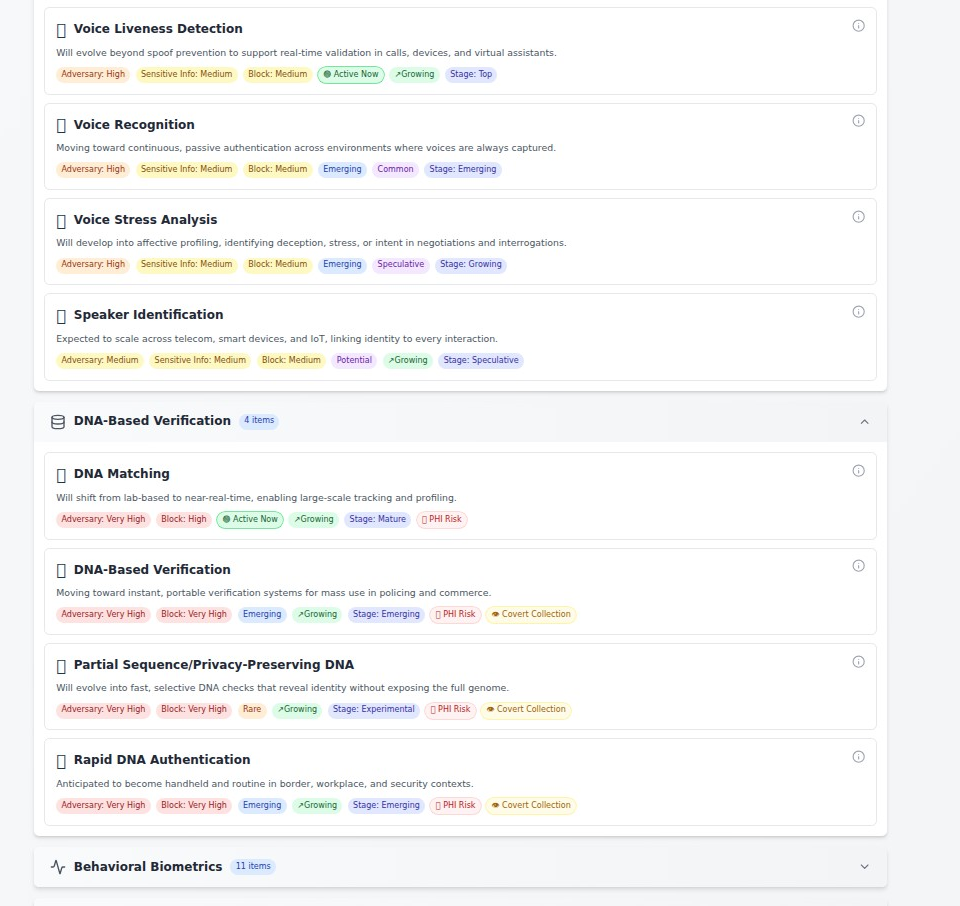
We’ve added special indicators for biometrics that can expose Protected Health Information (PHI):
- 🏥 PHI Risk Badge: Identifies technologies that reveal medical conditions- 👁️ Covert Collection Warning: Flags systems that can collect data without your knowledge
Key Insights from Our Research
The Invisible Threats
The most dangerous biometric technologies aren’t always the most obvious. While everyone worries about facial recognition, few know about:
- Remote Vascular Imaging: Can map your vein patterns from across a room using thermal cameras- Emotional AI: Combines multiple biometrics to detect vulnerability and persuasion opportunities- Continuous Behavioral Authentication: Never stops monitoring your patterns throughout a session
The Unchangeable Problem
Unlike passwords, you can’t change your biometrics. Once your DNA, iris pattern, or gait signature is compromised, it’s compromised forever. This permanence makes biometric data incredibly valuable to adversaries and incredibly dangerous when breached.
The Health Privacy Crisis
Many biometric systems inadvertently (or intentionally) capture health information:
- Blood oxygen patterns reveal cardiovascular health- Gait analysis can detect neurological conditions- Thermal imaging exposes stress and illness- Breath analysis identifies diseases and medications
How to Use the Tracker
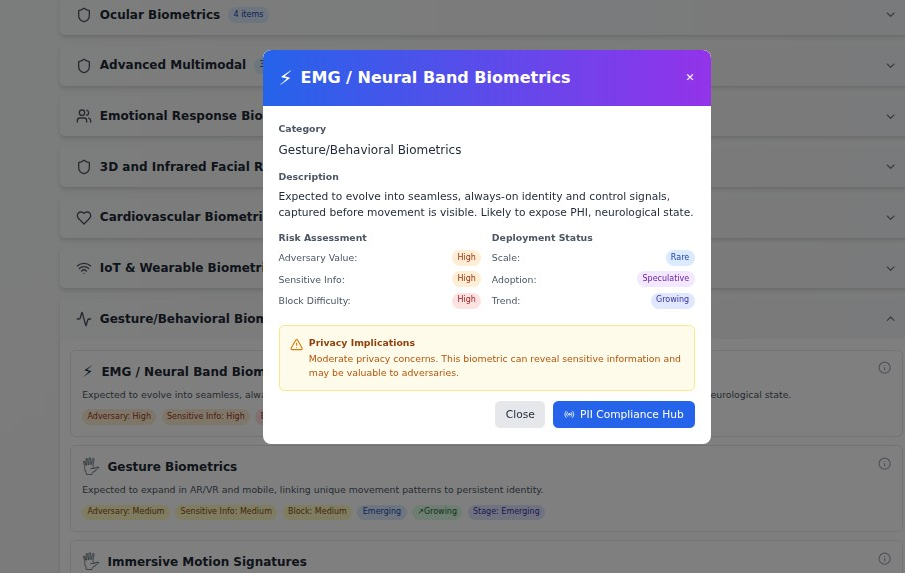
- Browse by Category: Explore different biometric families from ocular to olfactory2. Filter by Risk Level: Focus on the highest threats to your privacy3. Check Deployment Status: See what’s active now vs. what’s coming4. Search Specific Technologies: Research particular biometric systems5. Click for Deep Dives: Get detailed information on each technology
DeviceRisk.health - HIPAA Risk Assessment
Part of Our Privacy Protection Ecosystem
The Biometric Risk Tracker joins our suite of privacy tools:
- PII Compliance Hub: Track personal information regulations worldwide- Breach Notification Tracker: Monitor data breach requirements by jurisdiction- Medical Device Risk: Assess IoMT and medical device vulnerabilities- Digital Twin Risk: Understand virtual health model privacy implications
What You Can Do Today
Individual Actions
- Audit Your Exposure: Use our tracker to understand which biometrics you’re already exposed to2. Focus on High-Risk: Prioritize protecting against Very High and High risk biometrics3. Demand Transparency: Ask organizations what biometric data they collect4. Support Regulation: Advocate for biometric privacy laws in your jurisdiction
Organizational Actions
- Risk Assessment: Use the tracker to evaluate your biometric security posture2. Compliance Planning: Understand emerging biometric regulations3. Vendor Evaluation: Assess the privacy implications of biometric vendors4. Employee Education: Train staff on biometric privacy risks
The Road Ahead
Biometric surveillance is advancing faster than regulation or public awareness. Technologies that seem like science fiction today will be scanning you in public spaces tomorrow. Our tracker will evolve with these threats, adding new biometrics as they emerge and updating risk assessments as deployment expands.
PII Compliance Navigator | U.S. State Privacy Law Sensitive Data Categories
Access the Tracker
Visit biometric.myprivacy.blog to explore the full tracker. It’s free, requires no registration, and is updated monthly with the latest biometric surveillance developments.
Share the Knowledge
Privacy is a collective defense. The more people understand these technologies, the better we can protect ourselves and demand appropriate safeguards. Please share this tracker with your network:
- Security professionals who need to understand emerging threats- Privacy advocates working on policy and regulation- Journalists covering surveillance and privacy- Anyone concerned about their digital rights
🎧 Related Podcast Episode
Conclusion
We can’t stop the advancement of biometric technology, but we can arm ourselves with knowledge. The Biometric Risk Tracker 2025 is our contribution to that fight – a comprehensive, accessible tool that makes the invisible visible.
Your body is not a barcode. Your behavior is not a password. Your biology is not a tracking device.
It’s time to take back control.
Visit the Biometric Risk Tracker: biometric.myprivacy.blog
Questions or Feedback? Contact us through myprivacy.blog
Stay Updated: Follow us for monthly updates on emerging biometric threats and privacy protection strategies.
The Biometric Risk Tracker is a free resource provided by MyPrivacy.blog. We believe privacy protection begins with awareness and knowledge should be accessible to all.