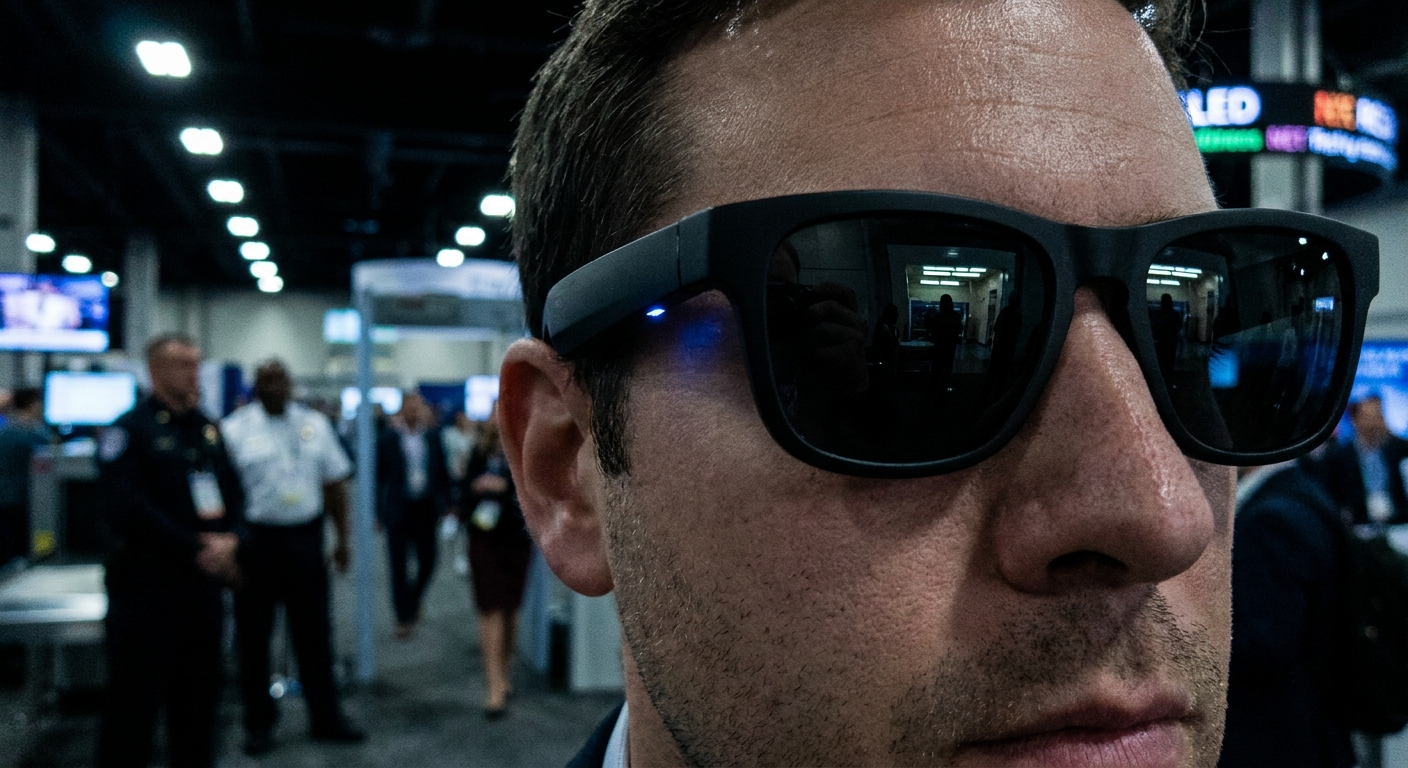
In April 2026, a coalition of more than 70 civil liberties organisations sent a formal demand letter to Meta: halt the planned rollout of “Name Tag,” a facial recognition feature for its Ray-Ban and Oakley smart glasses, and immediately disclose any discussions with Immigration and Customs Enforcement and Customs and Border Protection about deploying those wearables for immigration or border surveillance.
The signatories include the ACLU, the Electronic Frontier Foundation, EPIC, the Brennan Center for Justice, and dozens of state and regional civil liberties organisations. The breadth of the coalition reflects how significant a threshold they believe Meta is approaching.
The technology at issue is straightforward to describe and alarming to contemplate. Ray-Ban Meta smart glasses look like conventional sunglasses. They contain a forward-facing camera. The Name Tag feature, as described in Meta’s internal planning documents, would allow the glasses to recognise the faces of people in the wearer’s field of view — in real time, in public, without the recognised person’s knowledge or consent — and surface that person’s identity and profile information to the wearer.
The Memo That Changed the Conversation
The coalition’s letter would have been significant regardless. What made it explosive was an internal Meta memo from February 2026 that became public during the campaign.
The memo, reportedly circulated within Meta’s product team, acknowledged awareness of anticipated civil society opposition to the Name Tag feature. It outlined a plan to launch the feature during a period when civil society groups would be “distracted” by other political concerns — with the expectation that reduced opposition capacity would allow the rollout to proceed with less friction.
This is a company telling its own employees, in writing, that it anticipates its product will generate significant opposition from privacy and civil liberties advocates, and that the strategy is to move during a moment when those advocates are occupied elsewhere.
The memo did not describe Name Tag as having substantive privacy safeguards that would address the anticipated objections. It described a launch timing strategy to avoid them.
What Name Tag Would Actually Enable
The coalition’s objections are not hypothetical. Smart glasses with real-time facial recognition would represent the first mass-market deployment of ambient public facial recognition — a capability that changes the practical meaning of appearing in public.
Today, appearing in public means being visible to people around you, potentially being photographed, and having no expectation of legal privacy in your movements. What it does not mean, in most circumstances, is that any stranger who looks at you can instantly retrieve your name, your social media profiles, your employer, and any other information linked to your face in Meta’s database.
Name Tag would change that. A wearable device that fits into normal glasses frames means the capability is invisible to the person being identified. There is no camera on a tripod, no visible scanning process, no observable moment of data collection. The wearer looks at you. You are identified. You have no way of knowing.
The applications the coalition worries about run from the merely uncomfortable to the dangerous. An abuser tracking a survivor. An employer screening job applicants who attend union meetings. An immigration officer scanning a transit hub for individuals on a watchlist. A stalker learning the home address linked to a face they encounter on a commute.
The coalition’s explicit demand that Meta disclose any law enforcement and immigration agency discussions is based on a reasonable inference: if Meta is in conversations with ICE or CBP, the technology could be used for government surveillance without any of the legal authorisation, oversight, or judicial review that would normally accompany a law enforcement biometric programme.
Meta’s History With Biometric Data
This is not Meta’s first encounter with biometric privacy enforcement.
The company paid a $5 billion FTC fine in 2019 for privacy violations related to its handling of user data — the largest consumer privacy penalty in FTC history at the time. It separately settled biometric privacy lawsuits in Illinois and Texas for approximately $2 billion combined, stemming from its use of facial recognition in tag suggestions on Facebook without adequate consent under those states’ biometric privacy laws.
The pattern matters. Illinois’s BIPA requires informed written consent before a company collects facial geometry. Meta’s settlement there acknowledged it had deployed facial recognition without meeting that standard. The company has agreed not to use facial recognition on Illinois users.
Name Tag is a different product deployed in a different context — but the underlying question is similar: does the person whose face is being processed have meaningful notice and an opportunity to consent?
In public spaces, with invisible wearable cameras, the answer is structurally no. You cannot consent to recognition you do not know is happening.
Where This Goes From Here
Meta has not publicly committed to halting Name Tag. The company has not responded substantively to the coalition’s demand for law enforcement disclosure. The feature remains in development.
The coalition is pursuing parallel tracks: direct pressure on Meta, regulatory engagement with the FTC, and advocacy for legislation. Several state bills that would restrict real-time facial recognition in wearable devices are in various stages of development, though none has passed as of late May 2026.
The federal legal landscape remains permissive by default. There is no federal biometric privacy law. The FTC’s authority to regulate biometric practices exists in theory under Section 5 but has been used cautiously and on an ad hoc basis. Illinois BIPA remains the most powerful legal tool, but its geographic scope is limited.
The smart glasses case illustrates a recurring pattern in privacy technology: by the time legislative frameworks are drafted to address a new capability, products using that capability may already be deployed at scale. The coalition’s strategy is to create enough friction — reputational, regulatory, and commercial — to slow the deployment timeline while laws catch up.
Whether that strategy works depends on whether Meta concludes that the friction costs more than the feature is worth. Given the company’s history of treating privacy settlements as a cost of doing business, the calculation is not obvious.
The coalition letter to Meta was published in April 2026. The internal Meta memo was reported in civil society coverage of the campaign.