
🎧 Related Podcast Episode
The Final Nail in Privacy’s Coffin
On July 18, 2025, Mexico crossed a line that cannot be uncrossed. By signing into law the mandatory biometric digital identification system, the Mexican government didn’t just update its identification infrastructure—it created the most comprehensive citizen surveillance apparatus in the Western Hemisphere. Every Mexican citizen is now required to submit their fingerprints, iris scans, photographs, and personal data to a centralized government database, encoded in a QR code that will follow them from birth to death.
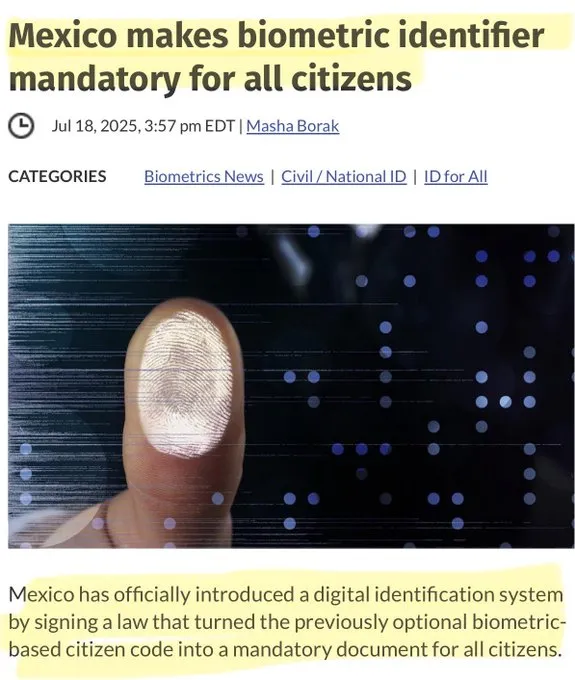 This isn’t modernization; it’s digitized authoritarianism. The Cédula Única de Identidad Digital (CUID) represents the complete abandonment of privacy rights and the implementation of a system where every citizen’s biological markers become state property. When a government demands your iris pattern and fingerprints not because you’ve committed a crime but simply because you exist, you’re no longer living in a free society—you’re living in a digital prison where your body itself is your tracking device.
Personal Protection: The “Gray Man” Theory
The Architecture of Total Surveillance
The Mexican biometric ID system goes far beyond traditional identification. Here’s what every Mexican citizen must now surrender to the state:
Biometric Data Collection
- Fingerprints: All ten fingers scanned and stored- Iris Patterns: Both eyes scanned with high-resolution imaging- Facial Recognition Data: Multiple angle photographs for 3D facial mapping- Voice Prints: Audio samples for voice recognition (planned for 2026)- DNA Samples: Proposed addition for “medical emergencies” (under consideration)
Personal Information Integration
- Full legal name and any variations- Date and place of birth- Current and historical addresses- Family relationships and genealogy- Employment history and current occupation- Educational records- Tax identification numbers- Voter registration data- Health insurance information- Criminal records (including arrests without conviction)
All of this data is encoded into a QR code that government officials, and increasingly private businesses, can scan to instantly access a citizen’s complete profile. This isn’t just an ID card—it’s a portable surveillance device that citizens are legally required to carry.
Biometric Data: The Future of Personal Identification or a Privacy Nightmare?
The Technology Behind the Tyranny
The technical infrastructure of Mexico’s biometric system reveals its true purpose. Built with assistance from international biometric companies with deep ties to intelligence agencies, the system incorporates:
Centralized Database Architecture
Unlike federated systems that distribute data across multiple databases with privacy protections, Mexico chose a fully centralized architecture. Every piece of biometric and personal data flows to a single massive database controlled by the National Population Registry (RENAPO). This creates a single point of failure that, when breached, will expose the complete biometric identity of every Mexican citizen—a catastrophic risk that authorities have dismissed as “manageable.”
This centralization makes Mexico’s entire population vulnerable to what we track at https://notification.breached.company/. When this database is inevitably breached—not if, but when—it will represent the largest biometric data breach in history. Unlike passwords or credit cards, you cannot change your fingerprints or iris patterns. Once this biometric data is compromised, every Mexican citizen will be permanently vulnerable to identity theft, with no recourse for protection.
Real-Time Tracking Capabilities
The system includes real-time tracking functionality that allows authorities to:
- Track when and where ID cards are scanned- Monitor movement patterns across checkpoint scans- Create heat maps of population movements- Flag “suspicious” travel patterns- Generate alerts for persons of interest- Build social network graphs based on proximity data
Integration with Private Sector
Most alarmingly, the law mandates that private businesses integrate with the biometric system for:
- Banking transactions- Mobile phone purchases- Hotel registrations- Transportation services- Healthcare access- Educational enrollment- Employment verification
This means that every aspect of daily life—from buying groceries to seeing a doctor—generates a data point in the government’s surveillance apparatus. The very Personally Identifiable Information (PII) that privacy laws supposedly protect is now mandatorily collected and centralized by government decree.
The False Promise of Security
Mexican authorities justified this biometric dystopia with familiar refrains: fighting crime, preventing identity theft, and streamlining government services. President Andrés Manuel López Obrador claimed the system would “eliminate corruption and bring transparency to government operations.” Yet examination of similar systems worldwide reveals a darker truth.
Biometric Technology and Privacy: A Balancing Act
Crime Doesn’t Decrease, Surveillance Increases
Countries with mandatory biometric ID systems show no correlation with reduced crime rates. India’s Aadhaar system, with over 1.3 billion enrolled citizens, has not reduced crime. Instead, it has:
- Enabled mass surveillance of political dissidents- Facilitated religious and ethnic discrimination- Created new forms of identity theft using biometric data- Excluded millions from essential services due to authentication failures
The Identity Theft Paradox
While marketed as preventing identity theft, biometric systems actually create catastrophic new risks. Traditional identity theft involves compromised documents that can be replaced. Biometric identity theft is permanent. When hackers steal your fingerprints—as happened with the U.S. Office of Personnel Management breach affecting 5.6 million government employees—you cannot get new fingers.
Global Privacy & Compliance Explorer
Mexico’s centralized database will become the world’s most valuable target for cybercriminals. The comprehensive PII collection as we’ve documented extensively creates a treasure trove worth billions on the dark web. Every Mexican citizen’s complete identity—biological, personal, and social—sits in a single database, waiting to be breached.
The Expansion Beyond Mexico
Mexico’s biometric ID system isn’t occurring in isolation. It’s part of a coordinated regional push that includes:
Central American Integration
Guatemala, Honduras, and El Salvador are developing “compatible” biometric systems that will share data with Mexico. This creates a supranational surveillance network covering over 180 million people. Citizens fleeing persecution in one country will find no refuge in another—their biometric data follows them across borders.
U.S. Border Integration
Most concerning is the planned integration with U.S. border control systems. The Department of Homeland Security has expressed interest in accessing Mexico’s biometric database for “immigration enforcement” and “national security” purposes. This means Mexican citizens’ biometric data could end up in U.S. intelligence databases without their knowledge or consent.
Corporate Data Sharing
International corporations operating in Mexico are being granted access to verify identities against the biometric database. Companies like Amazon, Walmart, and Uber will be able to scan Mexican IDs and receive comprehensive personal data. This corporate-government surveillance fusion represents the complete commercialization of citizens’ biological data.
The Human Rights Catastrophe
International human rights organizations have condemned Mexico’s mandatory biometric system, but their warnings have been ignored. The system violates multiple human rights principles:
Presumption of Innocence Destroyed
By requiring all citizens to submit biometric data, Mexico treats every citizen as a potential criminal. The collection of fingerprints and iris scans—traditionally reserved for criminal suspects—now applies to newborn babies. This reverses the fundamental principle of presumption of innocence that underpins democratic justice systems.
Freedom of Movement Restricted
With mandatory ID checks becoming ubiquitous, freedom of movement ceases to exist. Citizens cannot travel, work, or access services without submitting to biometric scanning. This creates invisible borders within Mexico, where algorithmic decisions determine who can go where.
Right to Privacy Eliminated
The Mexican Constitution supposedly guarantees privacy rights, but the biometric ID law effectively nullifies these protections. When the government has your fingerprints, iris scans, photograph, and personal history in a searchable database, privacy becomes a meaningless concept.
The Vulnerable Populations Hit Hardest
While affluent Mexicans might navigate this surveillance state with minimal disruption, vulnerable populations face catastrophic consequences:
Indigenous Communities
Mexico’s indigenous peoples, many of whom live in remote areas with limited technology access, face exclusion from essential services. Biometric registration requires traveling to government centers, often hundreds of miles away. Those who cannot or will not register become non-persons, unable to access healthcare, education, or legal recognition.
Undocumented Migrants
Millions of Central American migrants transiting through Mexico face an impossible choice: register their biometrics and risk deportation, or remain unregistered and lose access to any legal protection or services. The biometric system becomes a tool for immigration enforcement disguised as modernization.
Political Dissidents
Opposition activists, journalists, and human rights defenders face unprecedented surveillance. Every interaction—from buying a phone to booking a hotel—is tracked and logged. The government can construct detailed maps of opposition networks simply by analyzing ID scan patterns.
LGBTQ+ Community
In a country where discrimination remains widespread, the biometric database’s comprehensive personal information creates new vulnerabilities. Data about gender transitions, name changes, and family structures becomes permanently recorded and potentially weaponized.
The Technical Vulnerabilities
Beyond the principled objections to mass biometric surveillance, Mexico’s system contains critical technical vulnerabilities:
No Encryption Standards
Leaked technical documents reveal that biometric data is stored with minimal encryption. The QR codes on ID cards can be cloned using readily available equipment. This means criminals can create perfect digital copies of anyone’s identity with basic technical knowledge.
Authentication Failures
Biometric systems have inherent failure rates. Fingerprint scanners fail for people with worn prints from manual labor. Iris scanners struggle with certain eye conditions. Facial recognition performs poorly with indigenous features. These technical limitations mean millions of legitimate citizens will be denied services due to authentication failures.
ICE’s “Mobile Fortify” App: Expanding Biometric Surveillance
Database Breach Inevitability
Mexico’s government infrastructure has suffered multiple major breaches. In 2016, 93 million voter records were exposed. In 2019, the Mexican Social Security Institute leaked millions of patient records. The biometric database, infinitely more valuable to criminals, will face constant attack. When it’s breached—and our breach notification system will certainly document it—the consequences will be irreversible.
The Economic Exploitation
The mandatory biometric ID creates new forms of economic exploitation:
Forced Consumption
Citizens must pay for ID cards, renewals, and updates. With no alternative identification accepted, this becomes a mandatory tax on existence. The poor face choosing between food and maintaining valid identification.
Data Monetization
While citizens pay for their IDs, the government monetizes their data. International companies pay millions for access to the verification system. Citizens’ biometric data becomes a commodity traded between government and corporations.
Exclusion from Economy
Those who cannot or will not register—estimated at 10-15 million people—face complete economic exclusion. They cannot open bank accounts, get formal employment, or participate in the digital economy. This creates a permanent underclass of non-persons.
The Resistance and Workarounds
Despite the law’s mandatory nature, resistance is emerging:
Legal Challenges
Human rights organizations have filed constitutional challenges arguing the law violates Mexico’s privacy protections and international human rights obligations. However, the government-aligned judiciary seems unlikely to overturn the law.
World’s Iris-Scanning Technology: A Privacy Perspective on the Future of Digital Identity
Technical Resistance
Hackers and privacy activists are developing tools to generate fake QR codes and spoof biometric readers. While these efforts provide temporary relief, they also carry severe criminal penalties under the new law.
Mass Non-Compliance
In rural areas, entire communities are refusing to register. This civil disobedience carries severe consequences—loss of government benefits, inability to vote, and exclusion from legal economy—but many prefer these hardships to biometric subjugation.
The International Implications
Mexico’s biometric system sets a dangerous precedent for the Americas:
Regional Domino Effect
Brazil, Argentina, and Colombia are watching Mexico’s implementation closely. If Mexico successfully implements mandatory biometric ID without significant international consequences, expect similar systems throughout Latin America within five years.
Integration with Global Systems
The World Bank and International Monetary Fund have praised Mexico’s biometric system as a model for “digital transformation.” This international validation encourages other developing nations to implement similar surveillance systems.
Migration Weapon
As climate change and political instability drive migration, biometric systems become tools for population control. Countries sharing biometric data can track and control refugee movements with unprecedented precision.
The Path to Digital Authoritarianism
Mexico’s biometric ID system represents a crucial step toward complete digital authoritarianism:
Phase 1: Mandatory Registration (Current)
All citizens required to submit biometric data
Phase 2: Ubiquitous Scanning (2026)
ID scanning required for all transactions and movements
Phase 3: Social Credit Integration (2027)
Behavioral tracking and scoring based on ID usage patterns
Phase 4: Biological Authentication (2028)
Replacement of ID cards with implantable chips or biological markers
Phase 5: Complete Digital Control (2030)
All aspects of life mediated through biometric authentication
Each phase builds on the previous, creating path dependency that makes reversal increasingly difficult. Once citizens accept mandatory biometric registration, each subsequent expansion seems like a minor increment rather than a fundamental violation.
The Warning for the World
Mexico’s mandatory biometric ID system isn’t just a Mexican problem—it’s a preview of the future being planned globally. The technology being deployed in Mexico is developed by the same companies implementing systems in India, Kenya, and the Philippines. The databases follow the same architectures. The justifications repeat the same talking points.
When this system fails—when the breach occurs, when the discrimination is documented, when the exclusion becomes undeniable—it will be too late. Biometric surveillance, once implemented, is nearly impossible to reverse. The infrastructure, the bureaucracy, and the business models that develop around it create powerful constituencies for its continuation.
The PII vulnerabilities we track pale in comparison to the comprehensive exposure created by mandatory biometric systems. Every data breach, every privacy violation, every surveillance overreach we’ve documented becomes exponentially worse when backed by immutable biometric data.
Ken Paxton Secures $1.4 Billion Settlement with Meta Over Biometric Data Violations
Conclusion: The Last Stand for Human Dignity
Mexico’s mandatory biometric ID represents more than technical infrastructure—it’s an assertion that human beings are nothing more than biological data points to be catalogued, tracked, and controlled. When a government declares that your iris pattern and fingerprints are state property, it claims ownership over your very existence.
The international community’s muted response to Mexico’s biometric dystopia reveals an uncomfortable truth: governments worldwide want these capabilities. They’re watching Mexico’s implementation, learning from its successes, and planning their own versions. The surveillance infrastructure being built today will define human freedom for generations.
For Mexicans, the immediate future is clear: complete biometric registration or exclusion from society. There is no middle ground, no opt-out, no alternative. This binary choice—surveillance or exile—will soon face citizens worldwide as governments race to implement similar systems.
The breach notifications we’ll inevitably publish at https://notification.breached.company/ when Mexico’s biometric database is compromised will document the largest identity theft in human history. But by then, it will be too late. Once biometric data is stolen, it cannot be changed. Once surveillance infrastructure is built, it cannot be easily dismantled. Once freedom is surrendered, it cannot be easily reclaimed.
Mexico’s biometric ID system is a warning to the world: this is what happens when convenience trumps privacy, when security theater replaces actual safety, when governments view citizens as subjects to be monitored rather than free people to be served. The question isn’t whether other countries will follow Mexico’s example—they’re already planning to. The question is whether citizens worldwide will resist before their fingerprints, iris scans, and DNA become government property.
The dystopia isn’t coming—it’s here, encoded in a QR code that 130 million Mexicans must now carry to prove they exist. The rest of the world watches and waits its turn.