🎧 Related Podcast Episode
Executive Summary
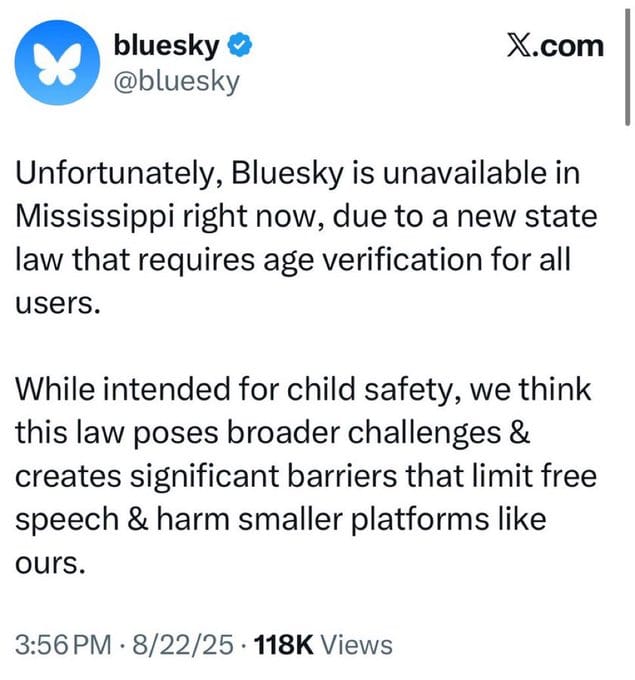
In an unprecedented move, social media platform Bluesky has completely blocked access to users in Mississippi rather than comply with the state’s sweeping new age verification law. This decision highlights a growing conflict between state regulations aimed at protecting children online and the practical realities of digital platform operations, raising significant questions about free speech, privacy rights, and the future of internet regulation.
The Law: HB 1126 - Walker Montgomery Protecting Children Online Act
Background and Intent
Mississippi’s HB 1126, known as the Walker Montgomery Protecting Children Online Act, was enacted in April 2024 after being unanimously approved by the state legislature. The law is named after 16-year-old Walker Montgomery, who died by suicide in December 2022 after a sextortioner on Instagram threatened to share an explicit video of him unless he paid $1,000.
Key Requirements
The law imposes several stringent requirements on social media platforms:
Age Verification for All Users: The law requires platforms to implement age verification for all users before they can access services like Bluesky, meaning every user must verify their age regardless of the content they wish to access.
Parental Consent for Minors: Platforms must obtain parental consent for anyone under 18 to create or maintain an account.
Content Monitoring: Social media companies must make “commercially reasonable efforts” to prevent minors from accessing “harmful material.”
Data Collection Restrictions: The law prohibits social media companies from collecting, selling, or sharing minors’ personal information.
Severe Penalties: The potential penalties for non-compliance are substantial — up to $10,000 per user.
Women’s Safety App Tea Suffers Massive Data Breach, Users’ IDs Exposed on 4chan
The Legal Battle and Supreme Court Decision
Initial Court Challenges
NetChoice, a tech industry group representing companies including Facebook, Instagram, YouTube, and others, sued Mississippi in June 2024. A federal district judge initially blocked the law on July 1, 2024 — the day it was originally set to take effect.
Appeals Court Reversal
The conservative 5th Circuit Court of Appeals lifted the temporary block in July 2025, allowing the law to go into effect without addressing whether it violates the First Amendment.
Supreme Court Decision
On Thursday, August 14, 2025, the Supreme Court refused to intervene, rejecting NetChoice’s emergency appeal to block the law while legal challenges continued in lower courts. Notably, Justice Brett Kavanaugh wrote a concurrence acknowledging that “under this Court’s case law as it currently stands, the Mississippi law is likely unconstitutional” but said NetChoice had not sufficiently demonstrated that they would be harmed by temporary enforcement.
The Global Age Verification Disaster: How Privacy Dies in the Name of “Safety”
Bluesky’s Response: A Platform Takes a Stand
The Decision to Block
Starting August 22, 2025, Bluesky began blocking all access from Mississippi IP addresses, making it the first major social media platform to completely shut down service in a state rather than comply with age verification requirements.
Rationale Behind the Decision
Bluesky cited several key factors in their decision:
Resource Constraints: As a small team focused on building decentralized social technology, Bluesky argued that “age verification systems require substantial infrastructure and developer time investments, complex privacy protections, and ongoing compliance monitoring — costs that can easily overwhelm smaller providers.”
Privacy Concerns: The law requires “collecting and storing sensitive personal information from all users, including detailed tracking of minors,” which conflicts with Bluesky’s privacy-focused approach.
Broad Scope: Unlike other age verification laws like the UK’s Online Safety Act, which only requires age checks for specific content and features, Mississippi’s law “requires age verification for all users, not just those accessing age-restricted content.”
Comparison to Other Jurisdictions
Bluesky emphasized the difference between Mississippi’s approach and regulations in other regions: “Bluesky follows the OSA in the UK. There, Bluesky is still accessible for everyone, age checks are required only for accessing certain content and features, and Bluesky does not know and does not track which UK users are under 18.”
Xbox’s New Age Verification: A Gateway to Digital Censorship?
Impact on Other Platforms
Major Tech Companies’ Response
Unlike Bluesky, major social media companies like Meta (Facebook/Instagram), Google (YouTube), and X have not announced similar blocking measures. The law is expected to impact these larger platforms differently because “tech giants with vast resources” are better positioned to implement the required infrastructure, while the law “entrenches existing big tech platforms while stifling the innovation and competition that benefits users.”
Industry-Wide Implications
The compliance requirements “disadvantage newer and smaller platforms like Bluesky, which do not have the luxury of big teams to build the necessary tooling.” This dynamic raises concerns about market consolidation and barriers to entry for new social media platforms.
Constitutional and Privacy Concerns
First Amendment Issues
Multiple civil liberties organizations have raised significant constitutional concerns:
The Electronic Frontier Foundation, along with the ACLU, filed an amicus brief arguing that HB 1126 is “an extraordinary censorship law that violates all internet users’ First Amendment rights to speak and to access protected speech online.”
Impact on Adults: The law “could entirely block access for the millions of U.S. adults who lack government-issued ID” and strips away “users’ protected right to online anonymity, leaving them vulnerable to exposure and harassment.”
Impact on Minors: The law places “unnecessary barriers between young people and crucial resources” and broadly restricts “minors’ access to a vague list of topics—the majority of which concern constitutionally protected speech.”
Age Verification and Child Protection Online: A Legal Perspective Based on the AEPD’s Guidance
Privacy Implications
The law requires collecting and storing sensitive personal information from all users, which Bluesky argues creates “significant barriers that limit free speech and disproportionately harm smaller platforms and emerging technologies.”
Vulnerable Populations: LGBTQ advocacy groups argued that the law would make it harder for gay and lesbian youth to find safe spaces online, stating that “online platforms, including social media sites, offer safe spaces for individuals, including youth, to connect with others who share their identities.”
Broader Context: A National Trend
Similar Laws in Other States
The Electronic Frontier Foundation reports it is “tracking laws in at least 10 other states requiring parental consent or age verification for online services,” indicating this is part of a broader national trend rather than an isolated incident.
Comparison to Adult Content Laws
The Supreme Court recently upheld a Texas law requiring age verification for pornographic websites, but Mississippi’s law is “far broader” as it “requires all users to verify their ages before using common social media sites ranging from Facebook to Nextdoor.”
Australia’s Digital Revolution: Age Verification and ID Checks Transform Internet Use
Technical and Implementation Challenges
Age Verification Methods
The law does not specify exactly how age verification must be implemented, but typical methods include:
- Government-issued ID verification- Credit card verification- Biometric scanning- Third-party age verification services
Each method presents significant privacy and security risks, particularly for a decentralized platform like Bluesky that emphasizes user control and minimal data collection.
Compliance Monitoring
Beyond initial verification, the law requires “ongoing compliance monitoring” and tracking of which users are minors, creating ongoing operational burdens and privacy risks.
Economic and Competitive Effects
Barriers to Innovation
Bluesky argues that the law “entrenches existing big tech platforms while stifling the innovation and competition that benefits users” because smaller companies cannot afford the compliance infrastructure.
Market Consolidation Risk
The differential impact on large versus small platforms could accelerate market consolidation, potentially reducing competition and innovation in the social media space.
YouTube’s AI Age Verification: The New Digital ID Era and the Global Push for Online Control
Looking Forward: Implications and Precedents
Legal Precedents
Courts across the country have “consistently ruled [similar age verification laws] unconstitutional. In cases from Arkansas to Ohio to Utah, courts have struck down similar online age-verification mandates because they burden users’ access to, and ability to engage with, protected speech.”
Potential for National Legislation
The patchwork of state laws creates compliance challenges that could accelerate calls for federal legislation to create uniform standards across states.
The Decentralization Factor
Importantly, Bluesky noted that “this decision applies only to the Bluesky app, which is one service built on the AT Protocol. Other apps and services may choose to respond differently,” highlighting how decentralized systems might handle regulatory challenges differently than centralized platforms.
Conclusion
The standoff between Bluesky and Mississippi represents a critical inflection point in the ongoing debate over internet regulation, child safety, and free speech rights. While the intention to protect children online is commendable and necessary, the broad scope of Mississippi’s law raises serious questions about implementation feasibility, constitutional compliance, and unintended consequences.
Bluesky’s decision to completely block service rather than comply sets a significant precedent that other platforms may follow, potentially leading to a fragmented internet where access to information and services depends on geographic location. This approach, while protecting user privacy and platform principles, also denies Mississippi residents access to a platform they may prefer for legitimate purposes.
The ultimate resolution of this conflict will likely have far-reaching implications for how states can regulate social media platforms, the balance between child protection and free speech rights, and the future of internet governance in the United States. As legal challenges continue and other states consider similar legislation, the tech industry, lawmakers, and courts will need to find solutions that effectively protect children while preserving the openness and accessibility that make the internet a powerful tool for communication, education, and expression.
UK vs. 4chan: A Digital Sovereignty Showdown
The case also highlights the unique challenges facing smaller, privacy-focused platforms in an increasingly regulated environment, and raises important questions about whether well-intentioned legislation might inadvertently strengthen the dominance of large tech companies at the expense of innovation and competition.