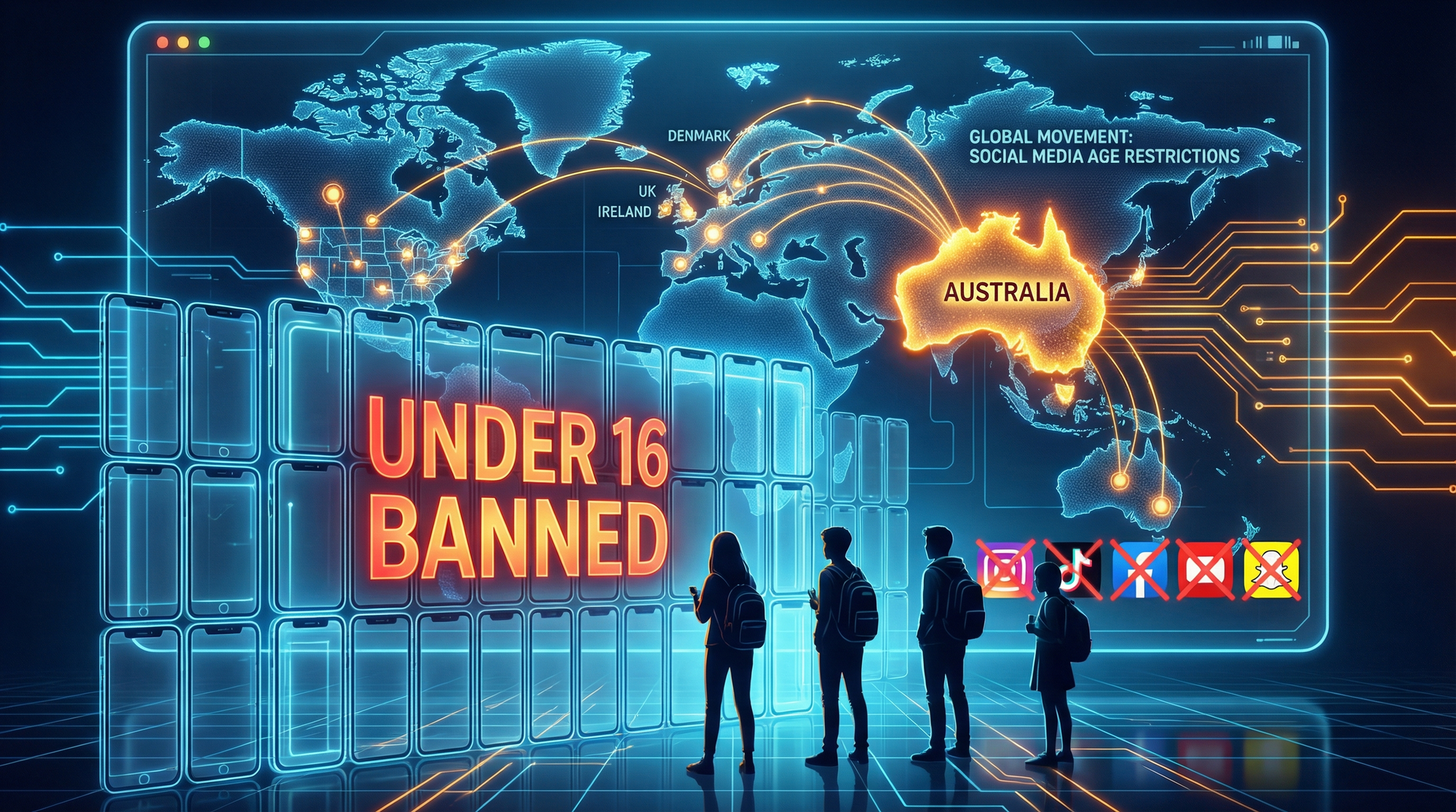
January 28, 2026 — On December 10, 2025, Australia became the first country in the world to implement a nationwide ban on social media for children under 16, permanently locking millions of teenagers out of Facebook, Instagram, TikTok, Snapchat, YouTube, Reddit, X (Twitter), Threads, Kick, and Twitch. With fines up to A$49.5 million (US$32 million) for non-compliance and no parental consent exceptions, the law represents the most aggressive social media regulation targeting minors ever enacted by a democratic nation.
Fifty days later, the Australian experiment has triggered a global cascade: Denmark is considering a ban for those under 13 with parental consent exceptions, Norway is exploring similar measures, and US states from Florida to Utah have already banned social media for users as young as 14 without parental permission. The UK’s Online Safety Act (implemented July 2025) requires platforms to implement “highly effective” age assurance, and Ireland is developing a government-run age verification app.
What began as a movement to protect children from cyberbullying, mental health crises, and algorithmic manipulation has evolved into the most significant restriction on young people’s internet access since the web’s creation. Critics warn it’s a dangerous precedent that infantilizes teenagers, undermines privacy, and pushes minors toward “darker corners of the internet.” Supporters argue it’s overdue intervention in a mental health catastrophe fueled by social media addiction.
🎧 Related Podcast Episode
Executive Summary
Australia’s World-First Ban:
- Effective date: December 10, 2025 (10 December 2025)- Age threshold: Under 16 (no parental consent exceptions)- Platforms banned: Facebook, Instagram, TikTok, Snapchat, YouTube, Reddit, X, Threads, Kick, Twitch- Platforms exempted: Discord, WhatsApp, Messenger, Roblox, YouTube Kids, Pinterest, Steam, GitHub, Google Classroom- Enforcement: Up to A$49.5 million fines for platforms failing to take “reasonable steps” to prevent under-16 access- No user penalties: Children and parents face no consequences for violations- Transition period: Platforms had one year (Dec 2024-Dec 2025) to implement age verification systems
Age verification methods deployed:
- Behavioral inferencing (estimating age from user behavior patterns)2. Facial age estimation (selfie-based biometric scanning)3. Government ID verification (uploading driver’s licenses or passports)4. Mixed signals approach (combining multiple data points)
Public support vs. effectiveness skepticism:
- 70% of Australian voters support the ban (December 2025 polling)- Only 33% believe it will work (58% not confident)- 75% of Australian teens say they won’t stop using social media (Behind the News poll, 17,000+ participants)
Global ripple effects:
- US states: Florida (under-14 ban), Utah (under-18 parental consent), Texas, California, Ohio, Tennessee implementing similar laws- Europe: UK Online Safety Act (July 2025), Denmark exploring under-13 ban, Norway considering restrictions- Asia: South Korea discussing social media age limits amid mental health concerns- Legal challenges: Australia’s High Court hearing constitutional challenges in February 2026 from Digital Freedom Project and Reddit
Unintended consequences (first 50 days):
- VPN surge: Teens bypassing geoblocking (eSafety Commissioner claimed “VPNs cost thousands” despite $20/month reality)- Privacy invasion: Platforms using facial recognition and biometric data collection- LGBTQ+ isolation: Queer teens cut off from support communities- Mental health paradox: Reduced access to crisis intervention resources (73% of young Australians accessed mental health support via social media)
The Origin Story: From a Premier’s Wife’s Book Recommendation to National Law
Australia’s social media ban began not with a government white paper or parliamentary inquiry, but with a wife’s recommendation to her husband to read a book.
In early 2024, Peter Malinauskas, the Premier of South Australia, was urged by his wife to read The Anxious Generation by social psychologist Jonathan Haidt. The book argues that smartphones and social media have caused an epidemic of adolescent mental health crises, with rates of depression, anxiety, and suicide skyrocketing since the introduction of the iPhone in 2007 and Instagram in 2010.
Malinauskas, father of four young children, was moved by Haidt’s thesis and thought “government should play a part in helping parents to regulate use of social media by their children at home.” He contacted former High Court Chief Justice Robert French, who agreed to investigate the issue. In September 2024, French delivered a 267-page proposal — which he dubbed a “Swiss Army knife” rather than a machete — to adapt to social media’s “changing landscape and complexity.”
The National Cabinet consensus: Malinauskas took French’s report to Australia’s National Cabinet (a coordinating body of state premiers, territory chief ministers, and the Prime Minister). Every state and territory government unanimously supported a federal social media age ban.
The tragic stories: Public support swelled after media coverage of parents who had lost children to suicide after cyberbullying:
- Kelly O’Brien’s 12-year-old daughter Charlotte took her own life due to bullying. O’Brien wrote a personal letter to Prime Minister Anthony Albanese, which moved him to support the ban.- At a September 2025 UN General Assembly event, a mother described her daughter’s death as “death by bullying… enabled by social media”, winning support from world leaders including EU President Ursula von der Leyen.
Political momentum: In September 2024, Prime Minister Albanese announced his government would introduce legislation for a minimum social media age requirement. Liberal opposition leader Peter Dutton pledged to implement a ban “within 100 days of being elected,” creating bipartisan support.
Albanese described social media as a “scourge” and said: “I want people to spend more time on the footy field or the netball court than they’re spending on their phones. [Social media] is having a negative impact on young people’s mental health and on anxiety.”
The News Corp campaign: Rupert Murdoch’s News Corp Australia newspapers launched a “Let Them Be Kids” campaign, publicizing stories of parents who lost children to suicide after social media-enabled bullying. The campaign ran across The Australian, The Daily Telegraph, Herald Sun, The Courier-Mail, and other outlets, building public pressure for the ban.
The Law: How Australia’s Ban Works
Legislative Timeline
November 21, 2024: Minister for Communications Michelle Rowland introduced the Online Safety Amendment (Social Media Minimum Age) Bill 2024 to federal parliament.
24-hour submission window: The Senate Environment and Communications Legislation Committee received 15,000 submissions in 24 hours (the committee requested 1-2 page submissions due to the “short timeframe”). Critics called the process “rushed.”
November 27, 2024: House of Representatives passed the bill 101-13
- For: Labor Party, Coalition (except Bridget Archer), 4 independent MPs- Against: 6 independent MPs, all Greens, Rebekha Sharkie, Bob Katter
November 28, 2024: Senate passed the bill with amendments 34-19
- Against: Entire crossbench, Liberal Senator Alex Antic, National Senator Matt Canavan
November 29, 2024: House reconsidered and passed with Senate amendments. Final passage.
December 10, 2024: Governor-General Sam Mostyn assented to the bill. Law took effect.
December 10, 2025: Age restrictions came into force (one-year implementation grace period for platforms).
What the Law Requires
Platforms covered: Facebook, Instagram, TikTok, Snapchat, YouTube, Reddit, X (Twitter), Threads, Kick, Twitch (list as of November 21, 2025; eSafety Commissioner stated “there will not be a static list” due to changing technology).
Age threshold: Under 16 (16th birthday required for account eligibility).
No parental consent exception: Unlike some US state laws (e.g., Utah allows 14-15 year olds with parental permission), Australia’s ban is absolute. Parents cannot give consent for their under-16 children to have accounts.
No user penalties: Children who violate the ban and parents who allow it face no fines or criminal penalties. The burden falls entirely on platforms.
Platform penalties: Companies that fail to take “reasonable steps” to prevent under-16s from having accounts face fines up to A$49.5 million (US$32 million) per systemic violation.
“Reasonable steps” standard: The law does not mandate specific age verification technologies. Platforms must implement “commercially reasonable” methods, which may include:
- Behavioral inferencing (AI analysis of user behavior to estimate age)- Facial age estimation (selfie-based biometric scanning)- Government ID verification (uploading driver’s licenses, passports)- Mixed signals (combining multiple data points like device type, browsing patterns, language, etc.)
VPN circumvention: Using VPNs to access banned platforms remains legal in Australia. However, platforms are expected to detect and block VPN users who appear to be under 16 in Australia.
Platforms Exempted (and Why)
Exempted services:
- Messaging apps: WhatsApp, Facebook Messenger (private communication, not “social media platforms”)- Gaming platforms: Roblox, Steam (despite social features, primary purpose is gaming)- Educational tools: Google Classroom, GitHub (educational/professional)- Pinterest: Visual discovery platform, deemed less harmful- YouTube Kids: Separate curated service for children- Discord: Classified as messaging/community platform, not social media
Controversies:
- YouTube inclusion: Google initially threatened to sue if YouTube was included. After eSafety Commissioner’s advice, YouTube was added to the ban on July 30, 2025. YouTube Kids remains exempt.- Roblox exclusion: Announced November 5, 2025, despite Roblox having social features. Critics argue inconsistency.- Reddit inclusion: Added November 5, 2025. Reddit is now suing in the High Court, arguing it’s a “forum more oriented to adults” and should be exempt.
How Platforms Are Implementing the Ban
Meta (Facebook, Instagram, Threads)
On November 19, 2025, Meta announced it would remove users under 16 from Instagram, Facebook, and Threads starting December 4 — six days before the official December 10 deadline.
Meta’s age verification methods:
- Facial age estimation: Users can take a selfie, which Meta’s AI analyzes to estimate age within a 2-3 year range2. Government ID upload: Users can submit driver’s licenses or passports3. Behavioral signals: Meta uses account activity patterns, friends’ ages, content interactions, and other “signals” to identify likely under-16 users
Meta’s preferred approach: The company stated they would prefer mobile app stores (Apple App Store, Google Play Store) to verify users’ ages at the device/account level, rather than requiring each platform to implement separate verification. This would create a single age verification checkpoint for all apps.
Data backup alerts: Meta notified Australian users under 16 to back up their photos, videos, and messages before their accounts were deleted, giving them options to:
- Update contact information- Download their data archives- Delete accounts voluntarily
Snap (Snapchat)
Snap confirmed it would comply with the law and implement age verification, but did not specify exact methods publicly.
TikTok
TikTok criticized the legislation as “rushed” and warned it could push younger users into “darker corners of the internet” where predatory behavior is less moderated. The company did not specify verification methods but stated it would comply.
YouTube / Google
Initial resistance: In late July 2025, Google warned it would sue the Australian government if YouTube was included in the ban.
Capitulation: After eSafety Commissioner Julie Inman Grant’s advice, the government added YouTube to the ban on July 30, 2025. Google is now “considering legal challenges” but has not yet filed suit.
YouTube Kids exemption: The separate YouTube Kids service (curated content for children) remains accessible.
Legal challenge: Reddit is pursuing separate High Court action, arguing:
- The ban violates the Constitution by restricting political discourse of young people (implied freedom of political communication)2. “A person under the age of 16 can be more easily protected from online harm if they have an account” — Reddit argues age-gated accounts enable better safety controls than anonymous access3. Reddit is a forum, not social media — Should be exempt like Discord or GitHub
Hearing scheduled: Initial hearing expected February 2026.
The Age Verification Technology Dilemma
Available Methods and Their Trade-offs
1. Behavioral Inferencing (AI-based age estimation)
How it works: Platforms analyze user behavior patterns to estimate age:
- Content viewed and shared- Language and vocabulary sophistication- Friends’ ages and social networks- Posting times (school hours vs. evening)- Device type and screen time patterns
Pros:
- No ID submission required (privacy-preserving)- Passive (doesn’t require user action)- Scalable and low-cost
Cons:
- Inaccurate: False positives (adults flagged as children) and false negatives (children passed as adults)- Gameable: Tech-savvy teens can manipulate behavior to appear older- Discriminatory potential: May target minorities, neurodivergent users, or people with atypical online behavior
2. Facial Age Estimation (Biometric Scanning)
How it works: User takes a selfie, and AI analyzes facial features to estimate age within a range (typically ±2-3 years).
Vendors: Yoti (UK-based, claims 99.6% accuracy for 13+ detection), Veriff, Ageify
Pros:
- Reasonably accurate for binary determination (under/over threshold)- No government ID storage required- Fast (seconds)
Cons:
- Biometric data collection: Creates facial recognition profiles that could be breached or misused- Racial bias: AI facial recognition systems have documented bias, less accurate for people of color- Privacy invasion: Many teens uncomfortable submitting selfies- Easily fooled: Masks, makeup, lighting tricks can deceive systems (though deepfake detection is improving)
In June 2025, ABC News reported: “Available age-verification systems did not always accurately detect a user’s age.”
3. Government ID Verification
How it works: User uploads driver’s license, passport, or other government-issued ID. Platform verifies authenticity and checks birthdate.
Pros:
- Most accurate (assuming ID is genuine)- Definitive proof of age
Cons:
- Massive privacy invasion: Platforms collect government IDs, creating databases linking real identities to online activity- Data breach risk: Single breach exposes millions of users’ IDs and social media accounts- Fake IDs: Teenagers with access to older siblings’/friends’ IDs can bypass- Excludes marginalized users: Homeless, undocumented, or those without government IDs cannot access platforms
4. Mixed Signals / Multi-Factor Approach
How it works: Combines behavioral inferencing, device fingerprinting, location data, and other “signals” to build confidence about a user’s age.
eSafety Commissioner’s recommendation: Julie Inman Grant suggested platforms use “various signals to identify children that are physically located in Australia and in the target age range, for the purpose of countering location-based […] and age-based circumvention.”
Pros:
- Higher accuracy than single methods- Harder to game than any one technique
Cons:
- Opaque: Users don’t know why they were flagged or how to appeal- Still gameable: VPNs, device spoofing, and other techniques can defeat signals
The Age Check Certification Scheme Report (June-August 2025)
The Australian government contracted Age Check Certification Scheme (ACCS), a UK company, to consult on age verification technology feasibility.
Preliminary report (June 2025): “There are no significant technological barriers” to implementing the ban.
Full report (August 31, 2025):
- Technically possible but coordination required: Different services must coordinate to avoid creating patchwork systems that confuse users- Privacy risks: Highlighted biometric data collection and ID database vulnerabilities- Trade-offs: No single method is perfect; each has benefits and flaws
eSafety Commissioner’s final rules (September 16, 2025):
- No legally enforceable effectiveness standard- Platforms have flexibility in choosing verification methods- eSafety Commissioner can take legal action for non-compliance, but burden of proof falls on platforms to demonstrate “reasonable steps”
The First 50 Days: How It’s Going
VPN Surge and Circumvention
eSafety Commissioner Julie Inman Grant (December 7, 2025): “Suitable VPNs are in the thousands of dollars and therefore out of reach of most teenagers.”
Reality: VPNs cost A$20/month or less (approximately US$13/month). Many offer free tiers. Grant’s claim was widely ridiculed as out-of-touch.
CNBC investigation (January 15, 2026): “As many teens find ways to circumvent the law, major tech firms are pushing back.”
ABC News (December 10, 2025): “Many children have already been able to get around the ban in various ways,” including:
- VPNs to spoof location (appear to be outside Australia)- Older siblings’/friends’ accounts- Fake birthdays when creating new accounts- Using exempted platforms (Discord, WhatsApp) for similar social functions
Behind the News poll (17,000+ Australian teens, November 2025):
- 75% said they would NOT stop using social media after the ban- 70% said the ban is NOT a good idea- 21% unsure, 9% support
Privacy and Biometric Data Concerns
Privacy Commissioner Carly Kind: Expressed skepticism about the legislation’s privacy implications.
Law Council of Australia: Raised concerns that “the scope of the legislation is too broad and poses risks to privacy and human rights.”
Real-world implementation: Meta’s facial age estimation system collects biometric data (facial scans). While Meta claims this data is not retained, privacy advocates note:
- Biometric data is inherently identifiable- Breaches could link real faces to social media activity- Governments could compel access to databases
LGBTQ+ and Marginalized Youth Isolation
Major concern: LGBTQ+ teens, neurodivergent youth, and those in rural/isolated areas are disproportionately reliant on social media for:
- Connection with peers in similar situations- Access to mental health resources and support groups- Escape from unsupportive home environments- Information about gender/sexuality (especially in conservative areas)
Mental health paradox: A director of a mental health service stated: “73% of young people across Australia who accessed mental health support did so through social media.”
The ban cuts off this access, potentially increasing suicide risk for vulnerable teens — the exact outcome the law aims to prevent.
Digital Industry Backlash
Digital Industry Group (tech advocacy organization): Called the law a “20th Century response to 21st Century challenges.”
140 experts signed an open letter opposing the ban, citing:
- Invasion of privacy from ID-based age checks- Lack of evidence that bans improve mental health outcomes- Risk of pushing teens to unregulated platforms
TikTok’s warning: The law could push users into “darker corners of the internet” where moderation is weaker and predatory behavior more common.
Polling: Support High, Confidence Low
Essential Research (December 10, 2025):
- 57% support the ban (down from 69% in July 2024)- 22% oppose (up from 14% in July 2024)- 66% think it will be somewhat or fully effective- 34% have no faith in effectiveness
Sydney Morning Herald’s Resolve Political Monitor (December 2025):
- 70% of voters endorse the ban- Only 33% believe it will work (58% not confident)
Parents’ compliance intentions:
- 53% plan to selectively allow platforms (not full compliance)- 29% intend full compliance- 13% will take no action
Interpretation: Australians like the idea of protecting children from social media but doubt the execution will succeed.
Unexpected Benefits: Educational Platforms Thrive
With YouTube banned, some Australian schools and libraries report increased use of:
- YouTube Kids (curated, still accessible)- Educational streaming services (Kanopy, CuriosityStream)- In-person activities (some families report more outdoor play, sports participation)
However, it’s too early to determine if these trends are sustained or just initial responses.
The Legal Challenges: Constitutional Questions
Digital Freedom Project (High Court Challenge)
Plaintiffs: Macy Neyland and Noah Jones (both 15 years old), represented by the Digital Freedom Project
Legal arguments:
- Violates implied freedom of political communication (Constitution Section 7 and Section 24 protections for representative democracy require free political discourse, including by minors)2. Age discrimination: Arbitrarily restricts rights based on age without sufficient justification3. Chilling effect on adults: Age verification requirements deter adults from using platforms due to privacy concerns
Key figure: John Ruddick (Libertarian Party, NSW Legislative Council member) serves as Digital Freedom Project president
Law firm: Pryor Tzannes & Wallis
High Court agreed to hear the case December 4, 2025. Arguments scheduled for February 2026 at earliest.
Government response:
- NSW, South Australia, Western Australia announced they would oppose the challenge- Federal government spokesperson: “The Albanese government is on the side of Australian parents and kids, not platforms.”
Reddit (Separate High Court Challenge)
Lead barrister: Perry Herzfeld (Thomson Geer law firm)
Reddit’s arguments:
- Accounts enable better safety controls: “A person under the age of 16 can be more easily protected from online harm if they have an account, being the very thing that is prohibited”2. Violates Constitution by restricting political discourse of young people3. Reddit is a forum, not social media: Should be out of scope (like Discord or GitHub)
Hearing: Could be held by February 2026, judgment later in the year
Google (Considering Challenge)
Google is “considering” a legal challenge to YouTube’s inclusion but has not yet filed suit.
Government’s Defiant Stance
Minister Anika Wells: “We will not yield to intimidation. We will not be deterred by legal disputes.”
eSafety Commissioner Julie Inman Grant: “If the court makes a decision, we’ll abide by it. It may be that the Commonwealth wins. It may be that some changes need to be made to the policy. Who knows? I’m just going to move forward, given there hasn’t been any legal constraint placed on us.”
Analysis: The government views these challenges as industry stonewalling rather than legitimate constitutional concerns. However, legal experts note the implied freedom of political communication has been used successfully to strike down internet regulations in the past (e.g., limits on election-related online speech).
Global Ripple Effects: The Worldwide Movement
United States: State-by-State Age Restrictions
While the US has not enacted a federal social media ban, at least 25 states have passed or are implementing age verification and parental consent laws (see related article: Half of US States Now Enforce Age Verification Laws).
Key examples:
- Florida HB 3 (effective January 1, 2025): Bans anyone under 14 from social media, requires parental consent for 14-15 year olds. VPN demand surged 1,150% after implementation.- Utah Social Media Regulation Act (SB 152/HB 311, March 2023): Requires parental consent for users under 18, originally included 10:30 PM - 6:30 AM curfew (later removed).- California SB 976 (December 2026 deadline): Requires platforms to exclude under-18s from “addictive” algorithmic feeds unless parental consent is given.- Texas HB 18 (SCOPE Act, June 2023): Requires parental consent for minors, prohibits collection of geolocation data and targeted advertising.
Federal proposals pending:
- Kids Online Safety Act (KOSA): Passed Senate 91-3 in July 2024, stalled in House. Requires platforms to provide “safeguards” for minors (vague standard).- Children and Teens’ Online Privacy Protection Act (COPPA 2.0): Raises data collection consent age from 13 to 16, bans targeted advertising to under-16s.
United Kingdom: Online Safety Act (July 2025)
Implemented: July 2025
Requirements:
- Platforms “likely to be accessed by children” must implement “highly effective” age assurance measures- Duty of care to protect children from harmful content (self-harm, suicide, eating disorders, pornography)- Enforcement by Ofcom (UK communications regulator)
Key difference from Australia: UK law does not ban minors from platforms; it requires platforms to implement safety measures and age-appropriate design. More flexible than Australia’s absolute ban.
Pornhub response (January 27, 2026): Blocked all new UK users who haven’t completed age verification, citing “flawed” implementation and privacy concerns. Only pre-registered users with verified accounts can access.
Europe: Denmark and Norway Exploring Bans
Denmark (October 2025): Government announced it is exploring legislation to ban social media for those under 13, with parental consent exceptions for 13-14 year olds (more permissive than Australia’s absolute ban).
Norway: Parliament discussing similar age restrictions amid youth mental health concerns.
European Commission President Ursula von der Leyen: Expressed support for Australia’s approach at September 2025 UN event, signaling potential EU-wide action.
Ireland: Government-Run Age Verification App (2026)
Ireland is developing a government-run age verification app using its digital ID infrastructure (established for passports/driver’s licenses).
How it would work:
- User proves age once to government authority, receives a cryptographic certificate- Platforms query the app, which returns yes/no (user is 18+) without sharing identity information- No biometric data shared with private companies
Advantage: Privacy-preserving (government already has ID data; no new collection)
Concern: Government tracks every website visit requiring age verification
Timeline: Ireland assumes EU presidency July 2026 and plans to roll out legislation for social media and pornography sites “in tandem.”
Asia: South Korea Discussions
South Korea, already dealing with a cybersecurity crisis (see related article: South Korea’s Cybersecurity Meltdown), is discussing social media age restrictions amid concerns about:
- Youth mental health- Gaming addiction (South Korea has existing “Cinderella laws” restricting gaming for minors after midnight)- Deepfake exploitation of minors
No formal legislation introduced yet.
The Case For: Why Supporters Believe It’s Necessary
Mental Health Crisis Data
Jonathan Haidt’s The Anxious Generation thesis:
- Adolescent depression rates doubled between 2010-2019 (correlating with smartphone and social media adoption)- Anxiety disorders among teens up 70% (2008-2018)- Suicide rates for girls aged 10-14 tripled (2010-2020)- Hospital admissions for self-harm among teenage girls doubled (US and UK data)
Proposed mechanism:
- Sleep deprivation: Social media use late into the night disrupts adolescent development2. Social comparison: Instagram and TikTok create unrealistic beauty standards and “highlight reel” envy3. Cyberbullying: Constant, inescapable harassment (bullying follows victims home via phones)4. Algorithmic amplification: Platforms algorithmically promote extreme content (eating disorder tips, self-harm methods, suicide glorification)5. Addiction by design: Infinite scroll, autoplay, and notification triggers exploit dopamine systems
Australian government’s position: Social media companies have failed to self-regulate despite years of harm. Government intervention is necessary to protect vulnerable children.
Parental Empowerment
77% of Australian parents support the ban (YouGov poll, November 2024) because:
- They feel unable to police their children’s social media use individually (peer pressure makes bans difficult)- Platforms are designed to be addictive; willpower alone is insufficient- Government-level action creates a “level playing field” where all teens face the same restrictions
Kelly O’Brien (mother of Charlotte, who died by suicide): “Parents shouldn’t have to fight billion-dollar tech companies alone. The government needs to help us protect our kids.”
Cyberbullying Prevention
Tragic cases that galvanized support:
- Charlotte O’Brien (12 years old): Suicide after sustained bullying at school, exacerbated by social media- Multiple other cases publicized by News Corp’s “Let Them Be Kids” campaign
Argument: If minors can’t access social media, cyberbullying (at least the portion occurring on major platforms) becomes impossible. Bullying may still occur via SMS or in-person, but removing the 24/7 online component reduces intensity.
Corporate Accountability
Supporters argue:
- Meta, TikTok, Snap, and other companies have known for years that their platforms harm teens (internal documents leaked by Facebook whistleblower Frances Haugen in 2021 showed Meta knew Instagram caused body image issues for teen girls)- Despite promises of safety features (teen accounts, parental controls), companies prioritized engagement and ad revenue over user well-being- Only legal mandates with severe financial penalties will force meaningful change
A$49.5 million fine represents approximately:
- 1% of Meta’s quarterly revenue (significant but not existential)- Enough to hurt smaller platforms like Reddit or Snap
The Case Against: Why Critics Call It Dangerous Overreach
Privacy Invasion and Surveillance Infrastructure
Electronic Frontier Foundation (EFF) and ACLU argue:
- Age verification (especially ID-based or biometric) creates mass surveillance databases linking real identities to online activity- Data breach risk: Single hack exposes millions of users’ government IDs and social media accounts- Normalizes digital ID requirements for accessing the internet (slippery slope to broader surveillance)
Australia’s Privacy Commissioner expressed skepticism about the law’s privacy implications.
Ineffectiveness: The VPN Workaround
Critics note:
- Tech-savvy teens easily bypass geoblocking with VPNs ($20/month or free)- Platforms cannot reliably detect VPN use without breaking encryption or causing massive false positives (flagging legitimate users abroad)- Result: Law only blocks less sophisticated users, while determined teens continue accessing platforms
Behind the News poll: 75% of Australian teens say they won’t stop using social media after the ban, suggesting widespread non-compliance.
Infantilization of Teenagers
Legal and developmental psychology experts argue:
- Teenagers aged 13-17 are developing critical thinking skills and need guided exposure to digital environments, not total isolation- Autonomy and risk-taking are normal parts of adolescent development; overprotection stunts growth- Arbitrary age cutoffs (16 vs. 13 vs. 18) lack scientific basis — maturity varies individually
Australia’s voting age is 18, driving age is 16-17 (state-dependent). Critics ask: If 16-year-olds are mature enough to drive cars (which can kill people), why aren’t they mature enough to use Instagram?
LGBTQ+ and Marginalized Youth Harm
Major concern: The ban disproportionately harms vulnerable youth who rely on social media for:
- Connection with LGBTQ+ peers (especially in conservative/rural areas)- Access to mental health crisis resources (73% of young Australians accessed support via social media)- Escape from abusive home environments- Information about gender transition, sexuality, and identity
Critics note the tragic irony: A law ostensibly designed to prevent teen suicide may increase suicide risk for queer and neurodivergent teens by isolating them from support networks.
Pushing Teens to “Darker Corners of the Internet”
TikTok’s warning: Banning teens from mainstream, moderated platforms will push them to:
- Smaller, unregulated forums with weaker moderation- Encrypted messaging apps (Telegram, Signal) where predatory behavior is harder to detect- Dark web forums or foreign platforms not subject to Australian law
Paradox: Mainstream platforms have content moderation teams, reporting mechanisms, and partnerships with mental health organizations. Alternative platforms often lack these protections.
Lack of Evidence for Effectiveness
Critics cite:
- No country has implemented a social media ban at scale before (Australia is the first), so there’s no empirical evidence it will improve mental health outcomes- Correlation is not causation: Rising teen mental health issues may have multiple causes (economic anxiety, climate change fears, academic pressure) beyond social media- Publication bias: Studies showing harm from social media are more likely to be published than studies showing neutral or positive effects
140 experts signed an open letter stating the ban is not evidence-based and may cause more harm than good.
Legal Fragility: Constitutional Concerns
Implied freedom of political communication:
- Australia’s Constitution (Sections 7 and 24) protects representative democracy, which requires free political discourse- Teenagers engage in political speech (climate activism, school policy debates, etc.) via social media- Age-based restrictions on political communication may violate this constitutional protection
High Court precedents: Courts have struck down internet content restrictions in the past when they chilled political speech (e.g., limits on election-related online ads).
If the High Court strikes down the law, the entire legislative effort collapses, and platforms may face no age restrictions at all — a worse outcome for ban supporters than the status quo.
The Middle Ground: Age-Appropriate Design Over Bans
Some experts argue for a third way between total bans and unrestricted access:
Age-Appropriate Design Codes
California AB 2273 (partially enjoined) approach:
- Require platforms to provide privacy-by-default settings for likely minors- Conduct Data Protection Impact Assessments (DPIAs) to identify features that harm children- Avoid “dark patterns” (manipulative design tricks that exploit children’s psychology)- No mandatory age verification — platforms use probabilistic methods to identify likely minors and adjust features accordingly
UK’s Age-Appropriate Design Code (2020): Similar approach, requiring platforms to:
- Turn off location tracking by default for children- Disable profiling and targeted ads for minors- Provide high-privacy settings by default- Use plain language in terms of service
Advantage: Protects children without requiring ID submission or banning access entirely. Focuses on platform design rather than user exclusion.
Platform-Level Safety Features
YouTube’s approach (not imposed by law):
- Machine learning detects likely child users based on viewing behavior- Restricts targeted ads and disables comments on videos watched by children- No age verification required — passive detection
Result: Children can still access educational content, but exploitative features (targeted ads, grooming via comments) are disabled.
Proponents argue: This approach balances child safety with internet access and privacy.
Parental Control Software (Device-Level)
Alternative to platform-level bans:
- Apple Screen Time, Google Family Link, third-party apps (Bark, Qustodio, Net Nanny)- Parents control which apps children can access, set time limits, monitor activity- Advantage: Parent-controlled, flexible, privacy-preserving (no ID submission to websites)- Disadvantage: Requires tech-savvy parents, doesn’t work on shared devices, children can bypass on non-family devices
Media Literacy and Digital Citizenship Education
Long-term solution:
- Teach children and teens to critically evaluate online content- Recognize manipulation, misinformation, and exploitative design- Develop healthy social media habits- Report harassment and abuse
Advantage: Addresses root causes without censorship or privacy invasion
Disadvantage: Requires sustained funding and curriculum changes; no immediate enforcement
What Happens Next: Scenarios for 2026 and Beyond
Scenario 1: The Ban Stands, Goes Global (Probability: 40%)
If Australia’s High Court upholds the law and compliance improves:
- Denmark, Norway, UK, Ireland implement similar bans (under-13 to under-16 thresholds)- US federal legislation passes (KOSA or similar), preempting state-level patchwork- Global norm shift: Social media bans for minors become accepted policy in democratic countries- Tech industry adapts: Platforms develop robust age verification systems, possibly coordinating across companies (single sign-on age verification)
Long-term effects:
- Reduced teen social media use (if enforcement improves)- Unclear mental health outcomes (will take 5-10 years to measure)- Privacy concerns persist but become normalized (similar to TSA airport security post-9/11)
Scenario 2: High Court Strikes Down the Ban (Probability: 25%)
If the High Court rules the ban unconstitutional:
- Australia forced to repeal or significantly modify the law- Global momentum stalls: Other countries hesitate to implement bans if Australia’s failed legal challenge- Platforms resume business as usual with voluntary safety features- Public backlash: Parents and mental health advocates angry at “tech industry victory”
Alternative response: Australia passes narrower law addressing specific constitutional concerns (e.g., exempt platforms with primarily political/educational content)
Scenario 3: Compliance is Low, Ban Becomes Unenforceable (Probability: 25%)
If VPN use and circumvention remain rampant:
- Platforms implement token verification efforts but teens easily bypass- eSafety Commissioner issues fines, but platforms argue they took “reasonable steps”- Stalemate: Law remains on books but is largely symbolic
Result: Australia becomes case study in why internet age restrictions are technologically unenforceable without authoritarian measures (deep packet inspection, VPN bans, etc.).
Scenario 4: Hybrid Outcome — Partial Compliance, Ongoing Litigation (Probability: 10%)
Most likely near-term reality:
- High Court issues narrow ruling that upholds some provisions, strikes down others- Platforms comply with some age restrictions (e.g., blocking obvious underage accounts) but don’t deploy invasive verification- Ongoing lawsuits and regulatory battles for years- Patchwork enforcement: Some platforms comply more than others
Global impact: Other countries watch Australia’s messy implementation and either learn from mistakes or abandon efforts entirely.
Conclusion: The Great Social Media Experiment
Australia’s under-16 social media ban represents the most ambitious attempt by a democratic nation to regulate young people’s internet access in history. It is simultaneously:
- A response to a genuine crisis: Teen mental health outcomes have worsened dramatically since 2010, and social media is implicated (though causation remains debated)- A privacy nightmare: Age verification systems require biometric data collection or government ID submission, creating surveillance infrastructure- Technologically unenforceable: VPNs, fake IDs, and behavioral gaming allow determined teens to bypass restrictions- Legally fragile: Constitutional challenges may strike down the law before it’s fully implemented- Globally influential: Whether it succeeds or fails, Australia’s experiment will shape social media policy worldwide
The fundamental tension:
- Supporters’ view: Children under 16 lack the neurological and emotional development to navigate social media safely. Government must intervene because parents cannot fight billion-dollar tech companies alone.- Critics’ view: Banning access infantilizes teenagers, invades privacy, and solves nothing (teens will find workarounds). Better to regulate platform design than restrict user access.
What’s certain:
- The status quo is unacceptable. Teen mental health outcomes are worsening, and social media companies have failed to self-regulate despite internal knowledge of harms.2. No silver bullet exists. Bans, age verification, design regulations, parental controls, and media literacy education all have strengths and weaknesses.3. The world is watching Australia. If the ban succeeds (reduces teen social media use without catastrophic side effects), expect global copycats. If it fails, expect a shift toward less restrictive alternatives.
As of January 28, 2026 — 50 days after implementation — the verdict is mixed: Platforms are complying nominally, but circumvention is widespread, privacy concerns are mounting, and legal challenges threaten the entire framework. The next 6-12 months will determine whether Australia’s bold experiment becomes a global model or a cautionary tale about the limits of regulating the internet.
One thing is clear: The debate over social media and minors is far from over. Australia has opened a Pandora’s box of questions about children’s rights, parental authority, corporate responsibility, and the limits of government power in the digital age. The answers will shape the internet — and childhood — for generations to come.