Emanuel Brünisholz would rather sit in a cell than let the state punish him for acknowledging that skeletons reveal biological sex
September 30, 2025
In a case that crystallizes the collision between scientific reality and ideological enforcement, a Swiss wind instrument repairman will spend 10 days behind bars this December for a Facebook comment about human biology.
Emanuel Brünisholz’s crime? Writing that archaeological evidence reveals only two biological sexes, and suggesting that beliefs to the contrary represent mental illness promoted through education systems.
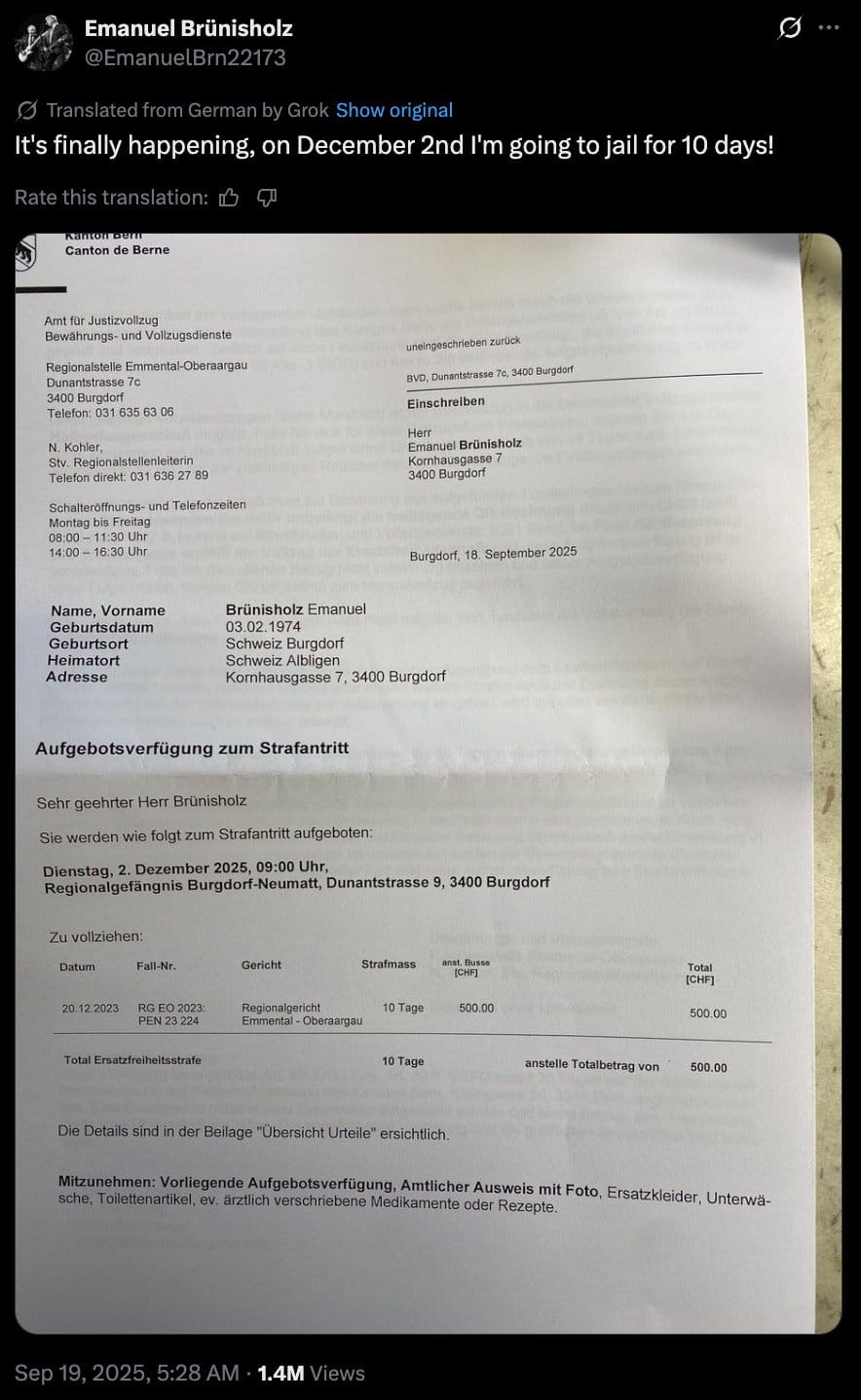
Rather than pay a 500 Swiss franc fine (approximately $580 USD) for what Swiss authorities deemed “incitement to hatred,” Brünisholz chose imprisonment—a decision he announced publicly on September 19, 2025, declaring: “It’s happening. On December 2, I’m going to prison for 10 days!”
His case has ignited debate about whether laws originally designed to combat genuine hate speech have metastasized into tools for suppressing scientific discussion and criminalizing dissent.
The Comment That Became a Crime
Brünisholz’s legal ordeal began in December 2022 when he responded to a Facebook post by Swiss National Council member Andreas Glarner. In his comment, Brünisholz wrote:
“If you dig up LGBTQI people after 200 years, you’ll only find men and women based on their skeletons. Everything else is a mental illness promoted through the curriculum.”
The statement references a widely-known observation in forensic anthropology: human skeletal remains exhibit sexual dimorphism that allows trained experts to determine biological sex with high accuracy. Features including pelvic shape, skull characteristics, bone density, and Q-angles differ predictably between males and females—knowledge that forms the foundation of forensic identification work performed by anthropologists and medical examiners worldwide.
For Brünisholz, this was a biological fact worth stating. For LGBT activists monitoring Swiss social media, it was hate speech that demanded punishment.
Within days, activists filed complaints with local police, alleging the comment violated Article 261bis of the Swiss Criminal Code—the nation’s anti-discrimination law that criminalizes public statements deemed to incite hatred or violate human dignity.
The Swiss E-ID Referendum: A Privacy Battleground That Divided a Nation
The Interrogation
On August 15, 2023—nearly nine months after his Facebook comment—Burgdorf Police summoned Brünisholz for interrogation. The questioning, conducted by the Regional Police Command Mittelland – Emmental – Oberaargau and documented in official transcripts, focused on his “intent” and beliefs.
When officers asked what he meant by his comment, Brünisholz responded: “Well, that those who think there’s not just man and woman, I want to tell them that there’s only man and woman.”
The interrogation continued: “What do you think of the LGBTQI community?”
His answer: “Nothing, absolutely nothing. It’s an extremist bunch. They want to silence me.”
These responses would seal his fate. The Bernese judiciary determined that “through his comment published on Facebook, [Brünisholz] has publicly belittled the group of LGBT(Q)I people based on their sexual orientation and in a way that violates human dignity.”
The characterization is telling. Brünisholz made no reference to harming LGBT individuals. He expressed no wish to discriminate against them in employment, housing, or public services. He simply stated a biological fact and offered his opinion about ideology in education—opinions that, however controversial, fall well within the bounds of legitimate political discourse in countries with robust speech protections.
In Switzerland, it was enough for a criminal conviction.
The Legal Proceedings
Brünisholz was issued a penal order fining him 500 Swiss francs, with the penalty convertible to 10 days imprisonment if unpaid. He immediately filed an objection, forcing the case to the Regional Court of Emmental – Oberaargau for review.
On December 20, 2023, the court affirmed the guilty verdict. Rather than reconsidering the prosecution, the court doubled down—adding an additional 600 Swiss francs in court fees.
Faced with a total penalty of 1,100 Swiss francs (approximately $1,270 USD), Brünisholz made his decision. He would not pay. Viewing the fine as an infringement on his right to express scientific facts, he opted to serve the jail time instead.
“I stand by every word,” he told police during questioning. Now he will spend 10 days in prison to prove it.
In a darkly ironic twist reported by multiple sources, Brünisholz claims the judge informed him he could serve his sentence at Hindelbank women’s prison if he registered as a woman. The absurdity—a man imprisoned for asserting biological sex differences being told he could declare himself female to change his prison placement—illustrates the contradictions embedded in the ideology that prosecuted him.
Article 261bis: From Anti-Racism to Thought Police
To understand how a factual statement about skeletal biology became criminal, one must examine the evolution of Article 261bis.
Originally enacted in 1994 after a narrow referendum victory (54.6% approval), Article 261bis aimed to combat racial, ethnic, and religious hate speech. Switzerland adopted the law to join the United Nations’ International Convention on the Elimination of All Forms of Racial Discrimination (ICERD).
The original provision criminalized:
- Public dissemination of ideologies that systematically denigrate persons based on race, ethnicity, or religion- Public denigration or discrimination that violates human dignity- Refusal to provide public services based on race, ethnicity, or religion
Violations carried penalties of up to three years imprisonment or monetary fines.
For decades, the law remained narrowly focused on preventing racist propaganda and discrimination. Then came the expansion.
The 2020 Extension
In 2018, Switzerland’s parliament voted to extend Article 261bis to include “sexual orientation.” The government claimed this change was necessary to protect LGBT individuals from discrimination and hate speech.
The extension proved controversial enough that opponents forced a nationwide referendum. On February 9, 2020, Swiss voters approved the expansion by 63.1%—a comfortable majority, but notably lower than approval rates for other equality measures.
The expansion added “sexual orientation” to the list of protected characteristics, making it criminal to:
- Publicly disseminate ideologies that systematically denigrate LGBT persons- Publicly denigrate or discriminate against LGBT persons in ways that violate human dignity- Refuse to provide public services to LGBT persons
Critically, the law requires that violations occur “in public” and “intentionally.” Private conversations among friends or family remain exempt. The law also requires that the speech “violates human dignity”—a vague standard that gives prosecutors and courts enormous discretion.
Supporters celebrated the change as necessary progress. Critics warned it would chill legitimate debate about gender ideology, sexual orientation, and related topics. The Brünisholz prosecution validates those warnings.
The Selective Enforcement Problem
Since 1995, the Federal Commission against Racism has registered 935 cases prosecuted under Article 261bis. Approximately 62% resulted in guilty verdicts, while 38% ended in acquittals or dismissed charges.
But legal experts note the selective nature of enforcement. The law is invoked far more frequently against certain types of speech than others. Critics point out that inflammatory statements about religion—particularly Christianity—rarely face prosecution, while comments about race or sexual orientation trigger immediate investigations.
The discretion inherent in phrases like “violates human dignity” and “belittles” allows authorities to prosecute speech they find ideologically objectionable while ignoring equally controversial statements that align with progressive orthodoxy.
The Scientific Reality Versus Ideological Mandate
At the heart of Brünisholz’s case lies an uncomfortable question: Can the state criminalize statements of biological fact when those facts contradict preferred narratives?
The skeletal differences between males and females are not controversial in forensic science:
Pelvic Structure: Female pelvises are wider and more circular to accommodate childbirth. Male pelvises are narrower and more heart-shaped. This single feature allows forensic anthropologists to determine sex with over 90% accuracy.
Skull Morphology: Male skulls typically feature more pronounced brow ridges, larger mastoid processes, and more robust overall construction. Female skulls tend to be smoother and more gracile.
Long Bone Dimensions: Males generally have longer and thicker long bones. Femur head diameter alone can determine sex with high reliability.
Bone Density: Males typically have denser, more robust skeletal structures throughout.
Skeletal Height: While individuals vary, male skeletons average significantly taller than female skeletons within populations.
These differences exist regardless of how individuals identify during life. A biological male who identifies as a woman will still possess a male skeletal structure. Forensic anthropologists examining remains 200 years hence—as Brünisholz’s comment suggested—would identify the skeleton as male based on these immutable characteristics.
This is not transphobia. It is not hate speech. It is anatomy.
Yet Swiss authorities determined that stating this reality “belittles” LGBT individuals and “violates human dignity.” The prosecution essentially declares that biological facts must be suppressed if they contradict gender ideology.
The Chilling Effect on Scientific and Political Discourse
Brünisholz’s prosecution sends an unmistakable message to Swiss citizens: certain topics cannot be discussed honestly without risking criminal prosecution.
Consider the implications:
For Scientists and Educators: Forensic anthropologists, biologists, and medical professionals must now weigh whether stating facts about sexual dimorphism could be construed as “belittling” LGBT individuals. Will textbooks need disclaimers? Will university lectures require trigger warnings before discussing skeletal differences?
For Parents and Concerned Citizens: Those who believe school curricula promote gender ideology—as Brünisholz explicitly stated—face prosecution if they voice these concerns publicly. The comment about curriculum was specifically cited in his conviction, effectively criminalizing criticism of educational policy.
For Political Debate: If factual statements about biology can be prosecuted as hate speech, how can citizens meaningfully debate policies around gender identity, women’s sports, single-sex spaces, or medical interventions for minors? The criminalization of dissent makes democratic deliberation impossible.
For Religious Believers: Many religious traditions hold that biological sex is binary and divinely ordained. Under Article 261bis, are public expressions of these beliefs now criminal? The law creates an inevitable collision between religious liberty and compelled speech.
The vagueness of “violates human dignity” means citizens cannot know in advance what statements will trigger prosecution. They must err on the side of silence—exactly the chilling effect that free speech protections exist to prevent.
The Proposed Further Expansion
Brünisholz’s case arrives amid efforts to expand Article 261bis even further. Since 2024, six parliamentary initiatives led by Switzerland’s Social Democratic Party have sought to add “gender identity” to the law’s protections.
The proposed expansion has sparked intense debate. A National Council commission is currently drafting legislation and wrestling with fundamental questions:
- Does “gender” refer to biological sex or self-identified gender identity?- Can the law protect both without creating contradictions?- How can gender identity protections be balanced against freedom of expression?- Would the expansion make it criminal to state that only biological women are women?
Advocacy groups like the Transgender Network Switzerland (TGNS) have pushed for explicit gender identity inclusion, citing recommendations from the European Commission against Racism and Intolerance (ECRI) and various UN bodies.
Critics warn that adding “gender identity” would intensify the prosecution of people like Brünisholz who assert biological realities. If “misgendering”—using pronouns that match biological sex rather than self-identification—can be prosecuted as hate speech, the law will effectively mandate compelled speech on a massive scale.
The timing of the Brünisholz prosecution has amplified concerns about overreach. As Switzerland debates whether to expand Article 261bis, citizens can see exactly how existing provisions are already weaponized against legitimate expression.
The International Context
Brünisholz joins a growing list of individuals worldwide prosecuted for expressing views on gender ideology:
United Kingdom: Countless individuals have faced police investigations, lost jobs, or been banned from social media for stating that biological sex is real and immutable. Women’s rights activists have been particularly targeted, with police recording statements about biological sex as “hate incidents” even when no crime occurred.
Canada: Professor Jordan Peterson rose to prominence after refusing to use compelled pronouns. Canadian law compels the use of preferred pronouns in certain contexts, with violators facing human rights tribunal penalties.
Finland: Parliament member Päivi Räsänen faced criminal prosecution for quoting Bible verses about sexuality. Though ultimately acquitted after years of legal battles, the prosecution itself demonstrated how hate speech laws can target religious expression.
Brazil: Feminist Isabella Cêpa (now Mizuno) fled to Europe after facing criminal charges for “misgendering” a trans politician. Brazilian law treats “transphobia” as a form of racism, carrying potential 25-year prison sentences.
Ireland: Teacher Enoch Burke has spent extended periods in prison for refusing to use a male student’s preferred pronouns, citing religious convictions. Despite no violence or harassment, Burke faces ongoing incarceration for maintaining his beliefs.
New Zealand: A Māori women’s rights advocate recently faced charges for social media comments about gender ideology, reported by a trans-identified male.
The pattern is consistent: countries without robust free speech protections like America’s First Amendment routinely prosecute citizens for expressing views on gender that were mainstream just years ago. What was once common sense—that humans are male or female, that biology matters, that women deserve single-sex spaces—has become criminalized dissent.
Switzerland’s Digital Surveillance Future
The Brünisholz prosecution arrives as Switzerland implements new digital identification systems. In September 2025, Swiss voters will decide on an e-ID referendum aimed at modernizing digital verification.
Critics warn that combining expanded hate speech laws with enhanced digital surveillance creates dangerous possibilities. If authorities can easily monitor online speech and prosecute “violations” of ever-expanding protected categories, citizens face unprecedented threats to privacy and expression.
The tools that enable convenient digital services can just as easily facilitate ideological policing. Once infrastructure exists to track online statements, expanding the list of prohibited speech becomes a matter of political will rather than technical capability.
Brünisholz’s prosecution demonstrates that Swiss authorities are willing to monitor social media, investigate citizens for wrongthink, and deploy criminal sanctions for ideological violations. Enhanced digital surveillance would only accelerate this trend.
The Principle of the Matter
Brünisholz’s refusal to pay his fine reflects a principled stand. By choosing imprisonment over compliance, he makes several statements:
The State Cannot Purchase His Silence: Paying the fine would constitute an admission that he did something wrong. It would validate the prosecution and encourage future cases. By refusing payment, Brünisholz denies the state’s authority to punish factual statements.
Some Principles Are Worth Defending: Ten days in jail is not trivial. Brünisholz has employment, presumably responsibilities, and a life that will be disrupted by incarceration. Yet he views the principle—that citizens must be free to state biological facts without criminal penalty—as worth defending at personal cost.
Public Attention Serves a Purpose: By announcing his imprisonment publicly and sharing the summons, Brünisholz ensures his case receives attention. His prosecution becomes a cautionary tale about where hate speech laws lead when divorced from common sense limitations.
Resistance Matters: Every person who complies with unjust laws makes the next prosecution easier. By resisting, even through the passive measure of non-payment, Brünisholz contributes to a culture of opposition that may eventually constrain overreach.
The Precedent and the Future
If Switzerland can imprison citizens for stating that skeletons reveal biological sex, what limits remain on state power to enforce ideological conformity?
The Brünisholz prosecution establishes that:
- Biological facts can be criminalized if they contradict preferred narratives- Criticism of educational curriculum can constitute hate speech- Expressing belief that gender ideology represents extremism justifies criminal investigation- Forensic anthropology—a legitimate scientific field—contains forbidden knowledge- The vague standard of “violating human dignity” empowers authorities to prosecute virtually any disfavored speech
These precedents will shape future prosecutions. Every teacher, scientist, religious believer, or concerned citizen who might speak on these topics must now weigh whether their words could trigger criminal investigation.
The effect is precisely what Article 261bis was supposedly designed to prevent: a class of citizens (gender ideology critics) who face systematic discrimination and silencing based on their beliefs. The irony of using anti-discrimination law to discriminate appears lost on Swiss authorities.
The Way Forward
Brünisholz’s case presents Swiss citizens and lawmakers with fundamental questions about the kind of society they want:
Option One: Doubling Down Switzerland could expand Article 261bis to include gender identity, criminalize “misgendering,” and further restrict discussion of biological sex. This path leads to more prosecutions, greater censorship, and the entrenchment of ideology over science.
Option Two: Course Correction Switzerland could recognize that Article 261bis has been stretched beyond its intended purpose. The law could be amended to explicitly protect statements of biological fact and legitimate political debate, even when such statements offend. Prosecutions like Brünisholz’s could be recognized as mistakes.
Option Three: Repeal The most radical option: acknowledge that hate speech laws inevitably become tools of ideological enforcement and repeal Article 261bis entirely. This would return Switzerland to a model where speech is broadly protected unless it constitutes direct incitement to violence or criminal conspiracy.
Currently, momentum favors Option One. The Social Democratic Party’s push to add gender identity protections suggests Swiss authorities want more prosecutions, not fewer. Transgender advocacy groups are already citing Brünisholz’s case as evidence that protections don’t go far enough.
🎧 Related Podcast Episode
Conclusion: The Skeleton in the Closet
Emanuel Brünisholz will spend 10 days in prison for acknowledging what every forensic anthropologist knows: human skeletons reveal biological sex.
His prosecution epitomizes how laws crafted with noble intentions—preventing racial hatred, protecting minorities—can mutate into instruments of ideological repression. When enforcing preferred narratives becomes more important than protecting speech, when biology becomes hate speech, when stating facts can land citizens in jail, something has gone profoundly wrong.
The skeletal differences between males and females exist whether or not acknowledging them violates someone’s dignity. Scientific reality does not require social approval. Truth does not become false because speaking it offends.
Brünisholz understands this. That’s why he chose a jail cell over capitulation.
His imprisonment will not change the facts. In 200 years, when archaeologists excavate graves in Burgdorf, they will identify skeletal remains as male or female based on morphology—just as Brünisholz said they would. No amount of hate speech prosecution will alter biology.
But by then, perhaps Switzerland will have learned that criminalizing truth serves no one—least of all the minorities such laws claim to protect. Movements that require state coercion to suppress dissent do not inspire confidence in their claims. Ideologies that need prison to enforce belief do not persuade through merit.
Brünisholz will serve his 10 days. His comment will remain factually accurate. And Swiss citizens will have to decide whether they want to live in a country where stating biological facts is a criminal offense, or whether freedom of expression—even for unpopular truths—deserves protection.
The skeletons don’t lie. The question is whether Switzerland will continue punishing those who acknowledge what the bones reveal.
Emanuel Brünisholz is scheduled to begin his 10-day prison sentence on December 2, 2025, at the Burgdorf-Neumatt regional prison in Burgdorf, Switzerland. His case continues to generate international attention as debates over hate speech laws, gender ideology, and freedom of expression intensify across Western democracies.