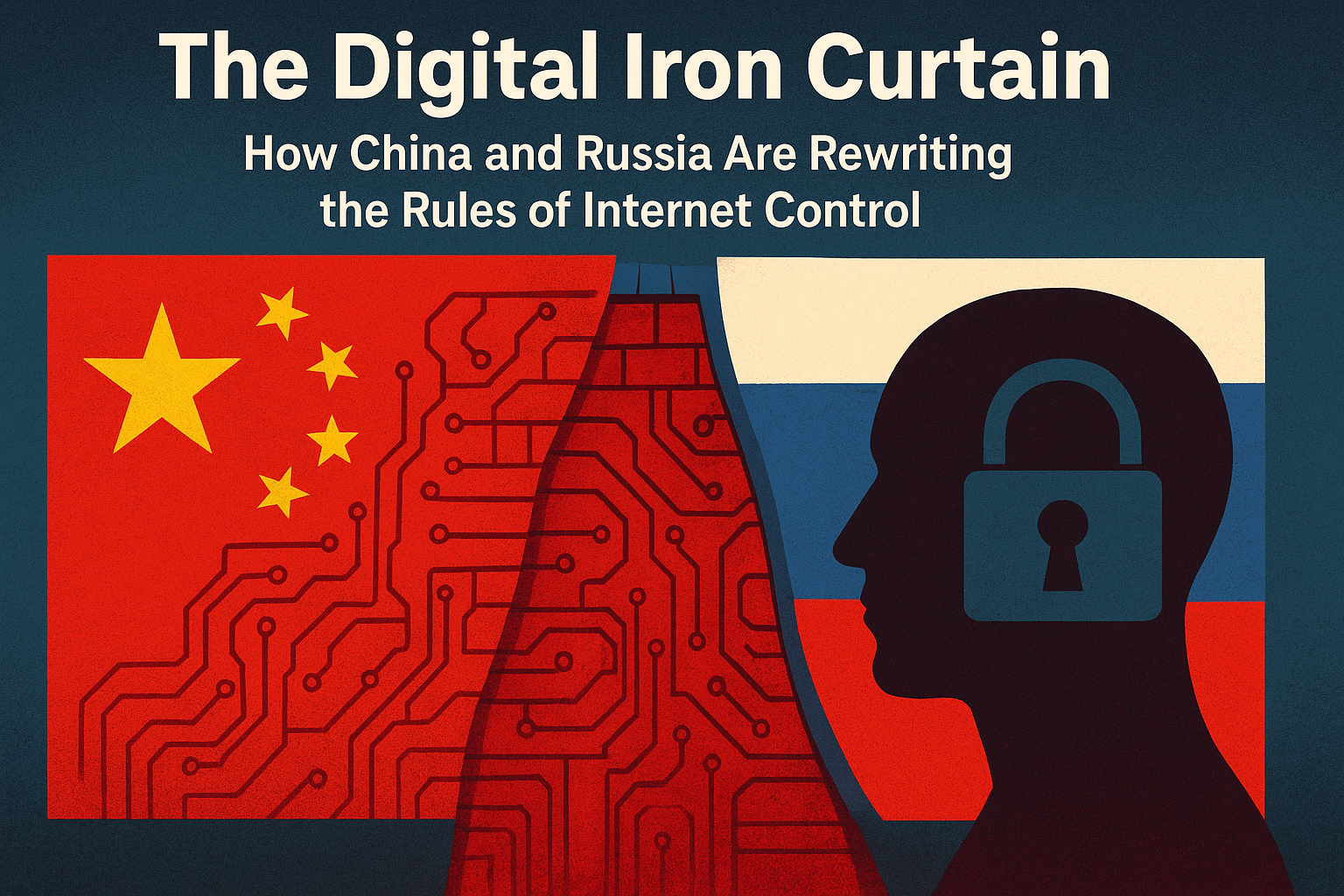
In an unprecedented escalation of digital authoritarianism, Russia and China are deepening their cooperation on internet censorship, creating a blueprint for surveillance that threatens to reshape global internet freedom.
The internet was once heralded as the ultimate tool for democratization—a borderless realm where information flowed freely and authoritarianism would wither under the bright light of transparency. But in 2025, that vision feels increasingly naive. Russia and China, the world’s leading architects of digital repression, are not just building walls around their own internet; they’re sharing the blueprints, comparing notes, and creating a new model of internet control that other authoritarian regimes are eager to adopt.
The Criminalization of Curiosity
On July 22, 2025, Russia crossed a chilling new threshold. The State Duma passed legislation that, for the first time, criminalizes the mere act of searching for content deemed “extremist” online. This isn’t about sharing, posting, or even saving prohibited content—it’s about looking for it. The message is clear: in Putin’s Russia, even curiosity is now a crime.
This represents a fundamental shift in the nature of internet censorship. Previously, authoritarian regimes focused on preventing the distribution of unwanted content. Now, Russia is pioneering the criminalization of consumption itself. Citizens face fines of up to 5,000 rubles (approximately $64 USD) for their first offense—a seemingly modest penalty that serves as a warning shot across the bow of anyone tempted to explore beyond the state-approved internet.
The Russian “extremist register,” maintained by the Ministry of Justice, contains 5,473 entries spread across more than 500 pages. What qualifies as “extremist”? The definition is deliberately vague, encompassing everything from genuine terrorist content to political opposition materials, LGBTQ+ resources, and religious texts outside the Orthodox mainstream. This ambiguity is not a bug—it’s a feature, designed to create a chilling effect where citizens self-censor rather than risk crossing an invisible line.
The War on VPNs
But Russia’s crackdown goes even deeper. Since March 2024, Russian authorities have banned the dissemination of information about censorship circumvention tools. By April 2025, Roskomnadzor, Russia’s internet watchdog, boasted that it had blocked at least 8,700 websites containing information on how to bypass censorship. The regime isn’t just building walls; it’s actively hunting down the ladders.
Virtual Private Networks (VPNs), long the go-to tool for citizens in authoritarian countries to access the free internet, are now in the crosshairs. The new law specifically targets individuals who use VPNs to access banned content, effectively criminalizing the tools that millions of Russians have relied on to stay connected to the global internet. It’s a tacit admission that the state’s censorship apparatus, despite its sophistication, remains vulnerable to determined users—and a sign that the regime is willing to criminalize basic digital literacy to maintain control.
The China Connection
Russia’s aggressive new measures didn’t emerge in a vacuum. Behind the scenes, Moscow and Beijing have been quietly collaborating on internet control strategies for years, sharing both technology and tactics. Leaked documents from closed-door meetings between China’s Cyberspace Administration (CAC) and Roskomnadzor reveal the depth of this cooperation.
China, with its infamous Great Firewall and sophisticated content filtering systems, has become the gold standard for digital authoritarianism. The Chinese model goes beyond simple blocking; it involves a complex ecosystem of surveillance, automated censorship, and algorithmic manipulation that shapes not just what citizens can see, but how they think about what they see.
Russia, initially less sophisticated in its approach, has been an eager student. Following high-level meetings between the two countries’ internet regulators, Russia implemented its own version of the “sovereign internet” law, creating the technical infrastructure to potentially disconnect Russian internet from the global network entirely. The Chinese provided not just technical expertise but also the ideological framework: the concept of “internet sovereignty,” which reframes censorship as a matter of national security rather than suppression of rights.
The Technology of Repression
The technical infrastructure supporting this censorship is increasingly sophisticated. Russia’s System for Operative Investigative Activities (SORM) and Technical Means for Countering Threats (TSPU) give authorities deep packet inspection capabilities, allowing them to monitor and filter internet traffic in real-time. These systems can identify and block specific types of encrypted traffic, making it increasingly difficult for citizens to use privacy tools.
China’s contribution to this technological arms race includes advanced AI systems capable of identifying and removing prohibited content at scale, facial recognition systems that can link online activity to real-world identities, and sophisticated social credit systems that create consequences for online behavior. These technologies are not just being shared between China and Russia; they’re being exported to other authoritarian regimes, creating a global market for digital repression tools.
The Domino Effect
The Russia-China censorship alliance is having ripple effects far beyond their borders. Other authoritarian governments are taking note, adopting similar technologies and legal frameworks. From Iran to Myanmar, from Cuba to Belarus, the playbook is being copied: criminalize VPN use, require real-name registration for internet services, deploy AI-powered content filtering, and create vague “extremism” laws that can be selectively enforced against dissidents.
Even more concerning is the normalization of these practices. As more countries adopt similar measures, what once seemed like extreme authoritarianism begins to look like standard practice. The “China model” of internet governance—once dismissed by Western democracies as incompatible with free society—is gaining adherents who see it as a path to maintaining political control in the digital age.
The Human Cost
Behind the statistics and technical specifications are real human stories. Russian journalists who can no longer access international news sources. LGBTQ+ youth cut off from support communities. Activists unable to coordinate or communicate safely. Researchers blocked from accessing academic resources. The cumulative effect is not just censorship but a kind of digital isolation, cutting citizens off from the global conversation and leaving them trapped in an increasingly narrow information ecosystem.
The psychological impact is profound. When even searching for information becomes a crime, self-censorship becomes a survival skill. Citizens learn to police their own curiosity, to avoid topics that might be problematic, to accept the boundaries of their digital prison rather than test them. This learned helplessness is perhaps the most insidious aspect of the new censorship regime—it doesn’t just control what people can access; it shapes what they dare to want to know.
The Resistance
Yet despite the increasingly sophisticated censorship apparatus, resistance continues. Tech-savvy citizens develop new workarounds faster than authorities can block them. Decentralized networks and blockchain-based communication tools offer hope for circumventing state control. International organizations work to provide censorship-resistant technologies to users in authoritarian countries.
But this cat-and-mouse game is becoming increasingly dangerous for those involved. With the criminalization of even searching for censorship circumvention tools, the stakes have never been higher. Digital resistance, once a relatively low-risk form of protest, now carries real legal consequences.
What This Means for the Global Internet
The China-Russia censorship alliance represents more than just a bilateral agreement between two authoritarian powers. It’s a direct challenge to the foundational principles of the internet itself. The vision of a single, interconnected global network is giving way to a “splinternet”—multiple, incompatible versions of the internet shaped by national boundaries and political ideologies.
For businesses, this means navigating an increasingly complex landscape of regulations and restrictions. For activists and human rights organizations, it means developing new strategies to support digital freedom in hostile environments. For ordinary citizens in democratic countries, it serves as a stark reminder that internet freedom is not inevitable—it must be actively defended.
The Road Ahead
As we move deeper into 2025, the battle lines over internet freedom are becoming clearer. On one side, the China-Russia axis promotes a vision of “cyber sovereignty” where governments have absolute control over their digital domains. On the other, democracies struggle to balance legitimate concerns about online harms with the preservation of fundamental freedoms.
The outcome of this struggle will shape not just how we communicate, but how we think, learn, and understand our world. The criminalization of curiosity in Russia and the systematic suppression of information in China are not just policy choices—they’re attempts to fundamentally rewire human behavior for the digital age.
The question facing the global community is not whether to respond, but how. As authoritarian regimes become more sophisticated in their censorship techniques and more willing to criminalize basic digital activities, the defenders of internet freedom must evolve as well. The stakes could not be higher: the future of human knowledge, communication, and freedom in the digital age hangs in the balance.
As the digital iron curtain descends across increasingly large swaths of the internet, the promise of a connected world feels more fragile than ever. The collaboration between China and Russia on internet censorship is not just a threat to their own citizens—it’s a blueprint for digital authoritarianism that threatens to reshape the internet as we know it. The question is no longer whether we can preserve the free and open internet, but whether we have the will to try.