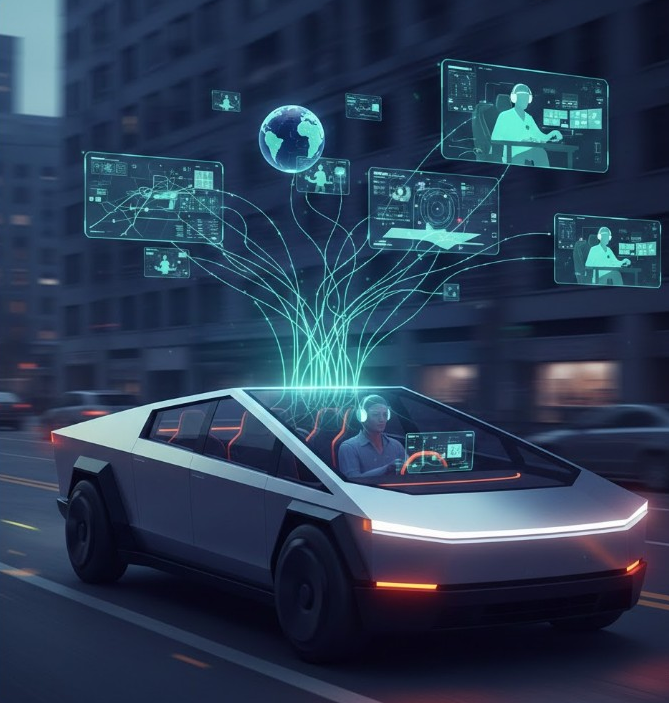
They’re marketed as autonomous. Fully self-driving. The future of transportation. But recent government disclosures, a contentious Senate hearing, and competing regulatory filings have peeled back the curtain on a truth the robotaxi industry would prefer to keep quiet: there are humans in the loop — and some of them are thousands of miles away.
Here’s what we now know about how Waymo and Tesla actually keep their fleets moving, and why it matters far beyond the transportation industry.
The Double-Edged Future: Privacy and Safety Risks in the Robotaxi Revolution
The Senate Hearing That Changed Everything
On February 4, 2026, Waymo Chief Safety Officer Dr. Mauricio Peña testified before the Senate Commerce Committee alongside Tesla VP of vehicle engineering Lars Moravy. The stated purpose was to build support for federal autonomous vehicle legislation. What happened instead was something closer to a reckoning.
Senator Ed Markey (D-MA) pressed Peña repeatedly on a straightforward question: does Waymo employ humans to remotely help its vehicles navigate difficult driving scenarios? The CSO’s evasive answers — emphasizing that remote agents “provide guidance” but don’t “drive” the vehicles — only intensified scrutiny. When Markey asked for a breakdown of domestic versus overseas operators, Peña admitted he didn’t have those figures, a response Markey called “very curious” for someone running the program.
The admission that ultimately went viral: a portion of Waymo’s remote assistance team operates out of the Philippines.
“The idea of transatlantic backseat drivers is both dangerous and unacceptable,” Markey said. He has since launched a broader investigation into remote oversight across the entire robotaxi industry.
Waymo’s Remote Assistance Program: What It Actually Is
Following the Senate hearing, Waymo’s head of global operations Ryan McNamara sent a clarifying letter to Senator Markey on February 17. The company was eager to frame the narrative on its own terms.
According to Waymo, its remote assistance (RA) team consists of approximately 70 agents — roughly half based in the United States, half in the Philippines. These agents are described as “fleet response” workers who provide advice only when the automated driving system specifically requests it, on an event-driven basis. They do not steer, brake, or accelerate the vehicle. The Waymo Driver — the company’s AI — retains full control of what the industry calls the “dynamic driving task” at all times.
What these agents actually do is meaningful, however. They can advise the vehicle on lane selection, propose navigational paths for the AI to consider, and help resolve ambiguous situations the software hasn’t been trained to handle. Think: construction zones with missing signage, unusual traffic patterns, or intersections where infrastructure has failed.
Speaking of which — infrastructure failures became a central exhibit in this debate.
The San Francisco Blackout: When the Backup System Became the Story
On December 20, 2025, a major power outage hit San Francisco, knocking out traffic signals across the city. For Waymo’s driverless fleet, this created an immediate crisis. Without functioning traffic lights, the vehicles encountered situations their AI wasn’t equipped to resolve independently at scale. Requests to the remote assistance team spiked dramatically, overwhelming the system. Parts of Waymo’s San Francisco fleet effectively stalled.
Waymo later acknowledged the blackout created a surge in RA requests that its team couldn’t keep pace with — a resourcing failure, the company admitted, not a technology failure. But the distinction proved cold comfort for passengers stuck in gridlocked Waymos while the city went dark around them.
Related: The Double-Edged Future — Privacy and Safety Risks in the Robotaxi Revolution
Tesla’s Very Different Kind of Human Oversight
Tesla’s February 13 filing with the California Public Utilities Commission (CPUC) offered a revealing contrast — and an opportunity for a competitive jab.
Tesla was quick to point to the San Francisco blackout as evidence of Waymo’s fragility, noting that its own ride-hailing service wasn’t disrupted because human drivers were present behind the wheel. That detail is key to understanding the fundamental difference between these two companies’ approaches.
Tesla’s “Robotaxi” service currently operates using Full Self-Driving (Supervised), a Level 2 driver assistance system that, by regulatory and legal definition, requires a licensed human driver in the vehicle at all times. Tesla’s remote operators — all U.S.-based, the company emphasized — serve as a secondary layer of oversight on top of that in-car human presence.
Tesla explicitly criticized Waymo’s use of overseas operators, arguing that domestically-based remote staff are more familiar with local traffic laws, offer superior network connectivity, and present a smaller cybersecurity attack surface.
What Tesla didn’t address quite as directly: its service isn’t actually autonomous. A human drives it. Tesla is fighting for the right to call this a “Robotaxi” while simultaneously telling regulators the vehicles require human drivers. A California court already ruled in December 2025 that Tesla’s marketing of “Autopilot” and “Full Self-Driving” violated state false advertising laws. The CPUC filing may reignite that fight.
Related: The Robotaxi Revolution — Privacy, Safety, and What Riders Aren’t Being Told
The Cybersecurity Dimension Nobody Is Talking About Enough
From a security standpoint, the remote assistance model deserves far more scrutiny than it’s currently receiving in mainstream coverage.
Senator Markey raised it directly during the hearing: overseas remote assistance operations may be more vulnerable to physical takeover by hostile actors, potentially granting them influence over thousands of vehicles carrying passengers on American roads. The latency inherent in international remote connections — even milliseconds matter in safety-critical scenarios — adds another layer of risk.
Waymo’s CSO noted the company performs risk assessments and vulnerability mitigation. But specific details about how overseas operator connections are secured, what access controls exist, and how the system would respond to a man-in-the-middle attack on an international RA session have not been made public.
For cybersecurity professionals, the threat model is straightforward and concerning: you’re dealing with a system where remote human input can influence the navigation decisions of a 4,000-pound vehicle moving at speed, that connection traverses international networks, and the operators are employed through what may include third-party staffing arrangements with their own security postures.
House Representative Earl Carter has already sent a letter to Transportation Secretary Sean Duffy calling for a formal investigation into robotaxi companies using foreign-based remote assistance operators.
Related: Privacy and Safety in the Autonomous Vehicle Era — A Deep Dive
What “Autonomous” Actually Means — And Doesn’t
The real story here isn’t that Waymo and Tesla use human oversight. That’s an industry-wide practice, and arguably a sensible safety precaution during a period when AI systems are still maturing. The real story is the gap between how these services are marketed and how they actually operate.
Waymo has long promoted its vehicles as fully autonomous and recently moved away from the term “self-driving” to distance itself from Tesla’s Level 2 marketing. But “fully autonomous” apparently still includes a global network of 70 human operators providing real-time guidance when the AI gets confused. The vehicles may always be “in charge” technically — but the people advising them in the moment make navigational decisions that shape where the vehicle goes.
Tesla, meanwhile, markets a “Robotaxi” that requires a human driver, has accumulated 14 reported collisions since its June 2025 Austin launch (including a hospitalization it initially underreported), and continues to redact crash descriptions from federal databases that competitors like Waymo publish openly.
The autonomy levels defined by SAE International — from Level 0 (no automation) to Level 5 (full automation) — exist precisely to give consumers, regulators, and the public a shared language for understanding what a system can and cannot do. Neither Waymo nor Tesla is operating at Level 5. Waymo operates at Level 4 within geofenced areas. Tesla’s current robotaxi service operates at Level 2. The marketing from both companies has consistently outpaced those technical realities.
The Labor Angle — From Manila to Your DoorDash Driver
There’s also an ethical labor dimension to this story that shouldn’t be buried in the policy discussion.
Remote assistance operators — whether in the Philippines, the U.S., or elsewhere — are performing safety-critical work. They’re watching live video feeds of vehicles in complex traffic situations, making rapid navigational recommendations, and potentially witnessing accidents or near-accidents in real time. Occupational health researchers have flagged the psychological toll of this kind of work, including exposure to traumatic events without the support structures typically available to first responders or transportation safety professionals.
The economics of offshore RA operators almost certainly reflect cost optimization rather than a safety-first philosophy. A domestic operator in San Francisco commands a dramatically different wage than a remote worker in Manila. As Senator Markey noted, this represents a pattern of automating American driving jobs while simultaneously offshoring the human oversight roles that automation requires.
But if you needed a sharper illustration of just how many human hands are still involved in “driverless” transportation, look no further than a Reddit post that surfaced in mid-February 2026: a DoorDash driver in Atlanta was offered $11.25 to close the door of a nearby Waymo that a passenger had left ajar.
Waymo confirmed the arrangement. When a departing rider leaves a door open, the vehicle cannot proceed until a human physically closes it. To solve this, Waymo is running a pilot program paying gig workers from DoorDash and Honk — an independent roadside assistance platform — to close robotaxi doors on demand. In Los Angeles, Honk users were reportedly offered up to $24 for the same task.
Waymo says future vehicles will have automated door closures. A timeline hasn’t been provided. In the meantime, a $126 billion company is dispatching gig economy workers to perform a task that costs between eleven and twenty-four dollars per occurrence.
It’s a small operational detail. It’s also a perfect metaphor for the current state of “autonomous” transportation: cutting-edge AI at the wheel, human beings filling in every gap the AI can’t handle — from navigation decisions in the Philippines to door-closing in Atlanta.
If Congress moves to mandate U.S.-based operators for all robotaxi remote assistance — which several lawmakers have signaled support for — the cost structure of these services changes significantly. That’s a real constraint on the path to profitability both Tesla and Waymo have projected.
What Comes Next
Federal autonomous vehicle legislation remains stalled. The NHTSA has lost roughly 25% of its workforce, leaving the Office of Automation with minimal staff to conduct oversight. State-level regulators in California and Arizona are revisiting permitting requirements. New York Governor Kathy Hochul withdrew a robotaxi expansion proposal entirely in February 2026 following legislative resistance and pressure from labor groups representing over 170,000 taxi and ride-hail workers.
The regulatory environment is fragmenting at exactly the moment these technologies are scaling. Waymo is operating 450,000 fully driverless rides per week across six cities. Tesla is in Austin with roughly 42 vehicles and below 20% availability. Both are expanding. Both are lobbying. And the rules governing them are still being written.
For passengers, the practical takeaway is this: when you get into a robotaxi, you are participating in a live experiment. The vehicle may be communicating with a human operator on another continent. That operator may be helping decide whether your car turns left or right. And the company may not be legally required to tell you any of this before the ride begins.
That’s not an argument against autonomous vehicles. The technology has genuine potential to save lives and improve transportation access for people who can’t drive. But it is an argument for transparency — and for demanding that the rules governing these services reflect what’s actually happening inside the system, not what the marketing suggests.
*At myprivacy.blog, we cover the intersection of emerging technology, data privacy, and cybersecurity so you can make informed decisions about the systems shaping your world. Have a question about autonomous vehicle privacy or security? *