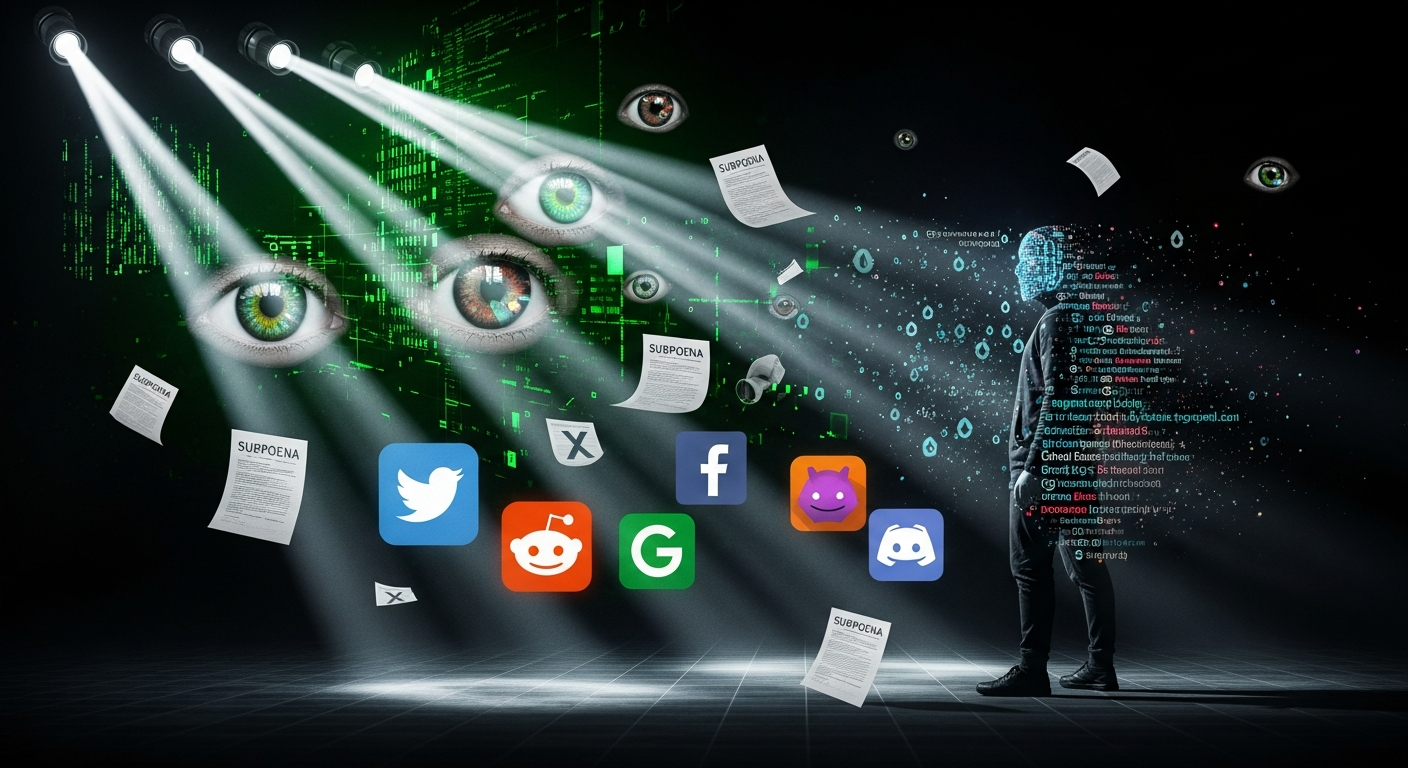
The federal government has discovered a surveillance loophole that requires no judge, no warrant, and no probable cause—and tech companies are rolling over.
When Federal Agents Came for a Retiree’s Email
It started with a polite email.
In late January 2026, a Philadelphia retiree—we’ll call him Jon, since his legal case is ongoing under the pseudonym “Doe”—did something millions of Americans do every day: he contacted a government official to voice his concerns. A lifelong citizen with no criminal record, no activist history, and no particular axe to grind, Jon sent a measured email to the Department of Homeland Security expressing his dismay at the agency’s increasingly aggressive immigration enforcement tactics.
Four hours later, DHS issued an administrative subpoena to Google demanding his identity.
The subpoena sought everything Google knew about John: his real name, his home address, his phone number, his IP addresses, the dates and times he’d accessed his account, and more. The boilerplate justification offered nothing specific—just that the information was sought “in connection with an investigation or inquiry relating to the enforcement of U.S. immigration laws.”
Jon had not threatened anyone. He had not planned violence. He had not even been particularly confrontational. He had simply exercised his constitutional right to criticize his government.
Within weeks, federal agents appeared at his doorstep.
Jon is now represented by the ACLU, which filed a motion to quash the subpoena. When faced with actual legal challenge, DHS quietly withdrew it—a pattern we’ll return to, because it’s perhaps the most damning evidence of what the government knows about the legality of its own tactics.
But Jon is not alone. He’s one of hundreds—possibly thousands—of Americans who have been subjected to what civil liberties organizations are calling “lawless” surveillance simply for speaking out against Immigration and Customs Enforcement.
The Student Journalist Who Fled to Senegal
Amandla Thomas-Johnson was a graduate student and aspiring journalist when he made the decision that would upend his life. Working on a story about ICE enforcement patterns in his community, he had been documenting raids, interviewing affected families, and posting his findings to social media under his own name.
Then he learned that DHS had subpoenaed his records from Google—including, according to a February 2026 report in The Intercept, his credit card numbers and bank account information.
Think about that for a moment. Not just his name and address. Not just his IP logs. His financial records. The credit card he uses to buy groceries. The bank account where his student loans are deposited.
For writing about ICE.
By the time the subpoena surfaced, Thomas-Johnson had made a calculation that should chill every American who believes in press freedom: he fled the country. As of this writing, he is living in Senegal, having concluded that remaining in the United States was too dangerous for someone who had committed the crime of journalism about immigration enforcement.
“I didn’t break any laws,” he told reporters. “I just wrote about what ICE was doing in my community. Now I can’t go home.”
These are not stories from some authoritarian regime. These are stories from the United States of America in February 2026. And they represent just the visible tip of a massive surveillance iceberg.
The Shadow Subpoena Machine
According to a New York Times investigation published on February 13, 2026, the Department of Homeland Security under Secretary Kristi Noem has issued hundreds of administrative subpoenas to major tech platforms—Google, Meta, Reddit, Discord, and others—seeking to unmask Americans who post critically about ICE operations online.
The scale is staggering. The implications are worse.
To understand why these subpoenas represent such a threat to civil liberties, you need to understand what makes an “administrative subpoena” different from the legal process most Americans imagine when they think of government surveillance.
What Most People Think Happens
When Americans imagine the government trying to access their private information, they typically picture something like this:
- Law enforcement suspects someone of a crime2. They gather evidence and present it to a judge3. The judge reviews the evidence and determines whether it meets the legal standard for a warrant or subpoena4. If approved, the judge signs the order5. The company receives the order and must comply
This process—judicial oversight—is a cornerstone of Fourth Amendment protections. It ensures that an independent arbiter reviews government requests before they’re issued, preventing fishing expeditions and politically motivated surveillance.
What’s Actually Happening
Administrative subpoenas work completely differently:
- A government agency decides it wants someone’s information2. An agency official—not a judge—signs the subpoena3. The company receives the demand4. That’s it. There is no step 4.
No judge ever reviews the request. No independent arbiter weighs the government’s justification against the target’s privacy rights. No one outside the agency that wants the information has any say in whether the subpoena should issue.
The Department of Homeland Security can—and is—issuing these subpoenas unilaterally, in bulk, targeting Americans for their political speech, with no judicial oversight whatsoever.
The Legal Fine Print Companies Ignore
Here’s what tech companies should know, but often seem to forget: administrative subpoenas are not self-enforcing.
If Google or Meta or Reddit receives an administrative subpoena and simply refuses to comply, what happens? Nothing. The government cannot fine them. The government cannot sanction them. The government cannot even compel them to respond.
The only way an administrative subpoena becomes enforceable is if the government goes to court to seek a judicial order compelling compliance. And if the government does that, suddenly they face exactly the judicial oversight they were trying to avoid: a judge will review whether the subpoena is legally valid, whether it serves a legitimate investigative purpose, and whether it violates the target’s constitutional rights.
This is why civil liberties organizations like the Electronic Frontier Foundation and the ACLU are urging tech companies to simply refuse to comply with DHS administrative subpoenas absent a court order. There is no legal obligation to comply voluntarily. There is no penalty for requiring judicial review.
But that’s not what’s happening.
Big Tech’s Shameful Capitulation
When Twitter received an administrative subpoena in 2017 demanding it unmask the anonymous @ALT_USCIS account—a parody account critical of Trump administration immigration policies—the company did something remarkable: it fought back.
Twitter immediately filed suit in federal court, arguing that the subpoena violated First Amendment protections for anonymous political speech. The ACLU jumped in to represent the anonymous account holder. Legal experts predicted a landmark case that would define the limits of government power to unmask online critics.
It never got that far. Within 24 hours of Twitter’s lawsuit, Customs and Border Protection withdrew the subpoena entirely. The government, faced with actual judicial scrutiny, tucked tail and ran.
The message was clear: these subpoenas cannot survive legal challenge. The government knows it. When forced to defend their tactics in court, they fold.
But nine years later, the tech landscape has changed dramatically. The companies that once positioned themselves as champions of user privacy have become something else entirely.
Google: Same-Day Surrender
According to documents reviewed by the New York Times and additional reporting from The Intercept, Google has complied with DHS administrative subpoenas at a pace that can only be described as eager.
In at least one case, Google fulfilled a subpoena demanding user information on the same day it sent the notification to the affected user. The company’s policy nominally gives users 10 days to challenge subpoenas before compliance—but Google admitted that “sometimes when Google misses its response deadline, it complies with the subpoena and provides notice to a user at the same time.”
Read that again: Google’s excuse for not giving users time to challenge subpoenas is that Google missed its own deadline.
In the student journalist case, Google handed over not just basic subscriber information but credit card numbers and bank account information. Financial data. For a journalist. To an agency investigating him for writing about immigration enforcement.
A Google spokesperson defended the company’s process as “designed to protect user privacy while meeting our legal obligations.”
But here’s the thing: Google has no legal obligation to comply with administrative subpoenas absent a court order. None. The company is choosing to prioritize a hypothetical legal convenience over the constitutional rights of its users.
Meta: The 100,000-Member Silence
Meta’s response has been, if anything, even more troubling.
The company disabled a Facebook group called “ICE Sightings—Chicagoland” with over 100,000 members. The group’s purpose was straightforward: community members would report ICE activity in their neighborhoods so that immigrants could make informed decisions about their movements.
This is not illegal activity. Courts have repeatedly ruled that there is no “doxing exception” to the First Amendment. Sharing publicly observable information about government agents conducting enforcement actions in public is protected speech.
But when the government pressured Meta to shut it down, the company complied without apparent resistance.
The group’s administrator, Kassandra Rosado, is now a plaintiff in a lawsuit against Attorney General Bondi and Secretary Noem, alleging that the government coerced tech platforms to censor constitutionally protected speech. But for the 100,000 members of that group—people who had organized a community resource to protect their neighbors—the damage is done.
Meta also appears to have unmasked at least one user without providing any advance notice, attributing the failure to a “technical glitch.” The company declined to comment to journalists.
Apple: Removing Apps on Command
Apple took a different approach: it removed ICE-tracking apps from the App Store entirely.
Apps like “ICEBlock” and “Eyes Up”—which helped users report and track ICE activity—were pulled after Attorney General Pam Bondi publicly bragged about forcing their removal. Mark Hodges, the creator of Eyes Up, is now a plaintiff in the FIRE v. Bondi lawsuit.
These apps remain available on Google Play, highlighting the arbitrary nature of Apple’s capitulation. The apps weren’t illegal. They weren’t facilitating violence. They were helping communities share information about government activity occurring in public.
But when the government said jump, Apple asked how high.
The Contrast With 2017
The difference between Twitter’s 2017 response and tech’s 2026 response is stark and damning.
In 2017, faced with a single administrative subpoena targeting a single anonymous account, Twitter immediately lawyered up, filed suit, and forced the government to back down.
In 2026, faced with hundreds of subpoenas targeting journalists, activists, and ordinary citizens, the largest tech companies in the world are complying as fast as their servers will allow.
“Companies have bent over backward to appease the Trump administration,” said Mario Trujillo, Senior Staff Attorney at the Electronic Frontier Foundation. “What we have seen in the 12 months since the leaders of Big Tech were there on the podium at the inauguration is much more friendliness of Big Tech towards the government and towards state power.”
Professor Neil Richards of Washington University St. Louis put it more bluntly: under federal law and state consumer protection statutes, companies cannot deceive consumers about their data practices. If a company promises to protect user privacy and then hands over user data without legal process, “that’s a deceptive trade practice.”
The Pattern That Proves They Know
Here’s the detail that should infuriate every American who cares about civil liberties:
Every single time a DHS administrative subpoena has been legally challenged, the government has withdrawn it.
Every. Single. Time.
The Philadelphia retiree? DHS withdrew the subpoena when the ACLU filed a motion to quash.
The 2017 Twitter case? CBP withdrew within 24 hours of Twitter filing suit.
When confronted with actual judicial scrutiny, the government doesn’t even try to defend these subpoenas. They know they’re unlawful. They know they can’t survive constitutional challenge.
“That’s like an acknowledgement that the Trump administration, when actually challenged in court, wasn’t even willing to defend itself,” said Trujillo.
This pattern reveals the entire strategy: issue subpoenas in bulk, rely on tech companies to comply voluntarily, and withdraw immediately if anyone fights back. It’s a surveillance program built on the assumption that most people won’t have the resources, knowledge, or courage to challenge the government.
And tragically, that assumption is largely correct.
The First Amendment Under Siege
The constitutional implications of what’s happening cannot be overstated.
Anonymous Speech Is Protected
The Supreme Court has repeatedly and unambiguously affirmed First Amendment protection for anonymous political speech. In McIntyre v. Ohio Elections Commission (1995), the Court struck down a law requiring political pamphlets to identify their authors, holding that “an author’s decision to remain anonymous… is an aspect of the freedom of speech protected by the First Amendment.”
This isn’t a close question. Anonymous criticism of the government is exactly the kind of speech the First Amendment was designed to protect. The Federalist Papers were published pseudonymously. Revolutionary pamphleteers operated anonymously. The entire American tradition of political dissent is built on the understanding that citizens must be free to criticize their government without fear of retaliation.
What DHS is doing—demanding that tech companies reveal the identities of anonymous critics—is a direct assault on this foundational right.
There Is No “Doxing Exception”
Government officials have attempted to justify these subpoenas by characterizing ICE-tracking activity as “doxing”—supposedly dangerous exposure of personal information about federal agents.
This argument fails on multiple levels.
First, sharing information about government agents conducting enforcement operations in public is not “doxing” in any meaningful sense. When ICE agents in marked vehicles conduct a raid on a public street, reporting that activity is journalism, not harassment.
Second, even if it were “doxing,” there is no First Amendment exception for it. As FIRE Senior Attorney Colin McDonnell observed, “It seems like the government is expanding that definition to encompass just sharing, even if there’s no threats, nothing violent. Just sharing information about what our government is doing.”
Courts have consistently held that true threats and incitement to imminent violence can be restricted, but mere sharing of information—even information that makes government officials uncomfortable—is protected speech.
The Chilling Effect Is Real
Constitutional lawyers speak of “chilling effects”—the way that government overreach can suppress protected speech even when specific prosecutions don’t occur. The mere threat of surveillance and retaliation causes people to self-censor, to avoid exercising their rights, to stay quiet when they should speak.
We don’t need to theorize about chilling effects. We’re watching them happen in real time.
Community members are moving ICE-watch efforts to encrypted group chats because they’re afraid of government surveillance on public platforms.
Facebook groups with tens of thousands of members have been shut down, fragmenting communities that had organized mutual aid networks.
A journalist fled the country rather than risk arrest for reporting on immigration enforcement.
A retiree who sent a polite email had federal agents appear at his door.
“If you can’t criticize a government official without the worry of having your private records gathered and agents knocking on your door,” said ACLU attorney Stephen A. Loney, “then your First Amendment rights start to feel less guaranteed.”
What the Government Is Really Doing
Let’s be clear about what’s happening here, stripped of euphemism and legal jargon.
The federal government is using surveillance tools designed for immigration enforcement to identify and intimidate Americans who criticize immigration policy.
The targets are not undocumented immigrants. They’re not criminals. They’re not terrorists. They’re citizens, journalists, activists, and ordinary people who have opinions about how their government operates.
The justification—“in connection with an investigation or inquiry relating to the enforcement of U.S. immigration laws”—is circular nonsense. Criticizing ICE is not an immigration violation. Documenting raids is not obstruction. Reporting government activity is not a crime.
Tom Homan, the administration’s border czar, has made the goal explicit: “We’re going to make sure everyone knows who they are… we’re going to broadcast every one of these people we arrest.”
This is not law enforcement. This is intimidation. This is the use of federal surveillance powers to punish political speech.
The Numbers Tell the Story
Consider the scale of what we’re describing:
- Hundreds: Administrative subpoenas from DHS specifically targeting ICE critics, according to the New York Times- 28,622: Total subpoenas received by Google in the first half of 2025 alone (all types)- 14,520: Total subpoenas received by Meta in the same period- 100,000: Members in the Chicago Facebook group disabled at government request- 4 hours: Time between John the retiree sending a critical email and DHS issuing a subpoena for his identity- 10-14 days: Time companies theoretically give users to challenge subpoenas- 0: Number of subpoenas DHS has defended in court when challenged
That last number is the most important. Zero. The government has not once stood behind these subpoenas when forced to face judicial scrutiny. They issue them in bulk, hope for voluntary compliance, and withdraw the moment anyone fights back.
What Tech Companies Should Do
The Electronic Frontier Foundation and ACLU have published an open letter to tech companies outlining what they should do—what they could do, legally and practically, right now:
- Require court intervention before complying with any DHS administrative subpoena. There is no legal obligation to comply voluntarily. Companies can simply say no and force the government to seek a judicial order.2. Give users maximum advance notice to challenge requests. Not “10-14 days that we sometimes miss.” Real notice, with real time to consult lawyers and file challenges.3. Provide users with copies of the subpoenas. Users have a right to know exactly what information the government is demanding about them.4. Resist gag orders. The government sometimes demands that companies not notify users. Companies should challenge these demands in court.5. Link users to legal aid resources. Most people don’t know their rights or how to challenge government surveillance. Companies can help.6. Take up legal fights on behalf of vulnerable users. Twitter did this in 2017. Nothing prevents Google or Meta from doing it in 2026—except the will to do so.
These recommendations are not legally complex. They don’t require new legislation or court rulings. They simply require tech companies to prioritize user rights over government convenience.
The fact that companies are choosing not to implement these practices tells you everything you need to know about whose side they’re on.
What You Can Do to Protect Yourself
If you’re reading this article on a privacy-focused blog, you probably already care about protecting your digital footprint. But the DHS subpoena campaign raises the stakes considerably. Here’s what you can do:
Understand the Threat Model
First, be realistic about what you’re protecting against. Administrative subpoenas can demand:
- Your real name and identity- Your home address- Your phone number- Your email addresses- Your IP addresses (including VPN exit nodes in some cases)- Session times and access logs- Credit card and bank account numbers associated with your accounts
They generally cannot demand the content of your communications (that requires higher legal process), but the metadata alone can be devastating.
Minimize Data Collection
Use services that collect less data in the first place.
- Consider email providers that don’t require phone numbers or collect minimal information (ProtonMail, Tutanota)- Use browsers that don’t track you (Firefox with privacy settings, Brave, Tor for sensitive activity)- Consider whether you need accounts at all for certain activities
Don’t link accounts unnecessarily. Using the same email address across services makes it easier to unmask your entire digital identity from a single subpoena.
Separate Your Identities
If you engage in political speech online, consider keeping it separate from your “real” identity:
- Use a separate email address created with minimal identifying information- Don’t link payment methods to anonymous accounts- Be aware that IP addresses can connect accounts; consider VPNs or Tor for sensitive activity- Remember that writing style and timing patterns can be used to connect accounts
Use End-to-End Encryption
For communications you want to protect:
- Signal for messaging (be aware that even Signal groups are reportedly under FBI investigation for ICE-tracking activity, but content remains encrypted)- Encrypted email services for sensitive correspondence- Remember that metadata (who you talked to, when) may not be protected even when content is
Know Your Rights
If you receive notice that a subpoena has been issued for your information:
- You may have limited time to challenge it. Act quickly.- Contact a lawyer immediately. Organizations like the ACLU, EFF, and FIRE may be able to help or refer you to someone who can.- Document everything. Save copies of any notices you receive.- Understand that challenging subpoenas works. The government has withdrawn every subpoena that’s been challenged in court.
Consider the Risks of Public Speech
This is the hardest recommendation to write, because it feels like surrender. But realistically:
- If you’re going to criticize ICE or document immigration enforcement, understand that you may be targeted- Use anonymous accounts if you’re concerned about retaliation- Be aware that “anonymous” is only as strong as the weakest link in your operational security- Consider whether you want to be public (with the visibility that provides) or anonymous (with the risks that entails)
Support Organizations Fighting Back
The ACLU, EFF, FIRE, and other civil liberties organizations are actively litigating against these surveillance tactics. They need resources to continue that fight. Consider:
- Donating to organizations doing this work- Sharing information about these cases- Contacting your elected representatives about administrative subpoena abuse
The Legal Fights Ahead
Several lawsuits are currently challenging the government’s surveillance campaign:
FIRE v. Bondi
The Foundation for Individual Rights and Expression has filed suit against Attorney General Pam Bondi and DHS Secretary Kristi Noem, alleging that they coerced tech platforms to censor constitutionally protected speech about ICE.
The plaintiffs include Kassandra Rosado, whose 100,000-member Facebook group was disabled, and Mark Hodges, whose ICE-tracking app was removed from the App Store. The suit seeks a permanent injunction against government coercion of platforms to suppress protected speech.
Doe v. DHS (ACLU)
The Philadelphia retiree’s case, filed under a pseudonym, challenges the subpoena issued after his critical email. As noted, DHS withdrew the subpoena after the ACLU filed a motion to quash—but the case continues, seeking to establish precedent that would protect future targets.
Tincher v. Noem
The ACLU of Minnesota has filed suit challenging ICE and Border Patrol violence and intimidation against protesters and community members. The complaint includes over 80 declarations documenting pepper spraying, arrests, and surveillance of people engaged in protected First Amendment activity.
EFF v. DOJ (FOIA)
The Electronic Frontier Foundation has filed a Freedom of Information Act lawsuit seeking disclosure of communications between the government and tech platforms about content removal and user data demands. This case could reveal the full scope of government pressure on tech companies.
What This Means for American Democracy
Step back from the legal details and consider what’s happening at a fundamental level.
The federal government has identified a loophole that allows it to conduct mass surveillance of political critics without judicial oversight. It’s using that loophole aggressively, issuing hundreds of demands to unmask people who criticize immigration policy.
The targets are not criminals. They’re citizens exercising their constitutional rights.
The companies that hold our data—the companies we trust with our emails, our documents, our financial information, our entire digital lives—are complying without resistance. They’re choosing government convenience over user rights, even when there’s no legal requirement to do so.
And when challenged, the government withdraws rather than defend its tactics in court—an implicit admission that what they’re doing can’t survive legal scrutiny.
This is what authoritarianism looks like in a digital age. Not jackbooted thugs kicking down doors (though that’s happening too, as the Tincher lawsuit documents). But quiet surveillance, bulk data demands, and the systematic intimidation of political opponents through perfectly legal-seeming administrative processes.
The constitutional guardrails exist. Judicial oversight exists. The First Amendment exists.
But they only work if people use them. They only work if companies refuse to comply with lawless demands. They only work if citizens know their rights and exercise them.
The next time you see someone posting critically about ICE, or documenting immigration enforcement in their community, or organizing mutual aid networks for immigrant families—know that the federal government may be watching. Know that your tech platforms may hand over their information without a fight.
And then decide what kind of country you want to live in.
Further Reading
- EFF’s Open Letter to Tech Companies: “Protect Your Users From Lawless DHS Subpoenas”- ACLU’s Motion to Quash: Legal filings in the Philadelphia retiree case- FIRE v. Bondi: Full complaint and case documents- Electronic Frontier Foundation: Ongoing coverage of government surveillance- McIntyre v. Ohio Elections Commission (1995): Supreme Court case affirming anonymous political speech