How Britain’s Online Safety Act Sparked an International Legal Battle Over Free Speech and Jurisdiction
The United Kingdom’s ambitious attempt to regulate the global internet has collided head-on with American free speech principles, creating an unprecedented international legal standoff that could reshape how nations enforce digital laws across borders.
The Opening Salvo
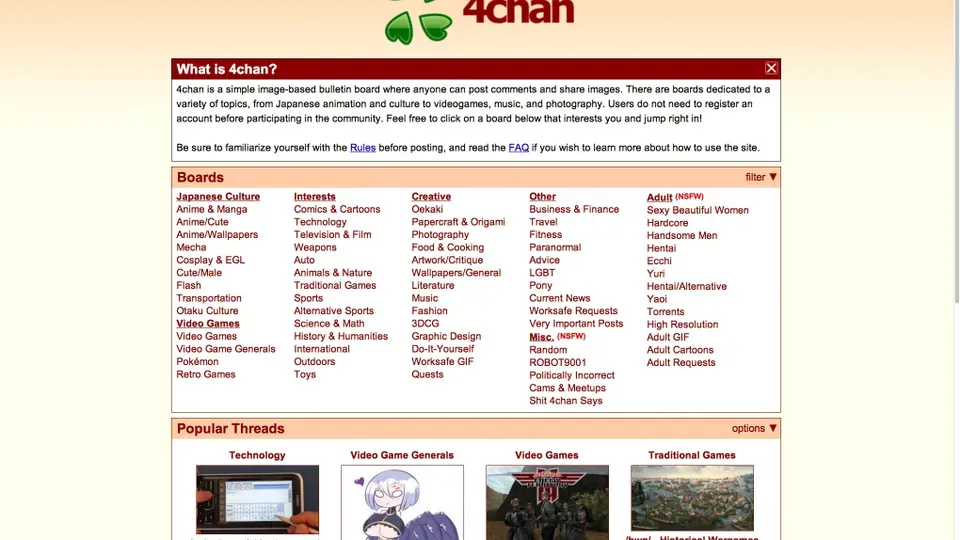
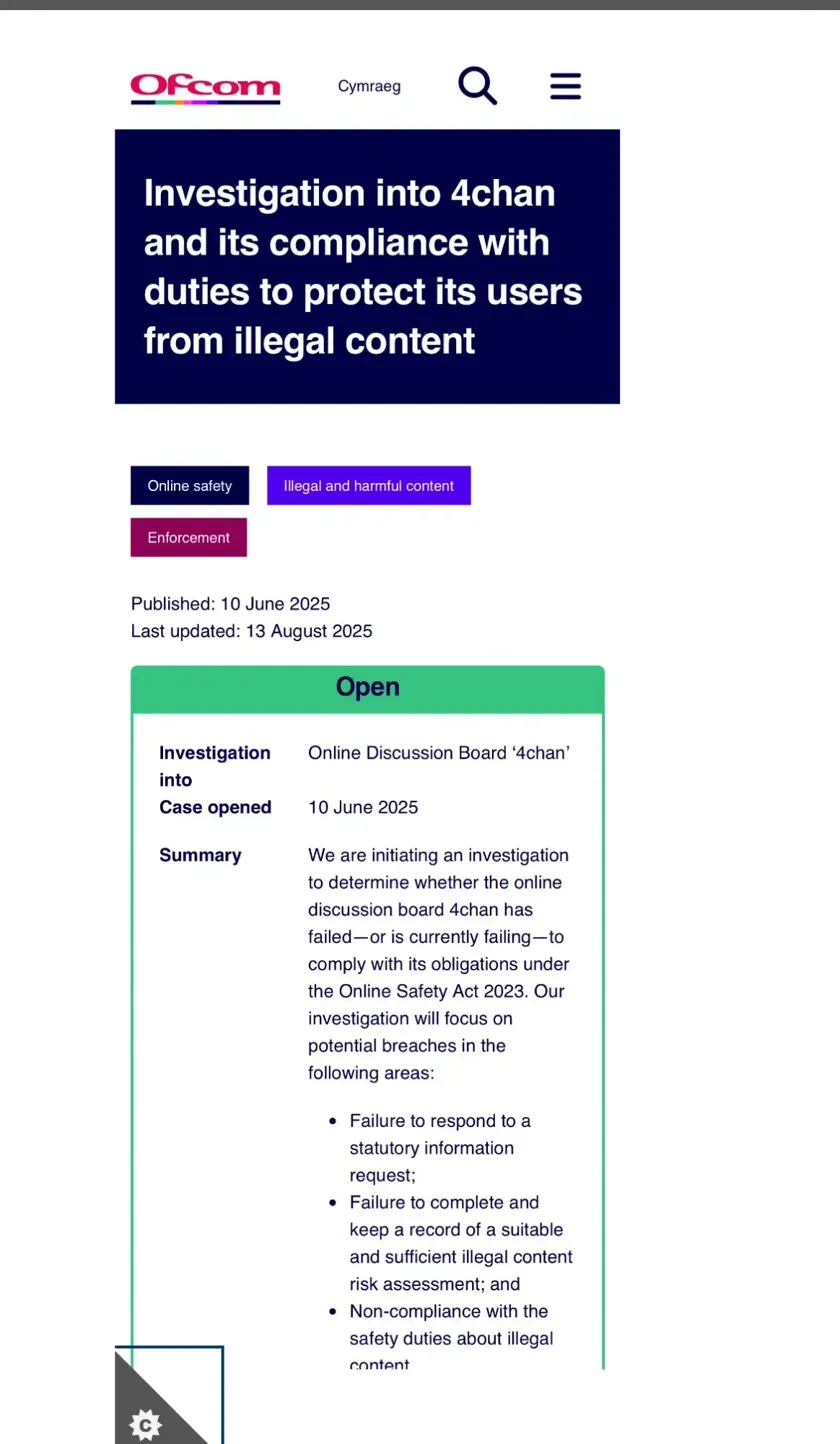
On June 10, 2025, the UK’s communications regulator Ofcom launched a formal investigation into the controversial imageboard 4chan, alleging the platform had failed to comply with its obligations under the Online Safety Act 2023. According to Ofcom, 4chan failed to respond to a statutory information request, failed to complete and keep a record of a suitable content risk assessment, and failed to comply with safety duties regarding illegal content. Having received no response from 4chan, Ofcom now intends to fine 4chan £20,000, followed by daily penalties.
The investigation represents one of nine enforcement actions Ofcom has initiated under the sweeping Online Safety Act, which came into full force in July 2025. The law gives Ofcom the authority to impose financial penalties of up to 10% of a company’s global turnover or £18 million, whichever is higher. Websites that fail to comply may be blocked from operating in the UK, and their senior managers could face criminal charges and prison sentences for repeated violations.
The American Response
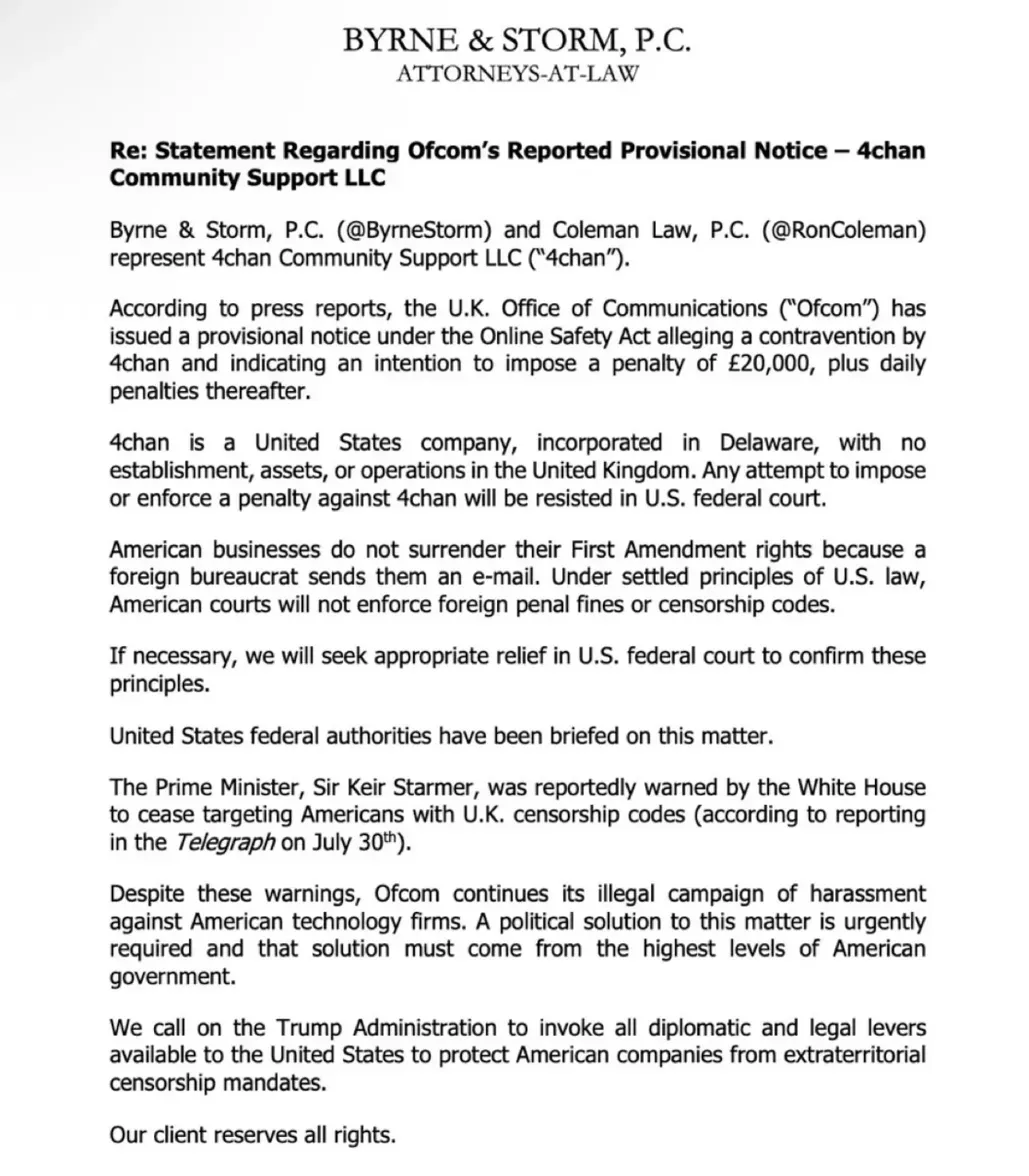
4chan’s response was swift and defiant. The platform retained high-profile American law firms Byrne & Storm and Coleman Law to mount a constitutional challenge in U.S. federal court. In a strongly worded statement, the lawyers reminded Ofcom that 4chan is incorporated in Delaware, has no assets or operations in the UK, and that any attempt to impose or enforce penalties will be resisted in U.S. federal court.
The legal team’s statement pulled no punches: “American businesses do not surrender their First Amendment rights because a foreign bureaucrat sends them an email. Under settled principles of U.S. law, American courts will not enforce foreign penal fines or censorship codes.”
Most significantly, the lawyers revealed that United States federal authorities have been briefed on this matter, suggesting the case has already attracted attention at the highest levels of the American government.
Echoes of The Pirate Bay: A Jurisdictional Déjà Vu
This isn’t the first time a platform has thumbed its nose at foreign legal authorities attempting extraterritorial enforcement. The current standoff bears striking resemblance to The Pirate Bay’s legendary 2004 response to DreamWorks’ legal threats over copyright infringement.
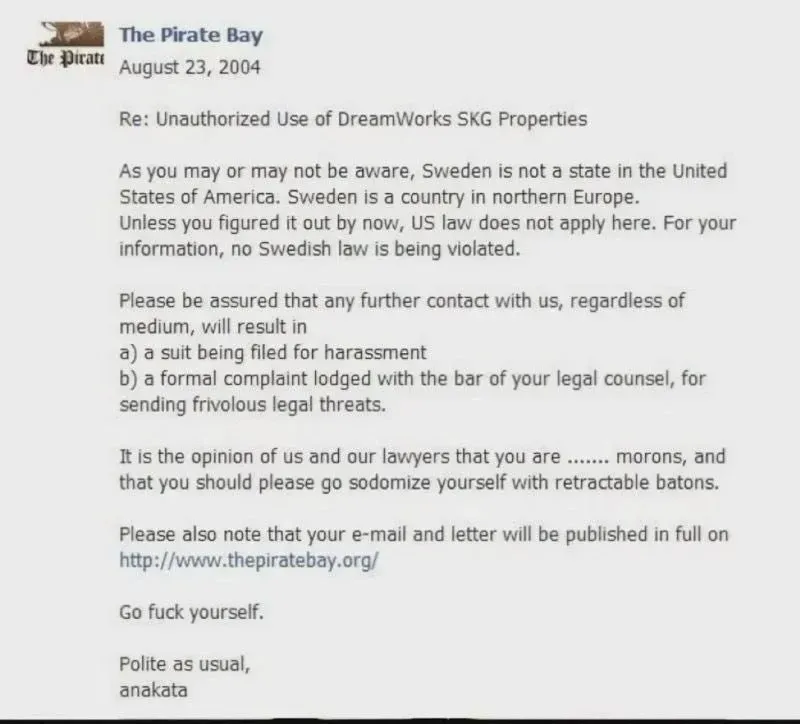
When DreamWorks sent a cease-and-desist letter to the Swedish file-sharing site, The Pirate Bay’s response became internet folklore. In a reply that has been quoted for decades, the site’s administrators wrote: “As you may or may not be aware, Sweden is not a state in the United States of America. Sweden is a country in northern Europe. Unless you figured it out by now, US law does not apply here. For your information, no Swedish law is being violated.”
The response concluded with characteristic bluntness: “It is the opinion of us and our lawyers that you are… morons, and that you should please go sodomize yourself with retractable batons.” They signed off with “Go fuck yourself. Polite as usual, anakata.”
The Pirate Bay’s defiant stance highlighted the fundamental challenge of enforcing national laws on a global internet—a challenge that remains unresolved twenty years later. While The Pirate Bay eventually faced Swedish legal action and its founders were prosecuted, the site’s initial response exposed the absurdity of expecting foreign websites to comply with laws from jurisdictions where they have no presence or obligation to follow.
White House Warnings
The 4chan case is part of a broader diplomatic tension that has been building between Washington and London over Britain’s internet regulation. The White House has warned Sir Keir Starmer to stop threatening American tech companies amid mounting backlash over Britain’s online safety law. Members of Donald Trump’s administration are monitoring the Online Safety Act with “great interest and concern” after key allies said it was censoring free speech and imposing unfair burdens on US businesses.
A senior US State Department official told The Telegraph: “President Trump has made it clear that free speech is one of our most cherished freedoms as Americans. Accordingly, we have taken decisive action against foreign actors who have engaged in extraterritorial censorship affecting our companies and fellow citizens. We will continue to monitor developments in the UK with great interest and concern.”
The diplomatic stakes became clear when during his meeting with the Prime Minister in Scotland, Mr Trump warned Sir Keir not to censor his social-media platform, Truth Social. In May, The Telegraph revealed that the president sent US officials to meet British pro-life activists over censorship concerns. The diplomats from the Bureau of Democracy, Human Rights and Labour (BDHL) travelled to London in March in an effort to “affirm the importance of freedom of expression in the UK and across Europe”.
The Jurisdictional Challenge
The core legal question revolves around whether the UK can enforce its laws against American companies with no physical presence in Britain. The offence is particularly troubling because it also has extra-jurisdictional application, meaning that the sender need not reside in the UK to be prosecuted. This creates a difficulty, because American users of the same social media platforms enjoy greater protections to their speech, guaranteed under the First Amendment to the U.S. Constitution, than UK users currently have.
The Act applies to any service that can be accessed by UK users, no matter where that company is based, even if it’s outside the UK. This means that the Online Safety Act is likely to have an extra-territorial effect, which leaves companies in the position where they have to choose between offering services in the UK, or providing end-to-end encryption.
The enforcement challenge is significant. Just how Ofcom proposes to enforce a fine to Meta of £10 billion without engaging in a decade-long court battle, we are yet to learn. British regulators are essentially asking whether our country – a nation with a GDP of just over 3 trillion Euro – is able to withstand locking horns with the U.S. tech giants.
Congressional Pushback
The UK’s approach has drawn sharp criticism from U.S. lawmakers. Congressman Jim Jordan, chair of the House Judiciary GOP committee, said the law was an attack on American companies. “Ask Apple and they would view it as a $500 million attack,” he told The Telegraph. “There’s general concern… and then there’s concern on how this impacts American citizens, American companies and infringes on our First Amendment.”
Vice President JD Vance has been particularly vocal, warning about online “censorship” in the country and expressing concern that the law affects “American technology companies and, by extension, American citizens”.
The Broader Pattern
The 4chan case is not isolated. As previously reported, officials in Westminster are bracing for a clash with the White House as far-right social media platforms have dismissed legal requests from Ofcom tackling illegal online content. Gab, a messaging platform with a significant neo-Nazi user base, and Kiwi Farms, a harassment forum, both described the legislation as amounting to censorship.
Ofcom’s move against 4chan follows a trend of fringe platforms withdrawing services from the UK altogether in protest of the legislation. Gab, Kiwi Farms, and video-sharing site Bitchute have all geo-blocked UK users in recent months, citing concerns over freedom of expression and state overreach.
What’s at Stake
The outcome of this legal battle could have far-reaching implications for internet governance worldwide. If the UK succeeds in enforcing its laws against American companies, it could set a precedent for other nations to impose their own extraterritorial regulations on foreign platforms. Conversely, if American courts block enforcement, it could severely limit the UK’s ability to regulate global internet services.
Young people should be able to access information, speak to each other and to the world, play games, and express themselves online without the government making decisions about what speech is permissible. Yet the UK’s approach has already forced major platforms to implement age verification systems that critics argue undermine privacy and free expression.
Following the enactment of this law, there was a significant rise in downloads of VPN services by users in the UK, since these can circumvent age verification requirements by routing traffic through another country without such regulations.
The Constitutional Collision
At its heart, this dispute represents a fundamental clash between two different approaches to online governance. The UK views internet regulation as a matter of public safety and child protection, willing to impose significant restrictions on speech and privacy to achieve these goals. The United States, by contrast, treats free speech as a nearly absolute right that should not be compromised by foreign regulatory overreach.
The US state department released its annual Human Rights Report, claiming there are “credible reports of serious restrictions on freedom of expression” in Britain. The “human rights situation worsened” in Britain in 2024, the report said, frequently referring to the period after Sir Keir Starmer won the election last July.
As this legal battle unfolds in American federal courts, it will test whether the digital age has truly created a borderless internet or whether national sovereignty can be enforced across cyberspace. The stakes could not be higher: the future of free speech online may hang in the balance.
The case also highlights a broader question about democratic governance in the digital age: Can nations effectively regulate global internet platforms without coordinated international cooperation? Or will the internet’s borderless nature ultimately make such unilateral enforcement efforts futile?
For now, 4chan continues to operate normally for users outside the UK, while British users may soon find themselves cut off from yet another corner of the internet—a preview of what some critics call the “splinternet,” where national borders increasingly define what citizens can see and say online.
The battle between Ofcom and 4chan is more than just a regulatory dispute—it’s a defining moment for internet freedom in an age where governments around the world are increasingly asserting control over digital spaces that were once beyond their reach.