The UK government’s latest legislative move threatens to transform every smartphone and tablet into a permanent government monitoring device while requiring ID verification for VPN usage.
The Bill Everyone Should Be Watching
Buried in pages 19-21 of the Children’s Wellbeing and Schools Bill are amendments that would fundamentally reshape digital privacy in the United Kingdom. While the bill ostensibly focuses on child protection and educational reform, recent amendments propose surveillance measures that privacy advocates are calling “Orwellian in scope.”
The legislation is currently at the Report Stage in the House of Lords and has garnered cross-party support, making it a credible threat to pass into law within the next 12 months.
Two Major Privacy Nightmares
1. Mandatory “Tamper-Proof” Device Surveillance
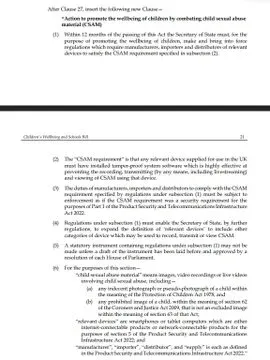
The bill proposes that any “relevant device supplied for use in the UK must have installed tamper-proof system software which is highly effective at preventing the recording, transmitting (by any means, including livestreaming) and viewing of CSAM using that device.”
Relevant devices are defined as “smartphones or tablet computers which are either internet-connectable products or network-connectable products.”
Let’s be clear about what this means: Every smartphone and tablet sold in the UK would need to have government-mandated surveillance software built into the operating system that cannot be removed or disabled by the user.
2. VPN Age Verification Requirements
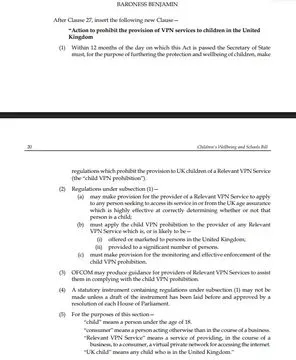
The bill would compel VPN providers to implement “age assurance, which is highly effective at correctly determining whether or not that person is a child.” This effectively means mandatory ID verification for anyone wanting to use a VPN in the UK.
The requirement would apply to any VPN service that markets itself to UK consumers or is used by a “significant number” of people in the country. OFCOM would produce guidance for VPN providers, and the government would establish monitoring regimes with penalties for non-compliance.
The Technical Reality: “Tamper-Proof” is a Myth
Any cybersecurity professional will tell you that the term “tamper-proof” is fundamentally misleading when applied to software systems. Here’s why:
No system is truly tamper-proof. As security researchers note, “There are no provably secure software anti-tampering methods; thus, the field is an arms race between attackers and software anti-tampering technologies.” The software security industry openly acknowledges that tampering resistance is always relative to an attacker’s resources and motivation.
Hardware backdoors are notoriously exploitable. Even military-grade chips with sophisticated anti-tamper protections have been successfully compromised by researchers. Once a backdoor exists—even if created with good intentions—it becomes a vulnerability that can be exploited by malicious actors.
The implementation creates systemic vulnerabilities. When you mandate surveillance capabilities in every device, you’re not just creating a tool for law enforcement—you’re creating a universal vulnerability that foreign intelligence services, criminal organizations, and sophisticated hackers will target.
Why This Goes Beyond Child Protection
While the stated goal is combating child sexual abuse material (CSAM), the implications extend far beyond this narrow purpose:
Scope creep is inevitable. Once the legal and technical infrastructure for on-device scanning exists, expanding what gets scanned becomes trivial. Today it’s CSAM. Tomorrow it could be “extremist content,” “misinformation,” or political dissent. The architecture for continuous surveillance would already be in place.
It breaks end-to-end encryption. To scan content, the system must access unencrypted data. This fundamentally undermines end-to-end encryption, which protects journalists, activists, whistleblowers, and ordinary citizens engaged in sensitive communications.
It creates a honeypot for attackers. A database that can identify and flag content on millions of devices becomes an irresistible target for nation-state actors and cybercriminals. The Five Eyes nations’ record with existing surveillance databases isn’t reassuring—CBS News documented dozens of cases where law enforcement officers abused criminal databases to harass exes, stalk women, and intimidate journalists.
The VPN ID Verification Problem
Requiring ID verification to use VPNs creates multiple problems:
It defeats the purpose of VPNs. The primary use case for VPNs among privacy-conscious users is anonymous access to the internet. Mandatory identification eliminates this protection.
It creates identification databases. Every VPN provider would need to collect and store identification documents for all UK users, creating massive databases that become targets for data breaches.
It’s easily circumvented. Technically sophisticated users (including the criminals this supposedly targets) will simply use VPN services based outside UK jurisdiction that don’t comply. The main impact falls on ordinary citizens seeking legitimate privacy protection.
It breaks privacy for everyone. While framed as protecting children, the requirement applies to all users, meaning adults must sacrifice their privacy rights to use basic privacy tools.
Expert Reactions
James Baker from Open Rights Group called the device surveillance proposal “Orwellian in scope,” arguing that “rather than imposing blanket bans or invasive monitoring, there are smarter, more liberal ways to tackle online harms.”
Lord Wei of Shoreditch warned in Parliament that the bill creates “the very legal machinery” that could be abused by “a future hard right Coalition or extremist government” to control curriculum and suppress dissent, with families having “nowhere left to go” once home education is also brought under state surveillance.
Privacy advocates from multiple organizations, including the Electronic Frontier Foundation and Open Rights Group, have expressed deep concern about the surveillance implications. A coalition letter stated: “We write to sound an urgent alarm about the grave threat posed by measures included in the Children’s Wellbeing and Schools Bill.”
The Broader Surveillance Context
These provisions don’t exist in isolation. The UK is experiencing what many observers characterize as a steady erosion of civil liberties:
- People are being arrested over online posts and private messages under broadly applied communications laws- Police are deploying live facial recognition systems in public spaces- The government has proposed a national digital ID scheme- The Online Safety Act already imposes extensive content moderation requirements
The Children’s Wellbeing and Schools Bill amendments would add device-level surveillance and VPN restrictions to this expanding surveillance apparatus.
What Happens Next
The bill is currently being debated in the House of Lords, with amendments tabled through December 9, 2025. After Lords review, it must pass through the House of Commons to become law. If passed, the government would have 12 months to enforce the VPN restrictions, with device requirements following implementation regulations.
The cross-party support these amendments have received makes passage a realistic possibility, despite the serious privacy concerns they raise.
The Bottom Line
The Children’s Wellbeing and Schools Bill demonstrates a fundamental misunderstanding of both technology and privacy rights. You cannot create “tamper-proof” surveillance systems that only work for good guys. You cannot require identification for privacy tools without eliminating their core function. And you cannot build surveillance infrastructure “for the children” without creating tools that can be used against everyone.
As security experts have known since the crypto wars of the 1990s: there’s no such thing as a backdoor that only the good guys can use. Once you build surveillance capabilities into systems, you’ve created vulnerabilities that will be exploited by malicious actors—whether they’re criminals, foreign intelligence services, or authoritarian governments.
The UK Parliament is being asked to mandate technical impossibilities wrapped in surveillance overreach, all under the banner of child protection. The result would be less security, less privacy, and no meaningful increase in child safety.
For a nation that claims to want to be “the safest place in the world to go online,” this legislation moves in precisely the wrong direction.
Key Takeaways
- Device surveillance mandate: All UK smartphones and tablets would need “tamper-proof” government surveillance software- VPN identification requirement: All VPN users would need to provide ID verification, eliminating anonymous access- Technical impossibility: “Tamper-proof” surveillance systems don’t exist—they create vulnerabilities for everyone- Scope creep risk: Infrastructure built for one purpose can easily be expanded to monitor other content- Privacy elimination: Adult privacy rights sacrificed under the banner of child protection- Timeline: Currently in House of Lords, could become law within 12 months
What You Can Do
- Contact your MP to express concerns about these amendments- Reach out to House of Lords members before the vote- Sign open letters opposing the surveillance provisions- Support organizations like Open Rights Group and Big Brother Watch fighting these measures- Spread awareness about what’s actually in this bill
The debate over digital privacy and security is happening right now. Whether we maintain fundamental privacy rights or surrender them to surveillance infrastructure depends on public awareness and political pressure in the coming months.
This article analyzes proposed amendments to the Children’s Wellbeing and Schools Bill based on the bill text and expert commentary. The legislation is currently under parliamentary review and subject to change.