From ISIS Counter-Messaging to Domestic Censorship: The Rise and Fall of America’s Information Warfare Apparatus
The United States government has officially terminated its primary counter-disinformation apparatus, marking the end of a controversial eight-year experiment that began with fighting ISIS propaganda and ended with accusations of systematically censoring American voices.
In last week’s sub streams, I explained that the fight to end GEC is not over, and I told everyone the exact bureau within the State Department that GEC’s censorship staff and programs will migrate to if GEC is terminated. If we win Matrix 1, we will enter the Matrix 2 arc: pic.twitter.com/13j6rzdLwb— Mike Benz (@MikeBenzCyber) December 18, 2024
On April 16, 2025, Secretary of State Marco Rubio announced the permanent closure of the Counter Foreign Information Manipulation and Interference office (R/FIMI), effectively ending the final remnant of what was once the Global Engagement Center (GEC). In a statement that left no room for ambiguity, Rubio declared the framework “dead” and vowed it would “not return.”
From Counterterrorism to Controversy
The story begins in 2016, when President Barack Obama signed Executive Order 13721, transforming the existing Center for Strategic Counterterrorism Communications into the Global Engagement Center. The center was initially established to “lead the coordination, integration, and synchronization of Government-wide communications activities directed at foreign audiences abroad in order to counter the messaging and diminish the influence of international terrorist organizations,” including ISIS.
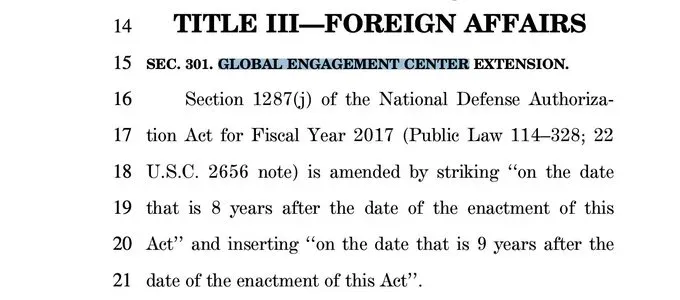
What started as a focused anti-terrorism initiative quickly expanded in scope. By the end of 2016, Congress had broadened the GEC’s authority through the Countering Foreign Propaganda and Disinformation Act, which was included in the National Defense Authorization Act and passed with overwhelming bipartisan support—92-7 in the Senate.
The expansion was driven by growing concerns about Russian interference in the 2016 election. The Washington Post and International Business Times reported that after the 2016 presidential election, worries grew that Russian propaganda had swayed the outcome, prompting Congress to authorize $160 million over two years for counter-disinformation efforts.
Mission Creep and Constitutional Concerns
What emerged over the following years was an apparatus that critics argue strayed far from its original counterterrorism mission. According to Secretary Rubio, the office “cost taxpayers more than $50 million per year” and “spent millions of dollars to actively silence and censor the voices of Americans they were supposed to be serving”.
The GEC’s activities included funding controversial organizations like NewsGuard and the Global Disinformation Index (GDI), which created rating systems for news sources and maintained “dynamic exclusion lists” distributed to advertisers. These censorship technologies and enterprises targeted many conservative media outlets, including The Daily Wire and The Federalist, seeking to limit their circulation and deprive them of advertising dollars.
Legal Challenges and Congressional Opposition
The controversy reached a boiling point in December 2023 when The Daily Wire, The Federalist, and the State of Texas filed a federal lawsuit against the State Department. The lawsuit alleged that the State Department was funding “one of the most egregious violations of the First Amendment’s guarantees of freedom of press and freedom of speech by the federal government in American history”.
The legal challenge was spearheaded by the New Civil Liberties Alliance, which argued that the State Department’s censorship regime violated the First Amendment rights of The Daily Wire, The Federalist, numerous similar outlets, and their readers.
Congressional resistance to the GEC also intensified. Republicans increasingly criticized the center for overstepping its mandate to focus solely on foreign disinformation, instead targeting domestic American media outlets. By late 2024, Congress had refused to extend the GEC’s authorization, effectively defunding it.
The Rebrand That Wasn’t
In a last-ditch effort to preserve the operation, the outgoing Biden administration attempted to restructure the GEC into the Counter Foreign Information Manipulation and Interference office (R/FIMI) in December 2024. Congress had zeroed out funding for the center, and the administration restructured the GEC, placing its approximately 50 employees under the authority of the new hub.
The State Department filed a notice with the court on December 10, 2024, informing it of the “substantially likely” termination of the Global Engagement Center on December 23. However, the agency also revealed plans to “realign” staff and funding to other departments, raising concerns that the censorship activities would simply continue under different names.
🎧 Related Podcast Episode
Rubio’s Final Blow
The administrative reshuffling proved short-lived. Upon taking office, Secretary Rubio moved swiftly to permanently dismantle the entire framework. In his statement, Rubio emphasized that “it is the responsibility of every government official to continuously work to preserve and protect the freedom for Americans to exercise their free speech”.
Acting Under Secretary of State for Public Diplomacy Darren Beattie was even more blunt, stating: “Far from spiking a single plan, we were proud to spike the entire GEC. Not only was GEC’s infamous censorship activity profoundly misaligned with this administration’s pro-free speech position, it was woefully and embarrassingly ineffective on its own terms”.
A Broader Reckoning
The dismantling of the counter-disinformation apparatus reflects a broader shift in how the government approaches information warfare. Rubio framed the closure as part of President Trump’s campaign promise to “close the book on a dark chapter in America’s constitutional history: the weaponization of America’s own government to silence, censor, and suppress the free speech of ordinary Americans”.
Critics of the shutdown argue that it leaves the United States vulnerable to foreign disinformation campaigns. Former State Department spokesman Ned Price wrote on X that the decision was “a deeply misleading (and) unserious portrayal of an organization focused on identifying foreign — primarily Russian — disinformation ops”. The closure leaves the US without a specialized mechanism to counter foreign disinformation for the first time in eight years, just as online propaganda campaigns by foreign adversaries continue to evolve.
The Censorship Industrial Complex
The GEC’s demise is part of a larger unraveling of what critics call the “censorship industrial complex”—a network of government agencies, nonprofit organizations, and private companies that worked together to identify and suppress information deemed problematic.
Mike Benz, Executive Director of the Foundation for Freedom Online, has described the GEC as “the first official censorship capacity in the US government,” explaining how it used ISIS as a pretext to establish “full surveillance through social media companies”.
The network included partnerships with organizations like Stanford University’s Internet Observatory, which participated in the Election Integrity Partnership that mass-reported alleged misinformation during the 2020 and 2022 elections. Like the GEC, many of these initiatives have faced legal challenges and congressional scrutiny, leading to their dissolution or significant restructuring.
State Department’s New Stance
State Department principal deputy spokesperson Tommy Pigott outlined the new approach: “Through free speech, the United States will counter genuine malign propaganda from adversaries that threaten our national security, while protecting Americans’ right to exchange ideas”.
This represents a fundamental shift from the previous model of government-funded rating systems and advertiser blacklists to a approach that emphasizes protecting rather than regulating speech.
Looking Forward
The shutdown of the counter-disinformation framework marks a significant victory for free speech advocates who argued that the government had overstepped its constitutional bounds. The New Civil Liberties Alliance, which represented The Daily Wire and The Federalist in their lawsuit, celebrated the closure as “an encouraging step” while noting that the legal battle continues to “expose the true depth of the government’s egregious censorship regime”.
However, questions remain about how the United States will address legitimate foreign disinformation campaigns without infringing on domestic speech rights. The challenge moving forward will be developing approaches that can distinguish between protecting national security and preserving the fundamental right to free expression that defines American democracy.
The eight-year experiment in government-sponsored counter-disinformation efforts began with the noble goal of fighting terrorist propaganda but ended as a cautionary tale about mission creep and the dangers of government overreach in the information space. Its demise signals a return to the principle that in America, the remedy for bad speech is more speech, not government censorship.
This article is based on official State Department statements, court filings, congressional records, and extensive reporting on the Global Engagement Center and its successor organizations.