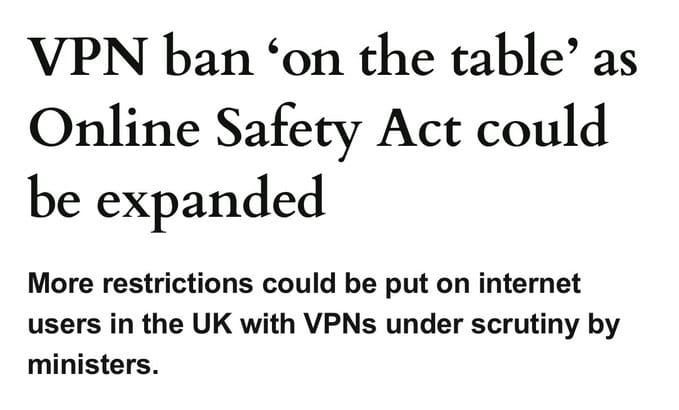
Digital Minister Baroness Lloyd warns “nothing is off the table” in crackdown on internet circumvention tools—as the Online Safety Act evolves from child protection measure to comprehensive surveillance infrastructure
🎧 Related Podcast Episode
Executive Summary
In a development that has alarmed privacy advocates and digital rights organizations worldwide, UK Digital Minister Baroness Liz Lloyd announced on October 30, 2025, that banning Virtual Private Networks (VPNs) remains “on the table” as authorities grapple with users bypassing the controversial Online Safety Act’s age verification requirements. While the government claims there are “no current plans” to ban VPNs, the minister’s statement that “nothing is off the table when it comes to keeping children safe” has sent shockwaves through the technology community and represents a potentially unprecedented escalation in government control over internet access.
The Online Safety Act, which entered its most aggressive enforcement phase on July 25, 2025, has already fundamentally transformed how UK citizens access the internet. What began as legislation ostensibly designed to protect children from harmful content has rapidly evolved into what critics describe as a comprehensive censorship and surveillance infrastructure that affects all internet users, regardless of age.
The Current State of the Online Safety Act
Since the Online Safety Act’s enforcement began in July 2025, the UK digital landscape has undergone dramatic changes that extend far beyond the legislation’s stated child protection goals. As detailed in our comprehensive analysis of the global digital crackdown, what began as child protection has evolved into systematic online censorship:
Widespread Platform Disruption
Major platforms including Xbox, Discord, Reddit, Bluesky, and Spotify have implemented mandatory age verification systems requiring users to prove their age through government ID uploads, facial recognition scans, or other privacy-invasive methods. The impact has been far-reaching—and as evidenced by Discord’s massive 2.1 million government ID breach in October 2025, these ID collection requirements create catastrophic security risks:
- Gaming Platforms: Microsoft announced that by early 2026, UK Xbox users who don’t verify their age will lose access to voice and text communication, party functionality, game invites, and the ability to share user-generated content- Social Media: Discord, Reddit, and other platforms now require age verification to access direct messaging features and any content flagged as “Not Safe for Work”- Content Services: Imgur has completely blocked access to UK users rather than implement the required age verification systems
The Immediate Effectiveness Problem
Within 24 hours of the Online Safety Act’s enforcement beginning, users discovered they could bypass Discord’s facial recognition age verification system using high-fidelity video game character images from titles like Death Stranding. This technical vulnerability, while quickly addressed, highlighted the fundamental challenge facing age verification systems: determined users will find ways around them.
According to research from not-for-profit Internet Matters, at least 8% of nine to 17-year-olds already use VPNs to browse the web. The actual number is likely significantly higher given the surge in VPN adoption following the Act’s implementation.
The Parliamentary Debate: VPN Restrictions Move to the Forefront
On October 30, 2025, the House of Lords debated a motion to regret Ofcom’s Protection of Children Codes of Practice under the Online Safety Act 2023. Lord Clement-Jones, the Liberal Democrat technology spokesman in the Lords, warned that VPN use by children has become “widespread” and “risks rendering age-assurance measures ineffective”.
Baroness Lloyd’s Concerning Response
In response to these concerns, Baroness Liz Lloyd stated that while there are “no current plans to ban the use of VPNs” due to their legitimate uses, “nothing is off the table when it comes to keeping children safe”. The minister acknowledged that “at the moment, there is limited evidence on children’s use of VPNs, and the Government is looking at ways of addressing this evidence gap.”
This measured-but-ominous language represents a significant shift in government rhetoric. The acknowledgment that VPN restrictions are under active consideration, combined with efforts to gather more data on VPN usage patterns, suggests the UK government is laying the groundwork for potential future action.
Beyond VPNs: Collateral Censorship Concerns
Lord Clement-Jones also highlighted another critical problem: “there are concerns also that important content such as political debate, educational sites and information sites like Wikipedia, and support forums dealing with LGBTQ+ rights or sexual health are being inappropriately age-gated on social media”.
This over-blocking phenomenon—where platforms err on the side of restricting access to avoid regulatory penalties—demonstrates how child protection legislation inevitably expands to censor legal content for adults as well.
Wikipedia’s Defiant Stand Against Digital ID Requirements
Perhaps the most high-profile resistance to the Online Safety Act has come from Wikipedia. Wikipedia founder Jimmy Wales told The House magazine that the Online Safety Act is “very poorly thought-out legislation” and declared: “We will not be age-gating Wikipedia under any circumstances, so, if it comes to that, it’s going to be an interesting showdown, because we’re going to just refuse to do it. Politically, what are they going to do? They could block Wikipedia. Good luck with that.”
Wales’s defiance underscores a fundamental question: Is the UK government prepared to block access to one of the world’s most valuable educational resources in the name of age verification compliance? And if so, what does that say about the Act’s true priorities?
The Global Context: Age Verification and VPN Restrictions Worldwide
The UK’s consideration of VPN restrictions is not occurring in isolation. Governments worldwide are implementing increasingly aggressive age verification and internet control measures, often using child safety as justification:
United States: A Patchwork of State-Level Restrictions
The United States has emerged as a laboratory for age verification experimentation, with 19 states enacting age verification requirements by May 2025. The fragmented regulatory landscape creates an impossible compliance burden for businesses:
Wisconsin’s Controversial VPN Ban Proposal: Wisconsin lawmakers are advancing legislation that would criminalize the use of VPNs to access adult content websites, representing one of the first serious attempts in the Western world to restrict VPN usage at the state level.
Texas App Store Accountability Act: Effective January 1, 2026, Texas will require both app stores and app developers to implement comprehensive age verification systems, with enforcement mechanisms that could extend to VPN usage monitoring.
Michigan’s Sweeping Internet Censorship Bill: Michigan Republicans introduced HB 4938, targeting VPNs, adult content, and even transgender expression, demonstrating how “child safety” legislation rapidly expands into broader speech control.
Australia: Social Media Ban for Under-16s
Australia’s Online Safety Amendment (Social Media Minimum Age) Act 2024 establishes a mandatory age verification infrastructure that will fundamentally transform how all Australians access the internet. The law, marketed as protecting children, creates precedent for comprehensive digital identity systems that affect all citizens. As we detailed in our analysis of the global age verification disaster, Australia has implemented a blanket social media ban for anyone under 16, with fines of up to $49.5 million for non-compliance.
The European Union: Coordinated Age Verification Push
The European Commission has published guidelines emphasizing coordination with other jurisdictions to strengthen online protection measures for children globally. However, the EU’s most controversial surveillance proposal—the Chat Control (CSAR) regulation—has faced repeated defeats. Despite Denmark’s push for mandatory message scanning, a blocking minority of EU member states has recognized that breaking encryption under the guise of “child safety” represents an unacceptable threat to privacy and security.
This coordinated approach suggests age verification mandates—and potentially VPN restrictions—are part of a broader international strategy rather than isolated national policies.
Authoritarian Precedents: Russia and China
It’s worth noting that comprehensive VPN bans are typically associated with authoritarian regimes:
- Russia: Has implemented extensive VPN restrictions and is now mandating state biometric ID for online age verification, creating a comprehensive surveillance state that controls access to banned websites and opposition content- China: Operates the “Great Firewall” which blocks most foreign VPNs as part of comprehensive internet censorship- Iran: Heavily restricts VPN usage to maintain control over information access- Turkey: Has periodically banned VPN services to limit access to restricted content
The UK’s consideration of similar measures places it in troubling company from a digital rights perspective.
The Technical and Practical Impossibility of Effective VPN Bans
Even if the UK government decides to pursue VPN restrictions, the technical reality presents enormous challenges:
The Whack-A-Mole Problem
VPN technology is fundamentally decentralized. Blocking known VPN services would simply drive users to:
- Self-hosted VPN solutions- Lesser-known VPN providers- Obfuscated VPN protocols that disguise traffic as normal HTTPS- Proxy services and anonymization networks like Tor- Emerging decentralized VPN technologies built on blockchain
Collateral Damage to Legitimate Use Cases
VPNs serve critical legitimate functions that would be severely impacted by restrictions:
Business Operations: Countless UK businesses rely on VPNs for:
- Remote workers accessing corporate networks securely- Secure communications with international offices- Protection of sensitive business data on public networks- Compliance with data protection regulations requiring encrypted transit
Privacy and Security: Individual users depend on VPNs for:
- Protecting personal data on public Wi-Fi networks- Securing financial transactions- Avoiding targeted advertising and tracking- Protecting whistleblowers and journalists- Enabling political dissidents to communicate safely
International Access: UK citizens abroad use VPNs to:
- Access UK-based services while traveling- Maintain security on foreign networks- Bypass geographic restrictions on legitimate content
The Implementation Nightmare
Baroness Lloyd acknowledged that “there is limited evidence on children’s use of VPNs” and admitted the government is still trying to understand how to address this “evidence gap”. This admission reveals that the government doesn’t yet understand the scope of the problem they’re proposing to solve—much less how to effectively implement a solution.
Why This Matters: The Slippery Slope of Internet Control
The consideration of VPN bans represents a dangerous expansion of the Online Safety Act far beyond its stated child protection goals. As we outlined in our Internet Bill of Rights framework, current “safety” legislation across the UK, EU, and US represents not protection but control. Several concerning patterns are emerging:
Mission Creep in Action
The Online Safety Act has evolved from:
- Protecting children from pornography →2. Age-gating all “adult content” →3. Restricting access to content about self-harm and eating disorders →4. Controlling access to content about gender identity and sexual orientation →5. Now considering banning the tools citizens use to maintain privacy and access information freely
The Chilling Effect on Free Expression
The Open Rights Group reports that content being inappropriately age-gated includes sexual health subreddits like r/STD and r/safesexPH, r/stopsmoking, news subreddits including r/Aljazeera and r/israelexposed, and public health information about periods and quitting drinking.
When platforms over-censor to avoid regulatory penalties, adults lose access to important health information, political discourse, and educational content. Adding VPN restrictions would eliminate one of the last remaining tools citizens have to access this information.
Normalizing Digital Surveillance
Age verification inherently requires comprehensive identity tracking. Combined with VPN restrictions, the UK government would have unprecedented visibility into:
- What websites citizens visit- What content they consume- Their political views and associations- Their health concerns and personal struggles- Their sexual orientation and gender identity
This level of surveillance was previously associated with authoritarian regimes, not liberal democracies. As documented in our Global Digital ID Systems Status Report 2025, over 100 countries worldwide have implemented or are developing national digital identity systems, with governments having issued approximately 5 billion digital identities globally.
Privacy Advocates Sound the Alarm
Digital rights organizations have responded with alarm to Baroness Lloyd’s comments:
The Electronic Frontier Foundation has consistently warned that the UK Online Safety Act represents “a dangerous attempt to remake the internet,” predicting that “instead of privacy, we will have age verification. Instead of security, we will have backdoors in end-to-end encryption. And instead of free speech, we will have scanning and filtering of all content, all the time.”
Privacy International and other UK-based organizations have emphasized that VPN restrictions would fundamentally undermine the privacy and security tools that enable:
- Investigative journalism- Whistleblower protection- Political dissent- Marginalized community communication- Personal privacy in an increasingly surveilled world
What Happens Next: Timeline and Potential Outcomes
Short-Term (Next 6-12 Months)
- Evidence Gathering Phase: The UK government will attempt to quantify VPN usage among minors and assess the “effectiveness” of age verification measures2. Regulatory Consultation: Ofcom will likely issue guidance or consultation papers on VPN usage and age verification circumvention3. Platform Pressure: Ofcom has already stated platforms must not host, share, or permit content encouraging the use of VPNs to bypass age checks, suggesting indirect restrictions may come before direct bans4. International Coordination: Expect increased coordination between UK, EU, and US authorities on age verification enforcement strategies
Medium-Term (1-2 Years)
If the government decides to proceed with VPN restrictions, potential approaches could include:
- Mandatory VPN Provider Registration: Requiring VPN services to register with UK authorities and comply with age verification requirements2. ISP-Level Blocking: Ordering Internet Service Providers to block known VPN protocols and services3. Payment Processor Restrictions: Preventing UK payment processors from handling transactions with unauthorized VPN providers4. App Store Removal: Requiring Apple and Google to remove VPN applications from UK app stores5. Criminal Penalties: In extreme scenarios, potentially criminalizing VPN usage for accessing restricted content (following the Wisconsin model)
Long-Term Implications
The precedent set by UK VPN restrictions would likely:
- Embolden other democracies to implement similar measures- Accelerate the development of more sophisticated circumvention tools- Drive privacy-conscious users toward decentralized, harder-to-regulate technologies- Further fragment the global internet along national boundaries- Establish digital identity as a prerequisite for internet access across Western democracies
What You Can Do: Protecting Digital Rights
For individuals concerned about the trajectory of the Online Safety Act:
- Contact Your Representatives: Reach out to your MP and members of the House of Lords to express concerns about VPN restrictions and internet freedom2. Support Digital Rights Organizations: Organizations like Privacy International, Open Rights Group, and the Electronic Frontier Foundation are fighting these measures3. Stay Informed: Monitor developments through trusted privacy-focused news sources4. Use Privacy Tools Now: Familiarize yourself with VPNs, encrypted messaging, and other privacy tools before they potentially become restricted5. Educate Others: Many people don’t understand the implications of age verification and VPN restrictions until it’s too late
For businesses and organizations:
- Assess Your Exposure: Evaluate how VPN restrictions might impact your operations, especially if you have remote workers or international operations2. Engage in Consultation Processes: Participate in Ofcom consultations and regulatory proceedings3. Consider Legal Challenges: Organizations with standing should consider supporting or initiating legal challenges to disproportionate restrictions4. Prepare Alternative Solutions: Develop contingency plans for maintaining secure communications if VPN access becomes restricted
Conclusion: A Critical Inflection Point for Internet Freedom
The UK government’s consideration of VPN bans represents a watershed moment for digital rights in the democratic world. While framed as protecting children, these measures would establish unprecedented government control over how citizens access information and communicate online.
The technical ineffectiveness of such measures—combined with the enormous collateral damage to legitimate privacy and security uses—suggests the real goal may be establishing digital surveillance infrastructure rather than genuinely protecting children.
As one privacy advocate noted, “People who prefer privacy must rely on VPNs or encryption and hope those tools remain permitted”. The UK’s decision on VPN restrictions will determine whether that hope is justified.
The question is not whether VPN bans will protect children—the evidence strongly suggests they won’t. The question is whether the UK is prepared to join authoritarian regimes in restricting the fundamental tools of internet privacy and freedom in the name of a security theater that harms more than it helps.
We believe this would be a step too far, and we will continue monitoring this situation closely. The Online Safety Act has already evolved from child protection measure to comprehensive censorship tool. Adding VPN restrictions would complete its transformation into a digital surveillance infrastructure incompatible with a free society.
Related Resources
UK Online Safety Act Coverage
- Digital Compliance Alert: UK Online Safety Act and EU Digital Services Act Cross-Border Impact Analysis- The Global Digital Crackdown: How Governments and Corporations Are Dismantling Online Freedom in 2025- The Internet Bill of Rights: A Framework for Digital Freedom in the Age of Censorship
EU Censorship & Chat Control
- EU Chat Control Fails Again: Blocking Minority Secured as Germany and Luxembourg Join Opposition- EU Chat Control: Final Hours Before September 12 Deadline - What Compliance Teams Need to Know
US Age Verification & VPN Restrictions
- The Age Verification Compliance Nightmare: How Businesses Can Navigate America’s Patchwork of Conflicting State Laws- Texas App Store Age Verification Law Faces Legal Challenges- YouTube’s AI Age Verification: The New Digital ID Era and the Global Push for Online Control- California’s Tech Surveillance Laws: What Compliance Teams Need to Know About AB 56, SB 243, and AB 1043- 2025 State Privacy and Technology Compliance Guide
Global Age Verification & Digital ID Systems
- Australia’s Digital Revolution: Age Verification and ID Checks Transform Internet Use- The Global Age Verification Disaster: How Privacy Dies in the Name of “Safety”- Global Digital ID Systems Status Report 2025- Russia Moves to Mandate State Biometric ID for Online Age Verification
Security Implications of ID Collection
- Discord Hit by Third-Party Customer Service Data Breach: Government IDs and User Data Exposed- Discord Breach Update: Threat Actor Claims 2.1 Million Government IDs Stolen in Massive 1.5TB Data Haul
Compliance Tools & Resources
- Global Compliance Map - Interactive tool for exploring global privacy regulations- Global Child Safety Legislation Wave: July-August 2025 Compliance Guide
About the Author
This analysis was prepared by the research team at CISO Marketplace and Compliance Hub Wiki, providing cybersecurity and compliance professionals with critical intelligence on evolving regulatory frameworks worldwide.
Last Updated: November 3, 2025
This article represents analysis and commentary on developing legislation and should not be construed as legal advice. Organizations and individuals should consult qualified legal counsel regarding their specific circumstances.