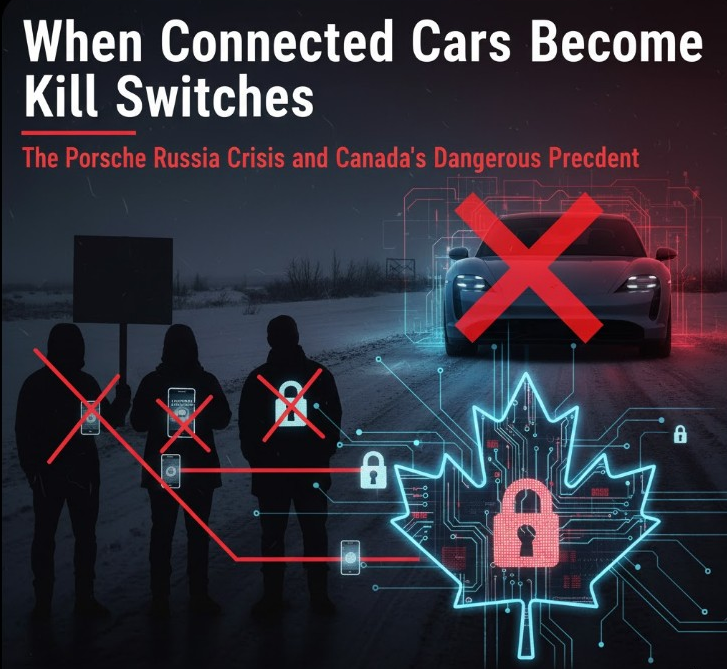
A technical failure—or deliberate shutdown—of hundreds of Porsches in Russia raises urgent questions about government control over connected vehicles, especially given Canada’s 2022 financial censorship of political protesters
The Incident: Luxury Vehicles Turned to Bricks Overnight
Beginning around November 28, 2024, hundreds of Porsche owners across Russia discovered their vehicles had become completely immobilized—engines refusing to start, fuel pumps disabled, and security systems locked down. The issue affected all Porsche models manufactured since 2013 equipped with the factory Vehicle Tracking System, including the Cayenne, Macan, Panamera, Taycan, 911, and 718 models.
Russia’s largest dealership network, Rolf, reported a surge in service requests, with technicians confirming that satellite connectivity had failed for all models and engine types. The dealership noted ominously that “there is a possibility this was done intentionally”, though no definitive evidence has emerged to confirm deliberate interference.
How the System Works—And How It Fails
The Porsche Vehicle Tracking System relies on satellites to track vehicle location and can send owners alerts about unauthorized movement. However, when the system loses satellite communication, it automatically activates the engine immobilizer as a security measure. This fail-safe feature, designed to prevent theft, became the very mechanism that rendered the vehicles inoperable.
Automotive experts note that the VTS depends on European servers for continuous authentication. Following sanctions after Russia’s 2022 invasion of Ukraine, Porsche halted deliveries to Russia, but thousands of vehicles remain in circulation. If connection to these authentication servers is severed, the system defaults to security mode, immobilizing vehicles.
The vulnerability exposed here isn’t unique to Porsche. As we’ve detailed in our comprehensive analysis of connected vehicle privacy risks, modern vehicles are essentially computers on wheels, continuously collecting and transmitting data to manufacturer servers. This includes location data, driving behavior, sensor information from cameras and radar systems, and even interior surveillance footage—all of which creates significant privacy and control risks when systems lose connectivity or are deliberately shut down.
Three Theories, Zero Official Answers
The incident has spawned three primary theories:
- Satellite Connection Loss: The VTS modules may have lost their ability to communicate with Porsche’s security servers, causing vehicles to activate defense mode.2. Infrastructure Abandonment: Since Porsche suspended operations in Russia in 2022 and cannot sell its three subsidiaries due to sanctions, security infrastructure may no longer be actively maintained.3. Deliberate Interference: Speculation about intentional satellite blackout or deliberate interference has circulated, though dealer representatives acknowledge there is no direct evidence supporting this theory.
Critically, Porsche’s Russian office and global headquarters in Germany have not commented on the system failure, leaving owners and observers to speculate about whether this represents a technical malfunction or something more calculated.
The Canadian Precedent: Financial Censorship Without Due Process
This incident gains chilling significance when viewed alongside recent precedents in Western democracies. In February 2022, the Canadian government under Prime Minister Justin Trudeau invoked the Emergencies Act for the first time in the law’s history to deal with the Freedom Convoy protests in Ottawa.
The Act allowed the Canadian government to freeze bank accounts of those suspected of supporting, orchestrating, and participating in protests with no due process, appeals process, or court order necessary. Under law enforcement direction, Canadian banks froze nearly $8 million held in 206 accounts, enacted under laws originally targeting terrorist and money laundering activities.
In January 2024, a Canadian court ruled the government was “not justified” and that the use of emergency powers was “unreasonable and ultra vires [beyond one’s powers]” and led to infringement of Canada’s charter of rights and freedoms. Yet the damage had been done—the precedent established.
Enter Mark Carney: Canada’s New Prime Minister
In March 2025, Mark Carney was sworn in as Canada’s 24th Prime Minister, becoming the first Canadian prime minister to have never served in prior elected office. Carney, a former governor of both the Bank of England and Bank of Canada, won the Liberal Party leadership election in a landslide with nearly 86% of the vote.
While Carney has positioned himself as a defender of Canadian sovereignty against U.S. trade pressures, his government has already demonstrated willingness to use executive power aggressively, including immediately reducing the consumer carbon price to $0 through an order in council—showing a comfort with unilateral policy implementation.
The Convergence of Threats: Technical Control Meets Political Will
The Porsche Russia incident demonstrates what happens when governments—or in this case, corporations responding to government pressure or infrastructure abandonment—possess kill switches in consumer vehicles. The technical capability exists. The legal precedents for financial censorship without due process exist. The question is no longer if these tools could be weaponized against domestic political opponents, but when.
Consider the technological architecture we’ve extensively documented in our automotive security research:
- Modern connected vehicles contain dozens of networked systems that can be remotely accessed. Bluetooth Low Energy has become critical in automotive systems, enabling smart access, keyless entry, and vehicle personalization—but also introducing new attack surfaces for both malicious actors and authorized controllers.- Vehicle telematics systems communicate regularly with manufacturer servers- Over-the-air updates can modify vehicle software without owner consent- Immobilization features are standard in anti-theft systems across manufacturers
Now consider the political willingness demonstrated in Canada’s 2022 actions:
- Extra-judicial financial censorship was deployed against citizens engaged in political protest- Broad enforcement powers were granted to financial institutions without clear oversight- Due process protections were suspended for those deemed to be participating in “illegal” protests- Court rulings against government overreach came too late to prevent the harm
The Cybersecurity Implications
From a cybersecurity perspective, the Porsche incident exposes multiple critical vulnerabilities that mirror broader concerns in IoT security. As detailed in our analysis of IoT security failures, the summer of 2025 revealed that millions of IoT devices—including vehicle infotainment systems—were being shipped with malware pre-installed or infected during setup, demonstrating how connected vehicle systems share the same fundamental vulnerabilities as other IoT devices.
Critical vulnerabilities include:
- Single Points of Failure: Dependence on centralized authentication servers creates catastrophic failure modes when those servers are inaccessible—whether due to sanctions, infrastructure neglect, or deliberate action.2. Over-Permissioned Security Systems: Anti-theft systems with the ability to completely disable vehicles represent excessive permission grants that can be exploited or abused.3. Manufacturer Control Without Accountability: Vehicle manufacturers possess technical capabilities to remotely disable vehicles, with minimal transparency or accountability for when and how such capabilities are exercised.4. Geopolitical Weaponization: The integration of vehicles with national telecommunications and satellite infrastructure creates opportunities for geopolitical pressure and control.5. Encryption and Authentication Weaknesses: As we’ve explored in our deep dive on IoT encryption, many connected devices—including vehicles—rely on encryption protocols that can be compromised, outdated, or deliberately bypassed by authorized parties with backend access.
What This Means for North Americans
During the 2022 Freedom Convoy crisis, one investment advisor warned: “The censorship of money is something we see in an authoritarian country, not one like Canada”. Yet it happened. And with Mark Carney now leading a government that has already demonstrated comfort with executive overreach, the prospect of similar controls being applied to connected vehicles is not paranoid speculation—it’s risk assessment based on established patterns.
The infrastructure is in place. The precedents exist. The political will has been demonstrated. The only missing element is the trigger—the next crisis, the next “emergency,” the next political movement deemed threatening enough to warrant extraordinary measures.
Modern vehicles collect extensive data including location tracking, driving behavior, route patterns, times of travel, and even interior camera footage. This comprehensive surveillance capability means that immobilizing a vehicle isn’t just about preventing movement—it’s about controlling a person who has already been extensively profiled and monitored.
Recommendations for Concerned Vehicle Owners
For individuals:
- Understand what telematics and tracking systems are installed in your vehicle (review our smart home and IoT risk assessment framework for evaluation methodology)- Review terms of service regarding remote access and control- Consider vehicles with minimal connectivity features for critical transportation needs- Document and photograph any unusual vehicle system behavior- Maintain mechanical backup transportation options- Understand your data rights under regulations like the EU Data Act (see our comprehensive guide)
For organizations:
- Audit fleet vehicles for remote control capabilities- Negotiate explicit limitations on manufacturer remote access in procurement contracts- Develop contingency plans for potential vehicle immobilization scenarios- Consider diversity in vehicle manufacturers and connectivity providers- Implement network segmentation so vehicle telematics systems cannot access critical business networks
For policymakers:
- Establish clear legal frameworks requiring due process before vehicle immobilization- Mandate transparency about remote control capabilities in vehicle sales- Create oversight mechanisms for manufacturer use of kill-switch capabilities- Prohibit extra-judicial vehicle immobilization without court orders- Require independent security audits of vehicle control systems
The Uncomfortable Truth
The Porsche Russia incident—whether technical failure or deliberate action—reveals the vulnerability inherent in our increasingly connected vehicle infrastructure. When combined with governments willing to bypass due process protections and freeze citizens’ financial assets for political participation, the risk matrix becomes unacceptably high.
As one retired banking executive noted after Canada’s 2022 actions, the federal government’s move “has not shaken trust in banks but in government”. The same principle applies here: the technology itself is neutral, but its deployment in the hands of governments with demonstrated willingness to circumvent constitutional protections should concern every citizen who values freedom of movement and political expression.
Your connected car is a computer on wheels. And like any networked computer, it can be controlled remotely by those with the keys. The question is: who holds those keys, and what prevents them from using them against you?
Additional Resources from CISO Marketplace Network
- Your Car Knows More Than You Think - Comprehensive analysis of automotive surveillance and privacy risks- Bluetooth Low Energy in Modern Automotive Systems - Technical deep dive into BLE vulnerabilities in vehicles- IoT Security and Privacy Failures - How vehicle systems share vulnerabilities with other connected devices- Smart Home Risk Assessment - Evaluation framework applicable to connected vehicles- Understanding EU Data Rights - Your rights regarding data collected by connected devices
About CISO Marketplace: We provide comprehensive cybersecurity consulting, offensive security services, and incident response for organizations navigating the complex intersection of technology, security, and governance. Contact us for vulnerability assessments and security architecture reviews of your connected vehicle infrastructure and fleet management systems.
Connect with Our Network: Visit HackerNoob.Tips for technical security research, MyPrivacy.Blog for privacy analysis, and SecureIoT.House for IoT security guidance.