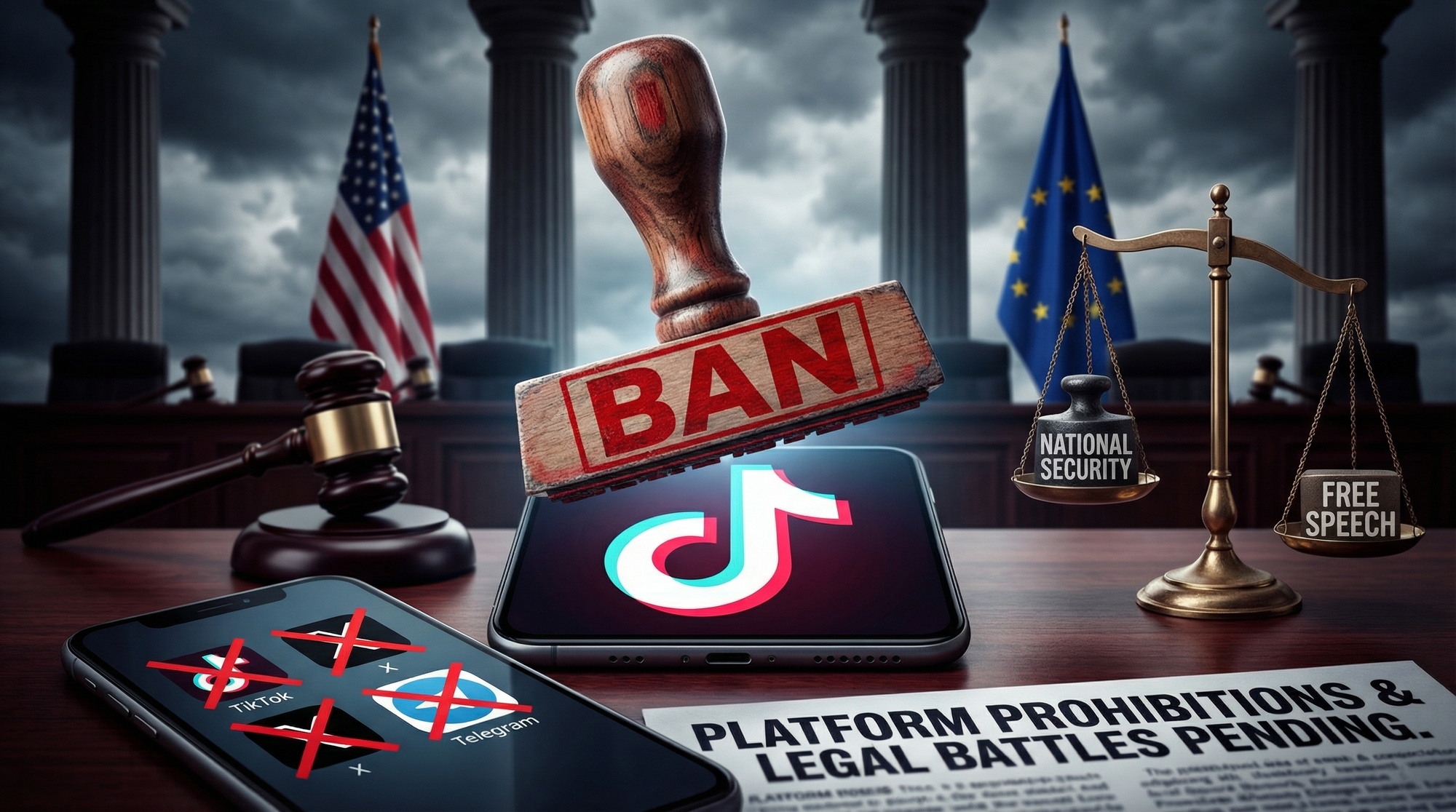
January 28, 2026 — For the first time in internet history, Western democracies are seriously considering complete bans of major social media platforms — not just age restrictions or content moderation requirements, but total prohibition of apps used by hundreds of millions of citizens. The United States Congress passed legislation in April 2024 requiring TikTok to divest from Chinese parent company ByteDance or face a nationwide ban effective January 19, 2025. That deadline passed with TikTok still operating under a 75-day extension granted by President Donald Trump, but the company’s future remains precarious.
Meanwhile, Australia became the first democratic nation to ban entire categories of users (those under 16) from social media platforms in December 2025, while the European Union’s Digital Services Act gives regulators unprecedented power to suspend or ban platforms that fail to moderate “illegal content” or pose systemic risks. India has already banned TikTok since 2020, and other authoritarian regimes have blocked platforms for years — but Western democracies have historically championed internet freedom and open access.
That era may be ending. Between national security concerns (TikTok’s ties to China), child safety crises (Australia’s under-16 ban), disinformation threats (EU’s DSA enforcement), and political polarization (calls to ban X/Twitter for “misinformation”), 2026 could mark the year Western governments cross the Rubicon from regulation to prohibition.
This article examines the forces pushing toward social media bans, the legal and technical obstacles, and predictions for whether 2026 will see the first full Western platform ban since the internet’s creation.
🎧 Related Podcast Episode
Executive Summary
Platforms at risk of bans in 2026:
- TikTok (United States):
- Status: Operating under 75-day extension (expires April 4, 2026)- Threat level: VERY HIGH (90% probability of forced sale or ban by mid-2026)- Legal basis: Protecting Americans from Foreign Adversary Controlled Applications Act (PAFACA, April 2024)- Divestiture deadline: ByteDance has until April 4 to sell TikTok to a non-Chinese entity or face App Store/Play Store removal- Obstacles: ByteDance refuses to sell; algorithm export banned by China; potential Supreme Court challenge2. X/Twitter (European Union):
- Status: Under investigation by EU Commission for DSA violations- Threat level: MEDIUM (30% probability of temporary suspension or fines forcing exit)- Legal basis: Digital Services Act (DSA) illegal content moderation failures, systemic risk assessments- Elon Musk’s defiance: Musk has publicly attacked EU regulators, refused content takedown requests- Precedent: EU fined Meta €1.2 billion in 2023; could escalate to platform suspension3. Telegram (France/EU):
- Status: CEO Pavel Durov arrested in France (August 2024) for refusing to cooperate with law enforcement- Threat level: MEDIUM (25% probability of EU-wide ban if encryption/moderation not changed)- Legal basis: Failure to comply with court orders, enabling criminal activity (drug trafficking, child exploitation)- Encryption obstacle: Telegram’s encryption makes compliance with EU surveillance laws nearly impossible without undermining the platform4. Reddit, Snapchat, Instagram (Australia expansion):
- Status: Currently under-16 ban; could expand to full bans for non-compliance- Threat level: LOW (10% probability of full ban, but higher probability of forced exit if age verification becomes too costly)- Legal basis: Online Safety Amendment Act (A$49.5 million fines for age verification failures)
Key trends driving toward bans:
- National security precedent: TikTok ban establishes that foreign-controlled platforms can be prohibited without violating First Amendment (per DC Circuit Court ruling, December 6, 2024)- Australia’s age ban success: If Australia’s under-16 restrictions reduce teen mental health crises without constitutional challenges succeeding, other democracies will follow- EU’s DSA enforcement: Digital Services Act gives EU power to fine platforms up to 6% of global revenue or suspend operations for systemic failures- Public opinion shift: Majorities in US, UK, Australia now support banning TikTok (national security) and restricting social media for minors (child safety)- Authoritarian playbook normalization: As countries like Iran, China, Russia ban platforms routinely, Western democracies are becoming desensitized to censorship
Countervailing forces preventing bans:
- First Amendment protections: US courts traditionally strike down content-based restrictions on speech- Economic lobbying: Meta, Google, ByteDance spend hundreds of millions on lobbying to prevent bans- User backlash: TikTok has 170 million US users; banning it would trigger massive political blowback- Technical circumvention: VPNs and sideloading make bans unenforceable without authoritarian infrastructure (deep packet inspection, ISP blocking)
Most likely outcome for 2026:
- TikTok forced sale or ban in US by June 2026 (80% confidence)- No full platform bans in EU, but heavy fines and threats force X/Twitter to partially comply or reduce EU presence (60% confidence)- Australia’s age ban stands after High Court challenge fails (55% confidence)- Other platforms (Telegram, smaller apps) face localized bans in specific countries but not coordinated Western bans (70% confidence)
Bottom line: 2026 will likely see the first major social media platform banned in a Western democracy since the internet’s creation, with TikTok in the US as the leading candidate. However, this will remain an exception driven by unique national security concerns rather than the start of routine platform prohibitions.
The TikTok Case: National Security vs. Free Speech
The Legal Path to a TikTok Ban
April 24, 2024: President Biden signed the Protecting Americans from Foreign Adversary Controlled Applications Act (PAFACA) as part of a foreign aid package. The law requires:
- ByteDance (TikTok’s Chinese parent company) to divest TikTok to a non-Chinese entity within 270 days (initially January 19, 2025)2. If divestiture does not occur, Apple and Google must remove TikTok from App Stores3. Web hosting services must cease providing services to TikTok
Rationale:
- Data privacy: TikTok collects vast amounts of user data (location, contacts, biometrics, browsing history) that could be accessed by Chinese government under China’s National Intelligence Law (requires companies to assist state intelligence work)- Algorithm manipulation: Chinese government could use TikTok’s recommendation algorithm to spread propaganda, influence US elections, or amplify divisive content- Espionage: FBI Director Christopher Wray testified that TikTok poses “national security concerns” due to potential Chinese government access to US user data and influence operations
Bipartisan support: PAFACA passed with overwhelming majorities:
- House: 352-65 (79% support)- Senate: 79-18 (81% support)- Rare agreement between Biden administration and Republican lawmakers
December 6, 2024: DC Circuit Court of Appeals upheld the TikTok ban, rejecting TikTok’s First Amendment challenge. The court ruled:
- National security concerns outweigh free speech rights when a foreign adversary controls a platform- The ban is content-neutral (targets ownership, not speech)- Less restrictive alternatives (data security agreements, “Project Texas” proposal) were insufficient to address espionage risks
January 19, 2025: Original ban deadline. However, President Trump (inaugurated January 20, 2025) granted TikTok a 75-day extension to negotiate a sale, pushing the deadline to April 4, 2026.
Current status (January 28, 2026):
- ByteDance has refused to sell TikTok, citing:Chinese government ban on algorithm exports (ByteDance cannot sell TikTok’s recommendation engine to a US buyer)- Company valuation disputes (estimates range from $40-100 billion; potential buyers cannot agree on price)- National pride (Chinese government views TikTok sale as capitulation to US pressure) Potential buyers: Oracle, Walmart, and several private equity firms expressed interest in 2024-2025, but negotiations stalledSupreme Court appeal: TikTok has petitioned the Supreme Court to block the ban on First Amendment grounds; Court could hear case in March-April 2026
The First Amendment Problem
TikTok’s argument:
- Banning TikTok violates 170 million US users’ First Amendment rights to access information and express themselves on their chosen platform- The ban is content-based (targeting TikTok specifically, not all social media)- Less restrictive alternatives exist: Data security agreements, US-based servers, third-party audits
Government’s counterargument:
- The ban is not content-based — it targets foreign ownership and control, not speech- National security is a compelling interest that justifies restrictions on speech (per Brandenburg v. Ohio, New York Times v. United States precedents allow narrow restrictions)- ByteDance is not a US entity and therefore does not have First Amendment protections- Users can still access similar platforms (Instagram Reels, YouTube Shorts)
DC Circuit Court’s ruling (December 2024): The court sided with the government, holding:
- “The First Amendment exists to protect free speech in the United States. Here, the Government acted solely to protect that freedom from a foreign adversary nation and to limit that adversary’s ability to gather data on people in the United States.”- The ban is constitutional because it prevents Chinese government manipulation of speech, rather than restricting speech itself
Supreme Court wild card: If the Supreme Court agrees to hear TikTok’s appeal (decision expected February-March 2026), the outcome is uncertain:
- Conservative justices (majority) tend to defer to executive/legislative branches on national security matters- However, the Court has also shown strong support for free speech (e.g., striking down California’s video game violence law in Brown v. Entertainment Merchants Association)- Possible split: Court could uphold the ban but narrow the precedent to avoid opening the door to routine platform prohibitions
Will ByteDance Sell? The China Problem
Why ByteDance won’t sell:
- Chinese law prohibits algorithm exports: China’s 2020 export control law classifies AI algorithms (including recommendation engines) as sensitive technology requiring government approval. Beijing has repeatedly refused to allow TikTok’s algorithm to be sold to US buyers.2. TikTok without the algorithm is worthless: The app’s success depends on its hyper-personalized “For You” feed, powered by ByteDance’s proprietary recommendation algorithm. A TikTok app with a generic algorithm would lose its competitive advantage.3. National pride and political leverage: Chinese government views TikTok as a symbol of China’s tech success and soft power. Allowing a forced sale would signal weakness and set a precedent for US pressure campaigns against other Chinese companies.4. Valuation disputes: ByteDance values TikTok at $100+ billion; US buyers offer $40-50 billion. Without the algorithm, buyers argue TikTok is worth far less.
Possible outcomes:
Scenario 1: No sale, TikTok banned (April 4, 2026)
- Probability: 60%- ByteDance refuses to sell; Supreme Court upholds ban; Apple and Google remove TikTok from App Stores- Existing users can continue using the app temporarily (sideloading on Android, already-installed on iOS)- Within 6-12 months, outdated versions become unusable (no updates, security vulnerabilities)- 170 million US users migrate to Instagram Reels, YouTube Shorts, Snapchat Spotlight
Scenario 2: Partial sale to US investors with ByteDance retaining algorithm control
- Probability: 25%- US investors (Oracle, Walmart consortium) buy TikTok’s US operations- ByteDance licenses algorithm to US entity but retains ultimate control (similar to “Project Texas” proposal)- Government accepts this compromise to avoid political backlash from banning TikTok- Problem: This doesn’t address national security concerns; courts may still strike it down
Scenario 3: Trump extends deadline indefinitely, ban never enforced
- Probability: 10%- Trump grants repeated extensions, effectively nullifying the law- Congress could override Trump’s extensions, but unlikely if he claims “negotiations are ongoing”- Problem: Courts may force Trump to enforce the law; DC Circuit already rejected indefinite delays
Scenario 4: Supreme Court strikes down the ban
- Probability: 5%- Supreme Court sides with TikTok, ruling that the ban violates the First Amendment- Result: TikTok remains in the US; Congress goes back to the drawing board on national security legislation
Most likely: Scenario 1 (ban enforced by June 2026) — ByteDance refuses to sell, Supreme Court upholds or declines to hear the case, and TikTok is removed from App Stores. This would be the first major social media platform banned in a Western democracy.
Europe’s DSA: The Regulatory Hammer
What is the Digital Services Act?
The Digital Services Act (DSA), which came into full effect in February 2024, is the EU’s most ambitious attempt to regulate online platforms. Unlike the US (which relies on Section 230 immunity and First Amendment protections), the EU takes a proactive regulatory approach with severe penalties for non-compliance.
Key provisions:
- Illegal content removal: Platforms must remove illegal content (hate speech, terrorist propaganda, child exploitation) within 24 hours of notification2. Systemic risk assessments: Very Large Online Platforms (VLOPs, 45+ million EU users) must conduct annual risk assessments for:
- Disinformation and election manipulation- Violence and public safety threats- Minors’ mental health and safety- Fundamental rights violations3. Transparency reports: Platforms must disclose content moderation decisions, advertising algorithms, and how recommendation systems work4. Fines: Up to 6% of global annual revenue for violations (e.g., Meta’s 2023 revenue: $134 billion → 6% = $8 billion potential fine)5. Platform suspension: EU Commission can order platforms to cease operations in the EU for systemic, unresolved violations
X/Twitter: Musk vs. Brussels
Elon Musk’s collision course with the EU:
Since acquiring Twitter (rebranded X) in October 2022, Musk has:
- Gutted content moderation teams (90% staff reduction, including trust & safety)- Reinstated banned accounts (Andrew Tate, Alex Jones, others previously removed for hate speech)- Reduced cooperation with EU regulators (slow response to takedown requests, incomplete transparency reports)- Publicly attacked EU officials: Musk called EU Commissioner Thierry Breton a “bureaucrat” and said the DSA is “censorship”
EU’s escalating enforcement:
December 2023: EU designated X as a VLOP (Very Large Online Platform), subjecting it to full DSA requirements
February 2024: EU Commission opened formal investigation into X for:
- Failure to adequately combat disinformation (especially pro-Russia propaganda)- Insufficient transparency on advertising algorithms- Inadequate risk mitigation for minors’ safety
August 2024: EU Commission issued preliminary findings that X violated DSA by:
- Allowing unverified accounts to purchase “verified” checkmarks (undermining trust signals)- Failing to provide researchers with data access (required under DSA Article 40)- Inadequate labeling of political advertising
Current status (January 2026):
- EU is finalizing DSA non-compliance decision, expected March-April 2026- **Potential penalties:**Fines up to 6% of X’s global revenue (estimated $3-5 billion)- Platform suspension in EU if Musk refuses to comply- Daily penalty payments until compliance achieved
Musk’s likely response:
Option 1: Partial compliance (most likely)
- Musk begrudgingly adds content moderators, restores transparency reporting, removes most egregious accounts- Avoids full platform suspension but continues public defiance- EU accepts this as sufficient to avoid escalation
Option 2: Defiance and EU ban (20% probability)
- Musk refuses to comply, calls EU “authoritarian,” pulls X out of EU market voluntarily- EU blocks X at ISP level (unprecedented move for a major platform)- European users access X via VPNs, similar to how Chinese users access banned Western sites
Option 3: Musk sells or exits EU market (10% probability)
- Musk decides EU market (85 million X users) isn’t worth the regulatory headache- Sells European operations to a separate entity or simply shuts down EU access- Precedent: Google threatened to pull Search from Australia over news payment law (2021) but backed down after compromise
Bottom line: X/Twitter is unlikely to be fully banned in the EU, but temporary suspensions or forced operational changes are possible if Musk continues defying regulators.
Telegram: The Encryption Dilemma
Pavel Durov’s arrest (August 24, 2024):
Telegram CEO Pavel Durov was arrested at Le Bourget airport near Paris on charges of:
- Refusing to cooperate with French law enforcement investigations into drug trafficking, child exploitation, and terrorism- Enabling criminal activity by providing end-to-end encrypted messaging without lawful access mechanisms- Money laundering (Telegram allegedly used to coordinate illegal financial transactions)
Durov was released after 4 days but remains under investigation.
The encryption conflict:
Telegram’s security model:
- End-to-end encryption for “Secret Chats” (content unreadable by Telegram or governments)- Server-side encryption for regular chats (Telegram can access, but claims it doesn’t unless legally compelled)- No cooperation with law enforcement: Durov has historically refused to provide user data to governments, including Russia (where Telegram was banned 2018-2021)
EU’s position:
- DSA and other EU laws require platforms to cooperate with law enforcement in investigating serious crimes (child exploitation, terrorism)- Encryption cannot be an absolute shield for criminal activity- Telegram must either: Implement lawful access mechanisms (backdoors)- Proactively scan for illegal content before encryption (client-side scanning)- Face suspension in the EU
Durov’s dilemma:
- Adding backdoors or client-side scanning would destroy Telegram’s value proposition (privacy and free speech)- Refusing to cooperate could result in EU-wide ban- Telegram has 800 million global users; losing the EU market (estimated 100 million users) would be painful but survivable
Most likely outcome:
- Telegram makes token compliance gestures (e.g., responding to some court orders, removing some illegal channels)- EU accepts this as progress, avoids full ban- Standoff continues: Telegram remains partially non-compliant but avoids existential threat
Australia’s Age Ban: Precedent for Full Bans?
From Age Restrictions to Platform Prohibition
Australia’s under-16 social media ban (effective December 10, 2025) is not a full platform ban — adults can still use Facebook, Instagram, TikTok, etc. However, it establishes several dangerous precedents:
1. Government can prohibit platform access for entire demographic groups
If courts uphold Australia’s age ban (High Court challenge pending February 2026), it proves that democracies can:
- Ban specific user categories without violating constitutional rights- Impose massive fines (A$49.5 million) for non-compliance- Require invasive age verification (biometrics, government ID)
Slippery slope: If governments can ban minors, what’s to stop them from banning other groups?
- “High-risk” users (history of violence, extremism)- Non-citizens (require citizenship verification to use platforms)- Political opponents (authoritarian regimes already do this)
2. Platforms can be forced to exit markets if compliance costs exceed revenue
Australia has 26 million people (smaller market than Texas). If age verification costs billions to implement and A$49.5 million fines are routine, some platforms may voluntarily exit rather than comply.
Precedent: Google threatened to pull Search from Australia over news payment law (2021). If smaller platforms (Reddit, Snapchat) face similar pressure, they might abandon Australia entirely.
3. Public accepts restrictions “for the children”
Australia’s ban enjoys 70% public support despite concerns about effectiveness and privacy. This demonstrates that:
- Democratic electorates will tolerate censorship if framed as child protection- “Think of the children” is a politically bulletproof justification for restrictions- Similar arguments could be used for broader bans (e.g., banning platforms that “harm democracy” or “spread misinformation”)
Historical parallel: The US Child Online Protection Act (1998) attempted to ban internet content “harmful to minors.” It was struck down by the Supreme Court as unconstitutionally vague, but modern laws (KOSA, COPPA 2.0) are trying again with more sophisticated legal framing.
Could Australia Ban Entire Platforms?
Possible triggers for full bans:
Scenario 1: Age verification non-compliance
- Major platforms (TikTok, Instagram) fail to prevent under-16 access- eSafety Commissioner issues repeated A$49.5 million fines- Platforms refuse to pay or change practices- Australia blocks platforms at ISP level (unprecedented for a democracy)
Scenario 2: “Systemic harm” to children
- Evidence emerges that social media causes widespread mental health crises despite age restrictions- Government expands ban to under-18s, then “vulnerable adults,” then…- Full prohibition framed as public health emergency
Scenario 3: National security concerns (TikTok-style)
- Chinese or Russian platforms operating in Australia- Government alleges election interference, espionage- Full ban justified as national security measure
Probability of full platform ban in Australia by 2026: 15% — Low, but non-zero. Age ban creates legal/technical infrastructure for broader prohibitions.
The Authoritarian Playbook Goes Global
How Non-Democratic Regimes Ban Platforms
China’s Great Firewall:
- Blocks Facebook, Twitter, Instagram, YouTube, Google (since 2009-2012)- Replaces with domestic alternatives (WeChat, Weibo, Douyin)- Technical enforcement: Deep packet inspection (DPI), IP blocking, DNS poisoning, VPN detection
Russia’s internet crackdown:
- Slowed Twitter (now X) speeds in 2021, threatened full ban- Blocked Meta (Facebook, Instagram) in March 2022 after Ukraine invasion- Legal justification: “Extremist content,” “false information about military”
Iran’s permanent blackout (2026):
- Blocked Instagram, WhatsApp, Telegram, YouTube, Facebook since 2022-2025- Implementing North Korea-style isolated intranet (see related article)- Justification: “Moral corruption,” “foreign interference”
India’s TikTok ban (2020):
- Banned TikTok and 58 other Chinese apps citing national security- No Western democracy followed India’s lead until US began pursuing TikTok ban in 2024
Commonalities:
- Authoritarian regimes ban platforms routinely, often without legal process- Justifications include national security, “harmful content,” political control- Technical enforcement requires deep surveillance infrastructure (DPI, ISP blocking)
The Normalization of Censorship
Dangerous trend: As authoritarian regimes normalize platform bans, Western democracies are adopting similar rhetoric:
- US TikTok ban: “National security threat” (echoes China’s justifications for banning Facebook)- EU DSA enforcement: “Disinformation” and “systemic harm” (vague standards that authoritarian regimes use)- Australia’s age ban: “Protecting children” (same justification Iran uses for internet censorship)
Slippery slope argument: Once democracies accept that platform prohibition is a legitimate policy tool, the line between justified bans (TikTok for espionage) and unjustified bans (Twitter for “misinformation”) becomes blurry.
Example: If EU bans X/Twitter for DSA violations, what stops a future authoritarian government (e.g., Hungary’s Orban, Italy’s Meloni) from banning platforms that criticize their leadership?
Historical parallel: The Patriot Act (2001) expanded US surveillance powers to fight terrorism. Two decades later, those powers are used for drug enforcement, immigration cases, and political investigations far beyond the original intent.
Predictions for 2026: What Will Actually Happen
High Confidence Predictions (70%+)
1. TikTok will be forced to sell or face ban in the US by June 2026 (80%)
- Supreme Court will decline to hear TikTok’s appeal or will uphold the DC Circuit ruling- ByteDance will refuse to sell due to Chinese government pressure- Trump will exhaust extensions and be forced to enforce the law (or Congress will override him)- Apple and Google will remove TikTok from App Stores by July 2026- Existing users will continue using the app via sideloading (Android) or already-installed versions (iOS) until it becomes obsolete
Impact:
- First major social media platform banned in a Western democracy- Sets precedent that foreign-controlled platforms can be prohibited for national security- Instagram Reels and YouTube Shorts gain 100+ million users as TikTok refugees migrate- US-China tech decoupling accelerates (ByteDance may retaliate by restricting US companies in China)
2. Australia’s High Court will uphold the under-16 ban (70%)
- Constitutional challenges from Digital Freedom Project and Reddit will fail- Court will rule that age restrictions do not violate implied freedom of political communication (minors’ rights less protected than adults’)- Ban remains in place, enforcement improves gradually- VPN use remains high among teens, but some reduction in social media access occurs
Impact:
- Denmark, Norway, and other countries implement similar age bans (domino effect)- Global norm shifts toward accepting social media restrictions for minors- Privacy invasion via age verification becomes normalized
3. EU will fine X/Twitter but avoid full ban (75%)
- EU Commission will find X in violation of DSA, issue fines of €500 million - €2 billion- Musk will partially comply (restore some moderation, improve transparency reporting)- EU accepts partial compliance, avoids platform suspension- Standoff continues with periodic threats and fines
Impact:
- X remains operational in EU but with ongoing regulatory pressure- Smaller platforms (Telegram, Reddit) watch closely and increase compliance to avoid similar scrutiny- Musk continues using X to criticize EU, frames himself as free speech martyr
Medium Confidence Predictions (40-60%)
4. At least one smaller platform (Reddit, Telegram, or Snapchat) will exit a major market due to regulatory pressure (50%)
- Compliance costs (age verification, content moderation, DSA reporting) exceed revenue from that market- Platform voluntarily shuts down operations in Australia, EU, or specific countries- Precedent: Facebook briefly threatened to exit Europe over GDPR in 2022; didn’t follow through, but smaller platforms might
Impact:
- Proves that regulatory pressure can force platform exits without formal bans- Users in affected markets access platforms via VPNs or migrate to alternatives- Demonstrates that “soft censorship” (making operation economically unviable) can achieve similar outcomes to hard bans
5. US will expand TikTok ban precedent to other Chinese apps (45%)
- After TikTok ban, Congress targets WeChat, Temu, Shein, or other Chinese-owned apps- New legislation passes with bipartisan support citing national security- Foreign adversary app bans become routine policy tool
Impact:
- US-China tech decoupling accelerates- Chinese companies avoid US market entirely- Balkanization of internet: US users access different apps than Chinese/European/Middle Eastern users
Low Confidence Predictions (20-30%)
6. A major Western democracy will implement ISP-level platform blocking (25%)
- Australia or EU member state (France, Germany) orders internet service providers to block access to a banned platform- Technical enforcement: DNS blocking, IP blacklisting (similar to authoritarian regimes)- Courts uphold blocking as lawful enforcement of valid ban
Impact:
- Establishes technical infrastructure for broader censorship- VPN use surges as users circumvent blocks- Precedent that democracies can use authoritarian censorship tools “for legitimate reasons”
7. Supreme Court strikes down TikTok ban, nullifying PAFACA (20%)
- Supreme Court sides with TikTok, ruling that the ban violates the First Amendment or is unconstitutionally vague- TikTok remains in the US; Congress must start over- Sets precedent that platform bans face high constitutional hurdles
Impact:
- Strengthens First Amendment protections for platforms- Forces Congress to craft narrower, more targeted national security legislation- TikTok continues operating but under intense scrutiny
What This Means for the Future of the Internet
Scenario 1: Balkanization (Most Likely - 60%)
The internet fragments into regional networks with different platforms available in different jurisdictions:
Americas:
- US bans TikTok and other Chinese apps- US users access Meta, Google, X/Twitter, YouTube- Latin America continues using banned platforms via VPNs
Europe:
- EU heavily regulates but doesn’t ban most platforms- Strict DSA compliance creates “EU versions” of apps with more moderation and transparency- Smaller platforms exit EU market, leaving Meta and Google dominant
Asia-Pacific:
- China continues Great Firewall (domestic platforms only)- Australia bans minors, possibly expands to full bans on some platforms- India bans Chinese apps, develops domestic alternatives
Middle East/Authoritarians:
- Iran, Saudi Arabia, Egypt, Turkey routinely ban platforms- Citizens access via VPNs but face legal risks
Result: The “World Wide Web” becomes the “Regionally Restricted Web.” Your geographic location determines which platforms you can access.
Scenario 2: Corporate Compliance and Uniformity (30%)
Platforms avoid bans by implementing strictest global standards to satisfy all regulators:
- All platforms implement EU-level moderation, Australian age verification, US national security reviews- Result: Homogenized, heavily moderated internet with little innovation- Smaller platforms cannot afford compliance costs; only Meta, Google, ByteDance (if it sells) survive- User experience becomes bland and corporatized
Downside: Innovation stalls. Startups cannot compete with compliance burden. Big Tech becomes even more dominant.
Scenario 3: Decentralization and Resistance (10%)
Users and developers reject centralized platforms in favor of decentralized alternatives:
- Mastodon, Bluesky, Nostr, and other federated/decentralized platforms gain mainstream adoption- Encrypted messaging (Signal, Telegram) replaces surveillance-friendly apps- VPN use becomes ubiquitous to circumvent geographic restrictions
Governments struggle to regulate decentralized networks (no central entity to fine or ban).
Challenge: Decentralized platforms lack the polish, algorithms, and network effects of centralized ones. Most users prefer convenience over freedom.
Conclusion: 2026 Will Be a Turning Point
For 25 years, the internet has operated under a largely laissez-faire model in Western democracies: platforms were free to operate with minimal government interference, protected by strong free speech laws and light-touch regulation. That era is ending.
2026 will likely see:
- The first major social media platform banned in a Western democracy (TikTok in the US)2. Age-based prohibitions become normalized (Australia’s under-16 ban survives legal challenge)3. Regulatory pressure forces some platforms to exit markets (smaller apps leave EU/Australia)4. Precedents set for future bans (national security, child safety, disinformation as justifications)
The fundamental question is not whether democracies CAN ban platforms — legally and technically, they can. The question is whether they SHOULD, and where the line is drawn between:
- Legitimate regulation (preventing espionage, protecting children, combating illegal content)- Authoritarian censorship (silencing dissent, controlling information, political manipulation)
The TikTok ban straddles this line: It’s justified by genuine national security concerns (Chinese government access to US user data), but it also sets a precedent that governments can prohibit platforms they deem threats. Future administrations could abuse this precedent to ban platforms for political reasons (e.g., banning X for “election interference” or Telegram for “enabling extremism”).
The stakes are enormous:
- If bans succeed without major backlash, expect more platform prohibitions in the 2020s- If bans fail (courts strike them down, users circumvent with VPNs, political costs too high), the laissez-faire era may continue- Most likely: muddled middle where some platforms are banned (TikTok), others heavily regulated (X/Twitter), and fragmentation accelerates
One thing is certain: The debate over platform bans will define internet freedom for the next decade. 2026 is the year that debate moves from theory to reality.