Individually, the AI executive orders of the past fourteen months read as ordinary technology policy. Read as a sequence, they describe something more coherent: the reclassification of artificial intelligence from a commercial sector into strategic infrastructure, with the legal consequences that classification carries.
The sequence
July 2025 — EO 14318, “Accelerating Federal Permitting of Data Center Infrastructure.” Creates a class of “Qualifying Projects” — $500 million in capex, or more than 100 MW of incremental load, or protective of national security, or designated by the Secretaries of Defense, Interior, Commerce, or Energy. Directs agencies to identify NEPA categorical exclusions for them and authorizes FAST-41 expedited scheduling. Covered in detail here.
December 2025 — “Ensuring a National Policy Framework for Artificial Intelligence.” Calls for a national AI policy framework and preemption of conflicting state AI laws, and directs the creation of a DOJ task force to identify such laws.
June 2026 — “Promoting Advanced Artificial Intelligence Innovation and Security.” Signed 2 June, published in the Federal Register 5 June. Establishes cybersecurity mandates for federal systems on aggressive 30- and 60-day timelines with deliverables due 2 July and 1 August 2026, prioritizes criminal enforcement against AI-enabled cyber activity, and establishes a voluntary framework for pre-release federal access to “covered frontier models.”
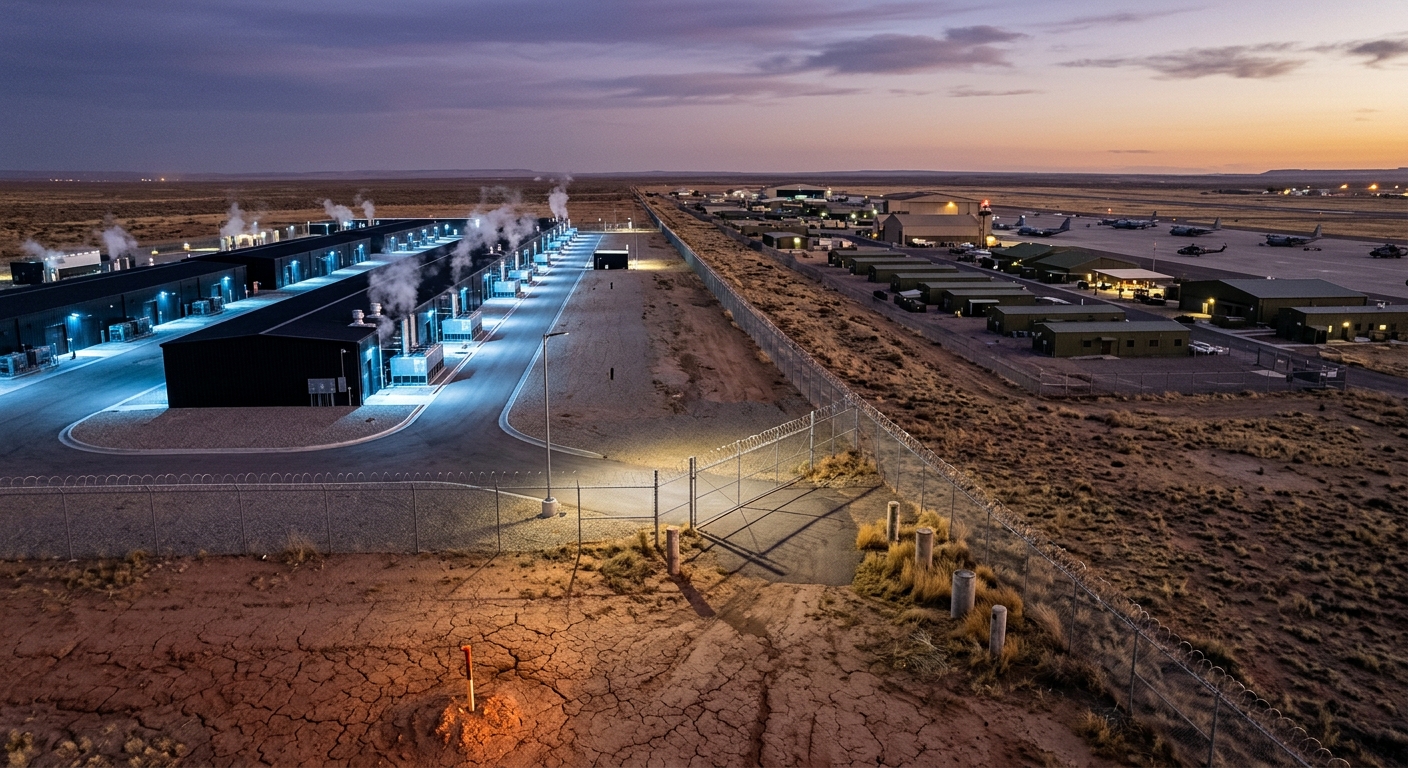
Alongside these, the Army’s Enhanced Use Lease program has issued conditional awards for roughly 1,384 acres at Fort Bliss to Carlyle and 1,201 acres at Dugway Proving Ground to CyrusOne, siting commercial data centers on active military installations.
What each piece does to the accountability layer
Take them one at a time, from the standpoint of someone trying to find out what is happening.
Permitting acceleration removes the documentary record. NEPA review is slow, and it is also the process that generates environmental assessments, alternatives analyses, and public comment dockets. Categorical exclusion is not merely faster review; it is the absence of the document. Siting on federal land goes further, removing county agendas, state open-meetings requirements, and state records law from the picture entirely.
Preemption removes the enforceable rules. This is the most consequential piece and the least understood. State law is currently the only binding American AI and privacy regulation that exists. California, Colorado, Texas, Illinois, and Washington have statutes covering automated decision systems, biometric identifiers, profiling opt-outs, and data broker registration. There is no federal comprehensive privacy law to replace them. Preemption of “conflicting state AI laws” without a substantive federal standard is not harmonization — it is deregulation with a procedural mechanism, and the DOJ task force is the instrument for identifying targets.
And “voluntary pre-release federal access to covered frontier models” is a category worth sitting with. The stated purpose is security evaluation, which is a real and legitimate function — the AI safety institutes in the US and UK have done genuinely valuable pre-deployment testing. But a standing government channel into frontier models before public release is a capability, and capabilities acquired for one purpose get used for others. Its voluntariness is doing a lot of work, and voluntary arrangements between a regulator and the entities it could regulate are voluntary in a specific and limited sense.
The one thing the June order got right
Credit where due, and it matters.
The June 2026 order explicitly provides that it does not authorize the creation of a mandatory governmental licensing, preclearance, or permitting requirement for AI model development, publication, release, or distribution.
That is a meaningful disclaimer, and it cuts directly against the most dangerous idea in this space: that publishing model weights should require government permission. Given how much the open-weights ecosystem now matters for anyone who wants to use AI without surrendering their data, an explicit federal statement that no licensing regime is being created is a real, if fragile, protection. Fragile because an executive order can be replaced by an executive order.
The strongest version of the government’s case
It should be stated properly, because it is not stupid.
If frontier capability development is genuinely strategically decisive — and reasonable people believe it is — then a regulatory environment that adds years to infrastructure timelines while a competitor state builds without those constraints is not neutral. The Stanford AI Index found that five independent open model families reached frontier quality simultaneously, most of them Chinese. That is not propaganda; it is measurement.
Fifty different state regulatory regimes genuinely do impose real compliance costs, and a patchwork does genuinely favor incumbents who can afford fifty compliance programs over startups who cannot. And keeping compute inside American jurisdiction has genuine benefits for data governance — a facility in Texas is subject to American process in a way that one in a jurisdiction with no privacy law is not.
The case for federal harmonization is legitimate. The problem is what is actually on offer.
Where that case fails
Preemption is being pursued without a replacement. Harmonization means one standard instead of fifty. What is being built is zero standards instead of fifty, plus a task force to find the fifty. If a comprehensive federal privacy and AI statute were moving through Congress alongside the preemption effort, this would be a legitimate debate about which level of government should regulate. It is not moving. The Secure Data Act and its predecessors have gone nowhere for years.
Speed and opacity are not the same problem, and only one is being solved. Every argument in the acceleration case is an argument about timelines. None of them requires that power draw, water consumption, ownership, or workload be undisclosed. You could grant every permitting concession the industry asks for and still require annual metered reporting. The orders do the first and not the second, and that choice was not compelled by the competition.
National security framings expand. “Protects national security” is one of four routes into Qualifying Project status under EO 14318, alongside two quantitative thresholds and a discretionary secretarial designation. Categories defined this way do not stay narrow. The history of critical-infrastructure designation in American law is a history of scope creep, and the scope in question here is exemption from environmental review and local process.
What it means in practice
By mid-2026 the United States has an AI policy, and it is an infrastructure policy. Build fast, build big, build on federal land where necessary, keep the compute domestic, harden federal systems, get early government visibility into frontier systems, and clear away subnational rules that slow any of it down.
What it does not contain is a single new enforceable protection for individuals. Not one. The affirmative obligations run toward federal system security and toward accelerating construction. The rights side of the ledger is the one being cleared, via preemption of the only binding rules that currently exist.
The parts of this that are genuinely defensible — permitting reform, domestic siting, harmonized standards — could all be delivered with a transparency and rights floor attached. That they are not is a choice, and it is the choice that should be argued about.
What you can do
- Defend state law specifically, not abstractly. The concrete targets are Illinois’s BIPA, California’s CCPA and ADMT rules, Colorado’s AI Act, and the state data broker registries. Preemption fights are won by naming the statute that would disappear, not by defending federalism in general.
- Read the DOJ task force’s output when it appears. A published list of “conflicting” state laws is a roadmap of which protections are targeted, and it will be the most useful document of the year for anyone working on this.
- Ask candidates and legislators the substitution question. “If state AI and privacy laws are preempted, what federal rule replaces them, and when does it take effect?” There is currently no good answer, and the absence is the whole argument.
- Support the transparency amendments, not just opposition. The most winnable version of this is not blocking permitting reform; it is attaching mandatory metered disclosure of power, water, ownership, and workload category as a condition of Qualifying Project status.
- Hold onto the licensing disclaimer. The June order’s explicit statement that no mandatory licensing of model development, publication, or distribution is authorized is worth citing every time a weights-restriction proposal surfaces. It is the strongest thing in the sequence for ordinary users, and it is one signature away from being gone.