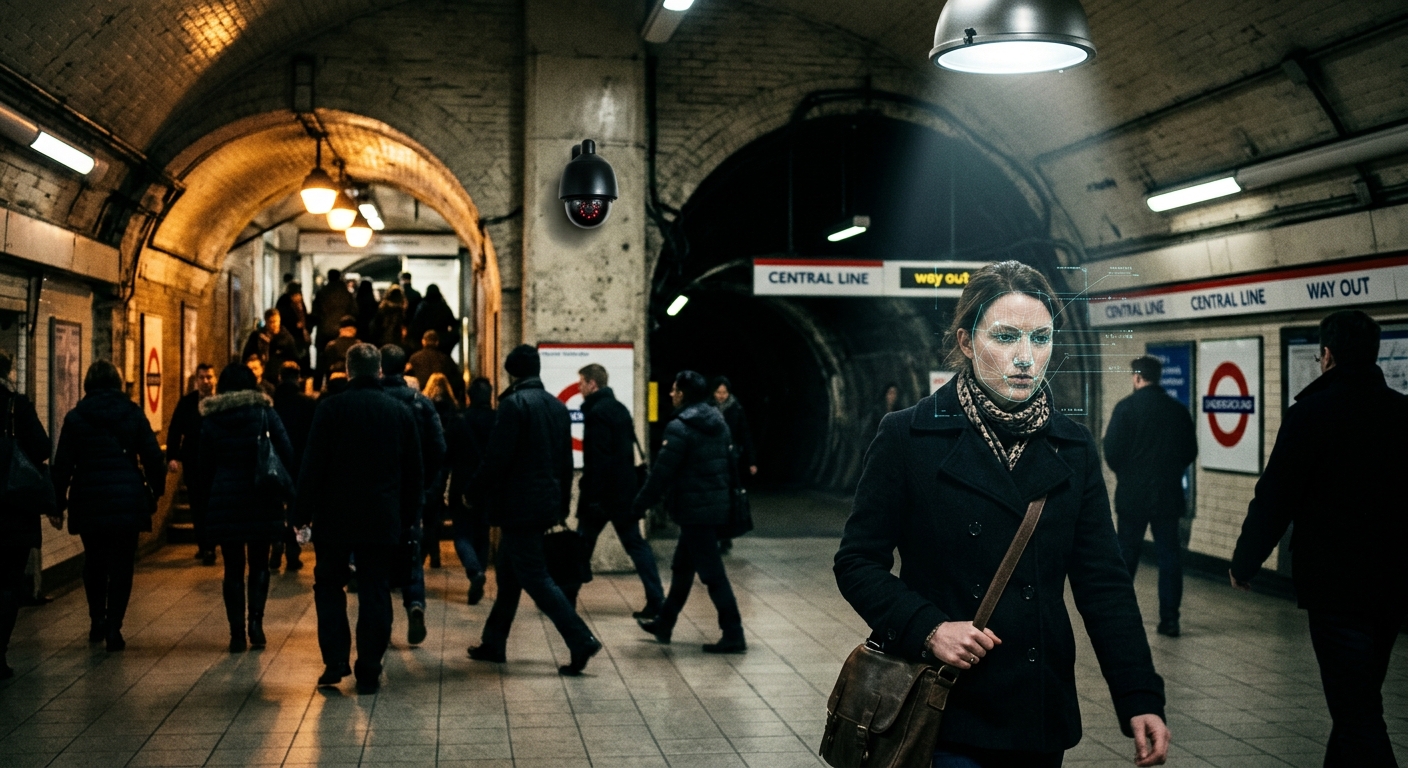
On Tuesday 11 August, British Transport Police deployed live facial recognition inside a London Underground station for the first time. The location was Victoria. The deployment is part of a trial that began on 11 February 2026 at surface transport hubs and now rotates between Underground and Network Rail stations until November 2026.
The system is NEC’s NeoFace M40. The mechanics are the ones every LFR deployment uses: a camera watches a passageway, every face in frame is detected and converted into a biometric template, and each template is compared against a watchlist of people wanted by police or the courts. When the comparison crosses a similarity threshold, an alert goes to an officer standing nearby, who decides whether to stop the person.
The deletion argument
BTP’s public position, and Transport for London’s, rests on one sentence: images of people who do not match the watchlist are not stored, but are automatically and immediately deleted.
This is true, and it is also the narrowest possible framing of what happened.
To determine that you are not on the watchlist, the system must first measure your face. It generates a template — a numerical representation of your facial geometry — and runs it against every entry on the list. That is a biometric identity check. It is conducted on you, without your consent, without suspicion, and without any opportunity to decline, because the alternative to walking past the camera is not using the station.
The deletion happens after the check. What is being described as “we don’t keep your data” is more precisely “we processed your biometrics and then discarded the result.” Those are different claims, and only one of them is a privacy protection.
Compare this to the standard everywhere else in the biometric world. Under Illinois BIPA, under Texas CUBI, under the GDPR’s Article 9, the regulated event is the collection and processing of a biometric identifier, not its retention. Retention is an aggravating factor. A system that scans a million faces and deletes 999,999 templates has still processed a million biometric identifiers.
What the EU just decided about exactly this
The timing is worth noting. The EU AI Act’s prohibitions on real-time remote biometric identification in publicly accessible spaces by law enforcement are in force, with narrow carve-outs for locating specific victims, preventing imminent terrorist threats, and locating suspects in a defined list of serious offences — each requiring prior judicial or independent administrative authorisation.
A rotating trial that scans commuters at a busy interchange against a general wanted-persons watchlist would not obviously survive that framework. Post-hoc facial recognition — running the tech over recorded footage after the fact — is classified as high risk rather than prohibited, and the high-risk obligations themselves have slipped, but the live, real-time, indiscriminate version is the one Brussels named as unacceptable.
The UK is not bound by the AI Act. That is precisely why the divergence is interesting: the same technology, deployed on similar populations, is a prohibited practice on one side of the Channel and a police trial on the other. There is no UK statute specifically authorising live facial recognition. The legal basis is assembled from common law policing powers, the Data Protection Act 2018, the Human Rights Act, and the Surveillance Camera Code — a stack that the Court of Appeal already found insufficient once, in Bridges v South Wales Police (2020), on the grounds that too much discretion was left to individual officers over who goes on the watchlist and where the cameras go.
Six years later the watchlists are bigger and the cameras are in the Tube.
Why the Underground specifically
Transport networks are the ideal LFR environment and the worst one, for the same reason: funnelling. A station concourse compresses a large population through a small number of fixed choke points where everyone must pass at a predictable distance from a fixed camera position with controlled lighting. It is the closest thing to a laboratory that public space offers.
It also means there is no meaningful opt-out. You can choose not to attend a football match or a protest. Millions of people cannot choose not to take the Tube to work. A deployment at Victoria is a biometric checkpoint on a compulsory route, and “the trial rotates between stations” means the checkpoint is unpredictable rather than absent — which is a description of how surveillance produces chilling effects, not a mitigation of them.
The watchlist is the real system
Public debate fixates on the camera. The camera is the boring part.
The consequential component is the watchlist: who is on it, on whose authority, for what offences, for how long, and with what process for getting off it. BTP’s published material describes people “wanted by police or the courts.” That phrase covers everything from a suspect in a serious assault to someone who missed a court date over an unpaid fare.
Every documented LFR controversy in the UK has been a watchlist controversy. South Wales Police included people whose cases had been dropped. The Met has run deployments where a substantial share of the list consisted of low-level matters. Watchlists are assembled from police databases, and UK police databases are known to contain millions of custody images of people never charged or convicted, retained in defiance of a 2012 High Court ruling that said they should not be.
That is the pool the matching runs against. The accuracy of NeoFace M40 is almost irrelevant next to the question of what it is accurate about.
What it means in practice
Passing a camera is now an identity check. Not a recording — a check. Understand the distinction when officials tell you nothing is stored.
Trials become infrastructure. No live facial recognition trial anywhere has concluded with the technology being removed. The November end date is a review point, not a sunset.
The consent model has quietly inverted. CCTV recorded a space and required a human to go looking for you in it. LFR asks, automatically and continuously, is this person one of the people we want? about every person present. The default has flipped from “no one is looking” to “everyone is checked.”
What you can do
-
Look for the signage and the officers. UK deployments are supposed to be signed and staffed. Knowing what a deployment looks like tells you when you are inside one.
-
You are not obliged to be scanned, but there is no clean way to refuse. Covering your face near a deployment has previously drawn police attention in England. Know that before you decide how to react.
-
If you are stopped on a match, ask directly whether it came from facial recognition, and ask why you are on the watchlist. A false match is a data protection matter, and you cannot complain about a record you never learn exists.
-
Exercise your subject access rights. You can ask a police force what personal data it holds about you, including custody images. Deletion of unconvicted custody images is available on request in England and Wales, and almost nobody asks.
-
Respond to consultations. The absence of a specific statutory framework for LFR is the central problem. It gets fixed politically or not at all — see the wider UK surveillance picture for what happens when police data governance is left to itself.