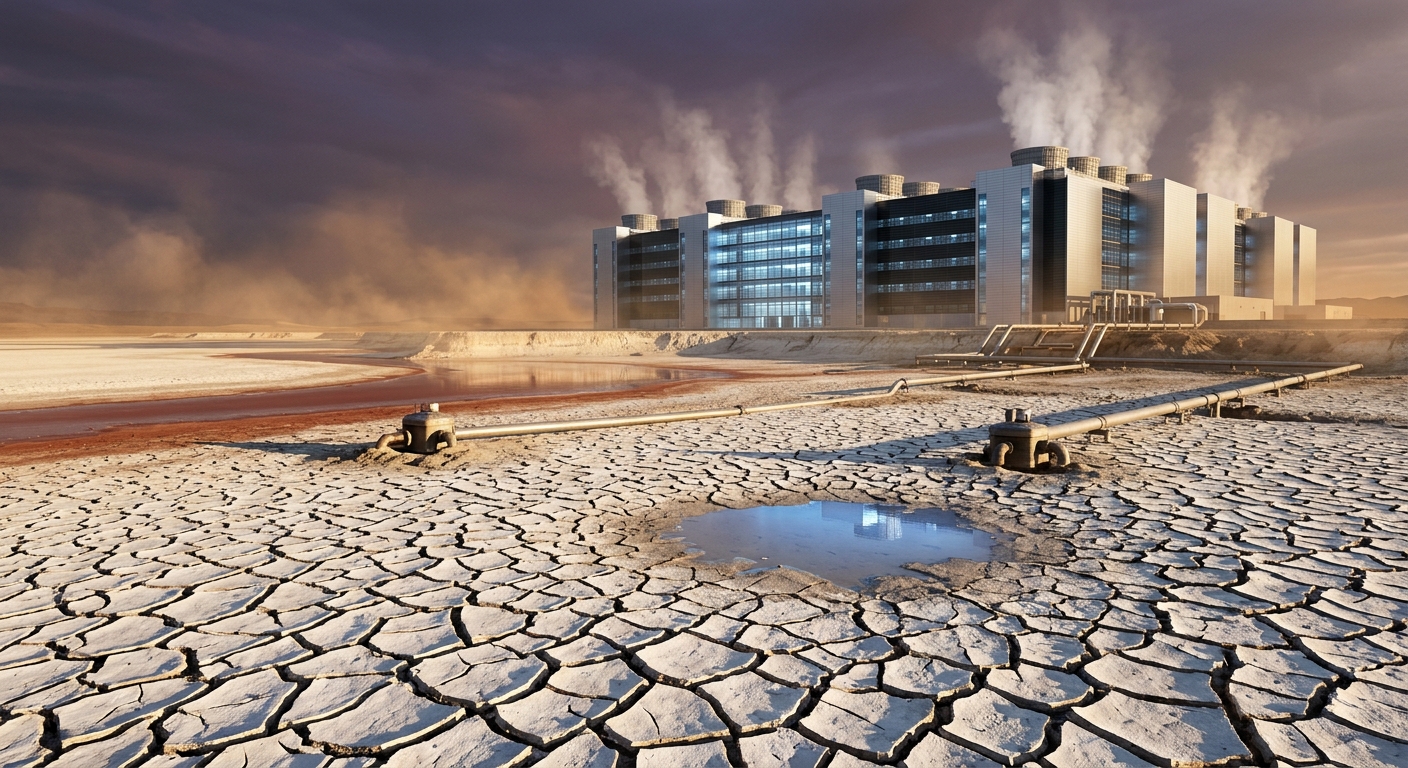
Water is the data center controversy that will outlast the others, because unlike electricity you cannot build more of it.
The mid-year numbers
Direct water consumption by US data centers was estimated at roughly 17.5 billion gallons in 2023 — the most recent year with a defensible national estimate — and projections have it doubling or quadrupling by 2028.
About two-thirds of US data centers built since 2022 are located in high water-stress areas. A separate analysis of 809 planned projects found that roughly two-thirds are slated for areas already facing water shortages.
The background conditions this year were not favorable. As of early May 2026, 50.9% of the US and Puerto Rico and 60.9% of the lower 48 states were in drought. The Bureau of Reclamation declared a Level 1 Shortage Condition on Lake Mead for 2026, triggering mandatory delivery reductions across the Lower Colorado Basin.
Regional projections are correspondingly steep. Western Resource Advocates estimated that data centers across Arizona, Colorado, Nevada, New Mexico, and Utah could consume around 7 billion gallons annually by 2035.
What individual facilities actually use
Aggregates are easy to dismiss. Site-level figures are not, and this year produced several.
Utah. The NSA’s Bluffdale facility consumed more than 126 million gallons between October 2024 and September 2025. Over the same period, Aligned Data Centers used 80 million gallons in West Valley and 47.4 million gallons in West Jordan. These figures exist because Utah requires disclosure of large water users’ consumption — a state-law quirk, not an industry practice.
Georgia. A Meta facility in Newton County that opened in 2018 uses roughly 500,000 gallons of water per day — about 10% of the entire county’s water consumption, for a single building.
That last ratio is the one to carry around. Not a percentage of a state, not a share of national withdrawals, but one facility consuming a tenth of a county.
The methodology fight, honestly stated
Water figures in this debate are contested, and some of the most-shared numbers do not hold up. Anyone arguing this seriously needs to know which is which.
“Training a single AI model consumes 185,000 gallons” is a widely repeated figure, and it is close to meaningless without qualification. Water consumption per unit of compute depends entirely on cooling architecture, local climate, and whether you count on-site evaporative loss only or also the water consumed generating the electricity. Estimates for the same workload vary by more than an order of magnitude depending on those choices. Citing a single gallons-per-model number as though it were a physical constant invites — and deserves — correction.
“Withdrawal” and “consumption” are different things and get conflated constantly. A once-through cooling system may withdraw enormous volumes and return nearly all of it to the source, warmed. An evaporative system withdraws less and consumes almost all of what it takes. Comparing a withdrawal figure for one facility to a consumption figure for another produces nonsense, and it happens in local hearings regularly.
Closed-loop and air-cooled designs exist and are increasingly common. A meaningful share of new build uses closed-loop liquid cooling with minimal makeup water, or air-side economization in cool climates. Treating all facilities as evaporative is simply inaccurate, and the industry is right to say so.
And electricity is the larger indirect draw. Thermoelectric generation consumes water. For a grid-connected facility in a region with substantial thermal generation, indirect water consumption via electricity frequently exceeds on-site cooling consumption. Which means the shift to on-site gas generation is also a water story, and one almost nobody is tracking.
The strongest version of the water concern survives all four caveats: two-thirds of new siting is in water-stressed regions, site-level consumption where it has been disclosed is very large relative to the host community, and disclosure is voluntary almost everywhere.
Why disclosure is the actual issue
Notice how the credible site-level numbers in this article were obtained. Utah’s came from a state disclosure requirement for large water users. Newton County’s came out of local reporting and municipal utility records. None of them came from a company report.
There is no federal water-use reporting requirement for data centers. Most states do not require site-level disclosure. Where municipal water is used, consumption is often aggregated into industrial totals rather than broken out. Where groundwater is used, in many Western states a facility can pump under a water right with minimal ongoing public reporting at all. And where a facility buys reclaimed or non-potable water — genuinely the responsible choice — the volumes are often governed by a confidential bulk agreement.
The consequence is that a county negotiating a twenty-year tax abatement frequently does not know, and cannot compel disclosure of, how much water the facility will use. Texas has now made water and cooling operations one of the six mandatory disclosure categories in its statewide audit. That is the first time a major jurisdiction has demanded it as a condition of grid access, and it is worth watching whether the answers survive commercial confidentiality claims.
The El Paso problem
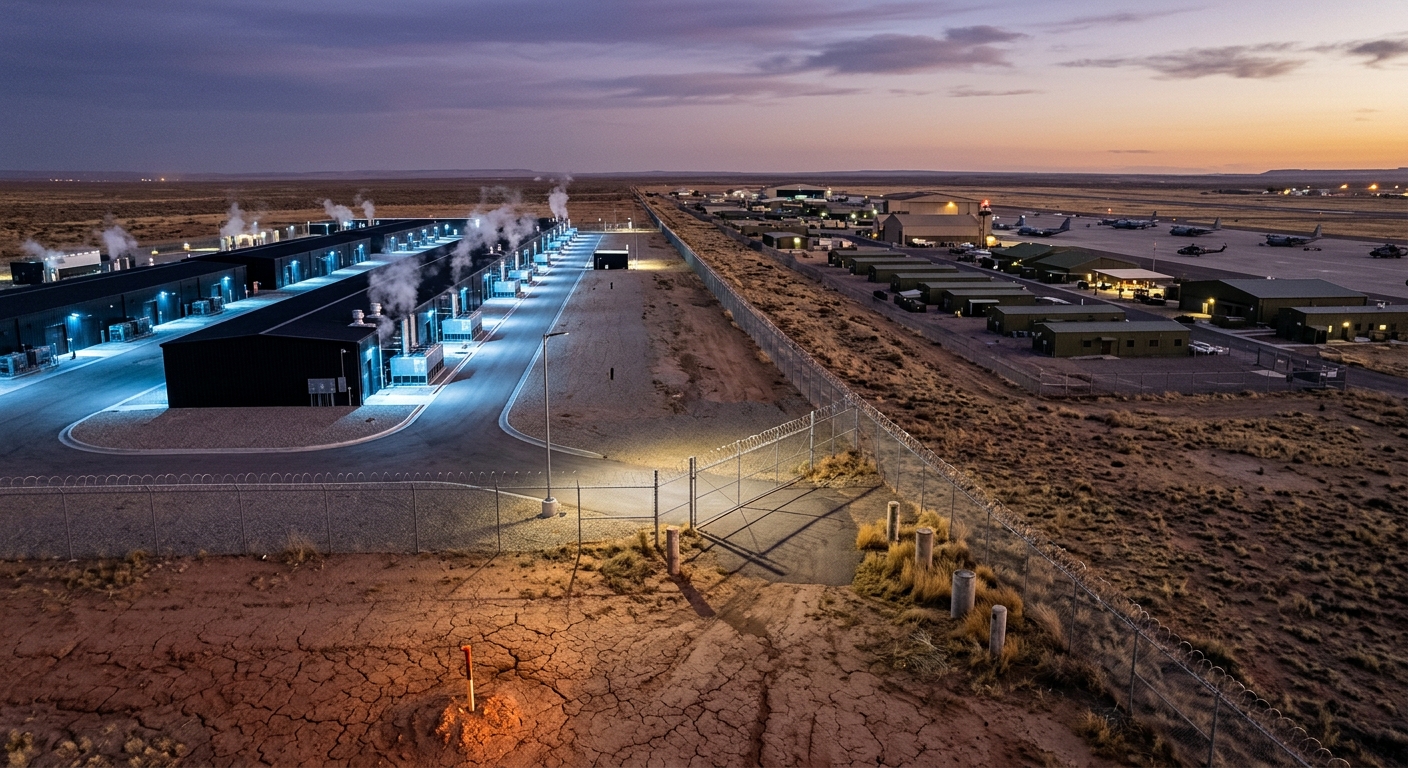
The clearest illustration of where this is heading is the Army’s Enhanced Use Lease program. Carlyle has a conditional award for roughly 1,384 acres at Fort Bliss, Texas — where Defense Department documentation rates area water risk as “Extremely High”, and where the facility’s projected power demand alone could exceed that of all 460,000 electricity customers in El Paso combined.
A large evaporatively cooled facility in the Chihuahuan Desert, on federal land, outside county jurisdiction, drawing on the same aquifer system as a metropolitan area approaching a million people, with no state or local disclosure requirement reaching it. That is not a hypothetical about 2035. It has a projected initial operating capability of fiscal year 2027.
What it means in practice
The water question is different from the power question in one decisive respect: electricity supply can be expanded with capital, and an aquifer cannot. When a region’s water is over-allocated, adding a large consumer does not create scarcity gradually — it reallocates an existing fixed quantity, and the reallocation is decided by contract and water right rather than by any public process.
Two-thirds of new siting is happening in exactly those regions. The volumes involved at individual sites are large relative to their host communities. And the public generally cannot find out the numbers unless a state has specifically legislated for it, which almost none have.
What you can do
- Ask for consumption, not withdrawal, in gallons per day, metered. Insist on the unit and the measurement method. Vague commitments to “water stewardship” and unqualified percentage reductions are not answers.
- Get the water agreement, not the press release. Bulk supply agreements with municipal utilities are contracts with a public body and are frequently obtainable under state records law, confidentiality assertions notwithstanding.
- Ask what happens in a drought year. The critical clause is curtailment: who gets cut first when the municipality restricts use. If residential users are curtailed before the facility, that is the single most important fact about the deal and it is written down somewhere.
- Check whether it is groundwater. Municipal supply is at least visible. A facility pumping under its own water right in a Western state may be effectively unmonitored, and that is a different and harder problem.
- Push your state toward the Utah model. Mandatory annual disclosure of consumption by large water users is a modest, already-tested requirement, and it is the reason anyone can cite real numbers for Bluffdale, West Valley, and West Jordan while comparable facilities elsewhere remain blank.