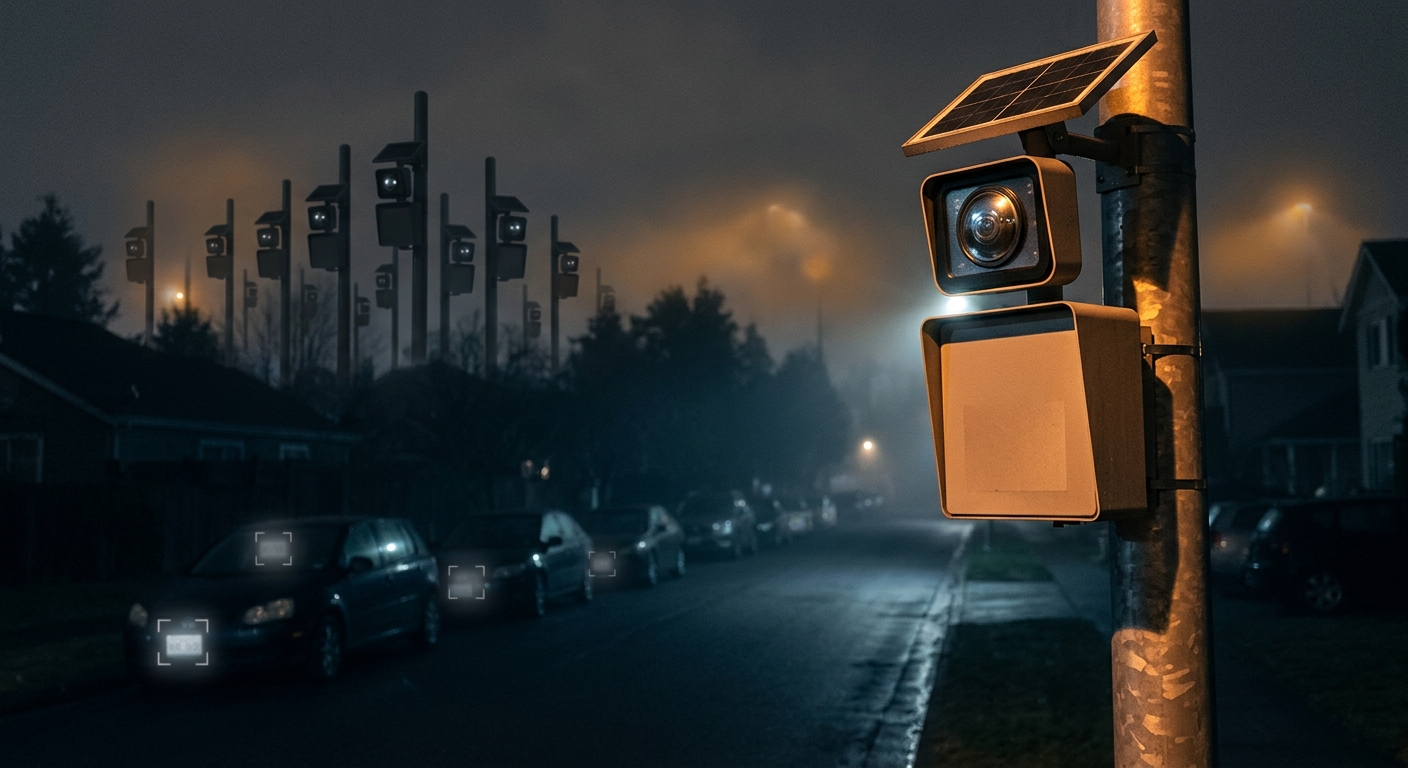
Flock Safety is having the strangest year of any surveillance company in America. It is growing and collapsing at the same time, in different places, for the same reason.
The scale
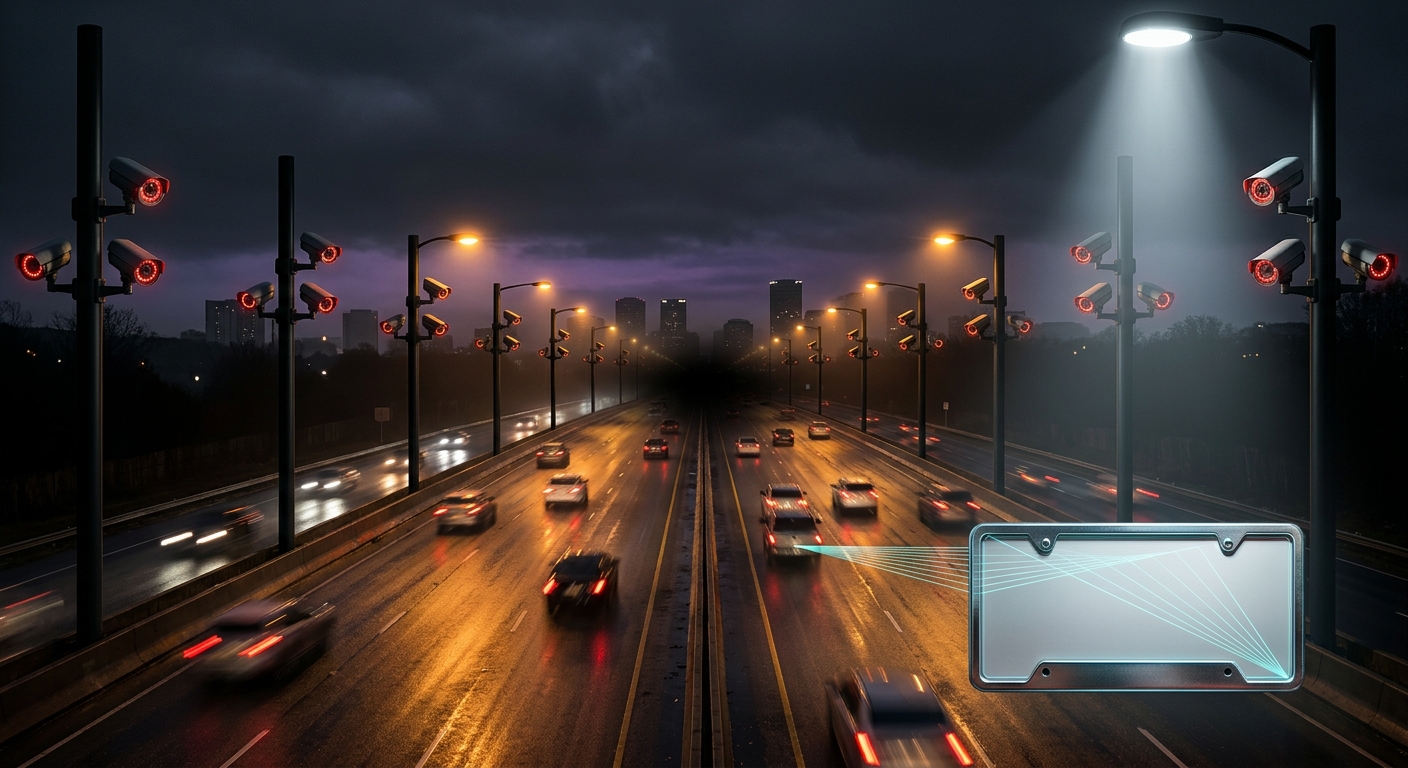
More than 100,000 cameras across 49 states. Roughly 20 billion license plates scanned per month. More than 5,000 communities on the network. An $8.4 billion valuation after an April 2026 funding round. The company claims involvement in solving more than 300,000 crimes.
Twenty billion plate reads a month is the number to hold. It means that in most of populated America, the default assumption should be that your vehicle’s movements are being recorded, timestamped, geolocated, and retained in a searchable national index operated by a private company — regardless of whether you have ever been suspected of anything.
The cancellations
Since late 2024, more than fifty municipalities have cancelled, suspended, refused to renew, or removed Flock deployments. The pattern is remarkably consistent, and it is almost always the same trigger: a city ran an audit and found out who had been querying its cameras.
Mountain View, California disabled 30 cameras on 3 February 2026 after audits revealed access by the ATF, the Air Force, and the GSA Inspector General.
Oxnard, California cancelled on 27 February 2026 after finding a “nationwide query” setting that violated state law.
Santa Cruz (January 2026), South Pasadena (14 cameras), and Austin, Texas all cited out-of-state access and ICE data sharing specifically.
Lynnwood, Washington became the first Washington city to cancel an active contract after discovering out-of-state agency access. Olympia uninstalled 15 cameras. Mountlake Terrace voted unanimously to cancel before installation.
Denver removed all 110 police cameras on 31 March 2026, the largest single removal to date, replacing them with a smaller Axon deployment.
Oshkosh, Wisconsin may be the most damning. On 23 April 2026, the council voted 7-0 to rescind a Flock contract less than 24 hours after approving it, after Police Chief Dean Smith determined that Flock had misrepresented the system’s heat-map movement-tracking capability — a representative having answered “no” to a direct question about whether the system builds movement heat maps.
And in August, the wave continued: Surprise, Arizona ended its contract and requested removal of all equipment after an officer was placed on leave over potential misuse, and Chandler announced it would stop using the cameras and not pursue renewal.
The lawsuit that could matter more than all of them
A class action filed in San Francisco Superior Court in February 2026 alleges that out-of-state and federal agencies — including ICE, CBP, the FBI, and the ATF — queried San Francisco’s cameras more than 1.6 million times in seven months.
California’s ALPR Privacy Act prohibits sharing plate data with federal or out-of-state agencies without case-by-case authorisation. The suit seeks $2,500 per violation. Multiply that by 1.6 million and the exposure runs into the billions. Consolidated class actions in California federal court target the data-sharing practices more broadly, with additional challenges in San Jose, Boulder, and Wichita raising state and federal constitutional questions.
Whatever happens to Flock’s municipal business, the statutory-damages arithmetic on a per-query basis is an existential number.
Why the growth continues anyway
Here is the part that makes the cancellation wave less decisive than it looks.
Flock is expanding through smaller municipalities and private networks — homeowners’ associations, businesses, apartment complexes, private developments — which require no council vote at all.
A city council can cancel a contract. It cannot cancel the HOA cameras at the entrance to a subdivision, the apartment complex parking lot, or the retail centre across the road. Those cameras join the same network, contribute to the same searchable index, and are subject to none of the audit-and-cancel process that produced the fifty municipal reversals.
This is the same structural move seen elsewhere in this series: when a public accountability venue proves effective, the activity relocates to a venue where that accountability mechanism does not exist. Data centers rejected locally reappear on federal land. ALPR cameras rejected by councils reappear on private property. The oversight tool works, and the response is to move outside its reach.
What Flock’s defenders get right
The case for ALPR is not empty and pretending otherwise makes the criticism easy to dismiss.
Plate readers genuinely solve crimes, particularly vehicle theft, hit-and-run, and cases where a vehicle description is the only investigative lead. Recovery of stolen cars and location of vehicles associated with missing persons and Amber Alerts are real, documented outcomes, and the departments defending these systems are not inventing them.
A licence plate is a public-facing government-issued identifier, displayed by legal requirement precisely so that vehicles can be identified in public. Photographing one is not obviously a search under existing doctrine, and the legal argument against bulk ALPR is genuinely harder than the intuition suggests.
And Flock did tighten its own rules. In August it cut default retention from 30 days to 7, added mandatory audit tooling, required case numbers on searches by end of 2026, and introduced automatic lockouts for anomalous behaviour — covered here. Those are real improvements.
The problem with the last point is that it is self-regulation adopted under commercial pressure, written by the vendor, with no external enforcement, and the word “warrant” appears nowhere in it. Rules a company writes for itself can be rewritten when the pressure passes.
And the deeper objection survives all three defences: the aggregation is the harm. One photograph of one plate is not a search in any meaningful sense. Twenty billion a month, retained and cross-queryable nationally, produces a record of where nearly everyone went — a capability no legislature ever authorised and that no individual investigation requires.
What it means in practice
The mid-year position is a stalemate that favours the incumbent. Fifty-plus cancellations, an existential class action, a documented instance of the vendor misrepresenting capability to a police chief, and demonstrated federal access in violation of state law — against 100,000 cameras, 20 billion monthly reads, an $8.4 billion valuation, and a private-network growth channel that bypasses every accountability mechanism that produced the cancellations.
The lesson of 2026 is that the audit is the weapon. Nearly every cancellation began with someone requesting the query logs. That is the entire causal chain: audit, discover federal or out-of-state access, cancel. Which means the highest-value action available to almost anyone is to ask for the log.
What you can do
- Request your jurisdiction’s Flock audit logs. They are public records in most states. Ask specifically for the list of querying agencies, out-of-state and federal query counts, and search reason codes. This one request is what triggered most of the fifty cancellations.
- Check the network settings, not just the contract. “Nationwide query” and state-sharing toggles are configuration choices, and Oxnard’s cancellation happened because someone asked what the settings were rather than what the contract said.
- Ask about private cameras in your area. HOA, apartment, and business deployments feed the same index with no public process. If you live under an HOA, the board vote is the only accountability point that exists.
- Ask directly about capability, on the record. Oshkosh got a false answer to a direct question about heat maps, in a recorded meeting, and that record is what killed the contract 7-0. Ask precise capability questions in a forum that produces a transcript.
- Support statutory query logging with penalties. California’s ALPR Privacy Act is the reason the 1.6 million queries are actionable at $2,500 each. Without a statute attaching damages to unauthorised queries, an audit produces outrage and nothing else.